



What Is Spec-Driven Development?
Every infrastructure team has automation it can’t fully explain, extend, or trust. That’s not a tooling problem. It’s an operating model problem. Spec-Driven Development (SDD) is the operating model that fixes it – governing how requirements become approved designs, designs become working automation, and every engagement produces a reconciled record the next team can actually start from.
TL;DR
What's In This Guide
The SDD Framework: What Spec-Driven Development is, how the five phases work, what each produces, and how the two approval gates govern phase transitions. Includes the core principles and the execution model that keeps builds governed.
Why It's Faster & Where It Compounds: How SDD affects time to value on initial build, and why the real payoff is Day 2 – every extension, debug session, and handoff starting from an as-built record instead of archaeology.
SDD Applied to Network & Infrastructure Automation: How the operating model maps to real network automation work, what it changes organizationally, how AI-driven and agentic operations fit within it, and why a governed execution platform is what makes SDD enforceable at scale.
Who this guide is for
Network & Infrastructure Engineers
Stop working from ticket interpretations. Start every engagement from an approved spec and end it with an as-built record the next engineer can actually use.
Automation Managers & Leads
Replace tribal knowledge with transferable artifacts. Make scope changes visible at gates, not at deployment. Build the operating model foundation that makes AI-assisted automation governable.
VPs, Directors & CTOs
Understand why tooling investment alone doesn't produce a trustworthy automation estate, and what operating model change does. SDD is the prerequisite for governed agentic operations at scale.
In This Guide
01 The Problem with Today's Infrastructure Operating Model 07 How SDD Accelerates Time to Value 02 What Is Spec-Driven Development 08 SDD in Network & Infrastructure Automation 03 Core Terms Defined 09 What SDD Changes Across the Organization 04 The Five-Phase SDD Framework 10 What SDD Changes By Role 05 Core Principles — The Operating Logic 11 AI-Driven SDD 06 Execution & How Builds Stay Governed 12 Agentic SDD & Autonomous Network OperationsThe Problem
The Problem with Today’s Infrastructure Operating Model
Network and infrastructure automation has matured significantly as a technical capability. Teams have access to powerful orchestration platforms, extensive integration libraries, AI-assisted tooling, and decades of accumulated automation patterns.
The tooling problem is largely solved. The operating model problem is not.
In most network and infrastructure organizations, automation is built and operated without a governing model for how that work moves from a request to a running, trusted, maintainable outcome. Network requirements are captured informally – in service tickets, Slack threads, verbal alignment on calls. Designs for automation workflows emerge during build rather than preceding it. Knowledge about why an automation works the way it does lives in the workflow itself, or in the institutional memory of the network engineer who built it. When that engineer moves on, the knowledge disappears with them.
The result is an automation estate that grows in size but not in trustworthiness. Teams accumulate scripts, network workflows, configuration templates, and orchestration playbooks but cannot reliably extend, audit, or explain them to the next person who needs to work with them. Each new automation effort begins with the same discovery process the last one required, because nothing was captured in a form that transfers.
Why Network Automation Is Especially Exposed
This operating model gap is more costly in network and infrastructure automation than in most other domains. A misunderstood requirement in network automation doesn’t produce a UI that needs to be redesigned – it can produce a routing change that takes a service down, a compliance automation that enforces the wrong policy, or a configuration workflow that introduces drift across hundreds of devices simultaneously. The blast radius of informal practice in network automation is operational risk.
3 Structural Failures That Repeat
Requirements gathering and environment discovery happen simultaneously.
Network engineers authenticate into the environment and begin exploring platform capabilities before the requirement is stable. Available integrations, API limitations, and platform constraints then silently shape what gets built – producing automation that reflects what the environment supports, not what the operations team needs. The original intent is never formally captured or approved.
Network automation design happens inside build, not before it.
There is no formal point at which a network automation design is produced, reviewed, and approved before implementation begins. Architecture decisions, integration choices, error handling, and rollback logic are determined during build – under time pressure, without structured review. Stakeholders discover design decisions at demo time, not at a design review.
Knowledge disappears when the engagement closes.
The delivered automation works, but the record of why it works the way it does doesn't survive. Workarounds, design trade-offs, scope changes, and platform-specific adaptations are encoded in the automation itself, not in any transferable artifact. The next engineer must rediscover what the previous team resolved.
What AI Changes About This Problem
AI-assisted tooling accelerates every phase of network automation work: requirements drafting, workflow design, code generation, orchestration logic, configuration templating. This is a genuine productivity advance. It is also a force multiplier on the structural failures above. When AI compresses timelines, ambiguity scales faster. More automation gets built on undefined requirements. Scope drift compounds before it surfaces. The same structural failures occur – at higher rate, with larger blast radius, at lower cost per occurrence, which means they accumulate faster than any team can manage reactively.
AI does not create the operating model problem in network and infrastructure automation. It makes operating without one untenable. The organizations that adopt a governing model before they scale AI-assisted network automation will compound. Those that don't will generate more automation faster while accumulating more of the same structural problems they already have.
| Without a Governing Operating Model | With Spec-Driven Development | |
|---|---|---|
| Requirements | Informal – tickets, verbal alignment, engineer interpretation | Captured in a written spec, approved before any work begins |
| Discovery | Begins immediately, silently reshapes the network requirement | Begins after requirements are approved, scoped to the spec |
| Design | Emerges during build, never formally reviewed | Produced as an explicit artifact, reviewed before build |
| Scope changes | Absorbed silently into the automation | Visible, recorded, approved before work continues |
| Knowledge | Leaves with the engineer; lives in the workflow | Preserved in as-built artifacts after every engagement |
| Reuse | Discovered by chance during build, or missed | Identified explicitly during design, before build begins |
| AI acceleration | Amplifies ambiguity and scope drift | Operates within a governed, structured process |
The Definition
What Is Spec-Driven Development
Spec-Driven Development (SDD) is a structured operating model for network and infrastructure automation that governs the full motion from a user request to a delivered, reconciled outcome. It defines how network requirements are captured and approved, how platform feasibility is assessed, how automation designs are reviewed before build begins, how workflows are validated during execution, and how delivered automation is documented as reusable organizational knowledge.
Spec-Driven Development is not a documentation practice. It is not a methodology applied selectively to high-risk projects. It is the governing operating model for all network and infrastructure automation work – the system that determines how every engagement moves through each phase, what must be produced at each transition, and what must be approved before work advances.
The methodology originates in software engineering, where specification-first development has been practiced since the formalization of test-driven development and design-by-contract approaches. SDD applies that discipline to network and infrastructure automation – an environment where the cost of ambiguity is higher, the blast radius of configuration errors is larger, and the dependency on tribal knowledge among network engineers has historically been greater than in application development.
The central principle: Network requirements must be defined and approved before feasibility assessment begins. Design must be reviewed and approved before build begins. What is built must be reconciled against what was designed, and that reconciled record must persist as the authoritative starting point for future work on the same use case.
SDD as the New Operating Model for Network & Infrastructure Automation
Framing Spec-Driven Development as “a better process” understates its role. SDD is a replacement for informal network automation practice – not a supplement to it. The structural failures described above are not corrected by incremental improvement. Writing better tickets does not fix discovery beginning before requirements are stable. Adding a design review step does not fix the lack of a formal design artifact. Better documentation does not fix knowledge disappearing because reconciliation was never built into the process. SDD fixes each of these structurally by defining the operating model that governs the motion rather than the artifacts that describe its outputs.
Terminology
Core Terms Defined
Spec-Driven Development introduces specific terminology that carries precise meaning throughout the operating model. Several terms have analogues in network engineering, project management, and software development – their meaning in the context of SDD for network and infrastructure automation is defined here and applies consistently throughout this guide series.
Terms Used in This Guide
Specification (Spec)
A written, structured statement of what network automation is being built, what it must do, which systems it must integrate with, what success looks like, and what is explicitly out of scope. The spec is the first required artifact in SDD. It is produced before any environment access, platform discovery, or design work begins. It is reviewed and approved at the first approval gate and remains the authoritative record of intent for the duration of the engagement.
Approval Gate
A formal decision point at which work stops, a required artifact is reviewed, and explicit approval is recorded before the process advances to the next phase. An approval gate is not a meeting, a status update, or an informal sign-off. It is a recorded decision, based on a specific artifact, that authorizes the next phase to begin. SDD has two approval gates: one between requirements and feasibility, and one between design and build.
Solution Design
A structured implementation plan for the network automation workflow produced after platform feasibility assessment is complete. The solution design specifies which components will be built, which existing automation assets will be reused, the dependency order for build, acceptance criteria for each component, and the testing approach. After approval at the second gate, it functions as the execution contract for the build phase.
As-Built Documentation
The post-delivery record of what network automation was actually implemented, compared against the approved solution design. As-built documentation – a term network and infrastructure engineers will recognize from their own domain – captures deviations from the approved design, scope changes that occurred during the engagement, and platform-specific adaptations that were required. It is added additively after delivery, preserving the original approved design alongside the as-built reality. The reconciled record becomes the authoritative starting point for any future engagement on the same use case.
The Framework
The Five-Phase SDD Framework
Spec-Driven Development organizes network and infrastructure automation work into five sequential phases. Each phase owns a specific type of work, produces a required artifact, and transitions to the next phase through a formal handoff. Phases do not overlap. Feasibility does not begin while requirements are incomplete. Build does not begin while design is unapproved. As-built documentation is not deferred when build is complete.
Requirements
Spec Agent
customer-spec.md
Feasibility
Solution Arch. Agent
feasibility.md
Design
Solution Arch. Agent
solution-design.md
Build
Builder Agent
assets / configs
As-Built
Builder Agent
as-built.md
Each phase produces a specific artifact that either passes through an approval gate or feeds directly into the next phase. The artifact is the handoff – not a meeting, not a verbal summary, not an email thread. Below is what each phase owns, what it produces, and what happens next.
Requirements: Define What the Network Automation Must Do
The requirements phase produces the spec – the written, structured statement of what network automation is being built, which systems it must integrate with, what the automation must do, and what constitutes a successful outcome. Requirements are gathered through structured review of the request: business context, integration dependencies, operational constraints, success criteria, and explicit out-of-scope boundaries. No environment access, no platform exploration, and no design work occurs during this phase. The output is a spec complete enough to be reviewed and approved at Approval Gate 1 – the condition for advancing to feasibility.
Feasibility: Assess What the Network Environment Can Actually Support
Feasibility begins after Gate 1 confirms the requirements spec. The target network and infrastructure environment is assessed against the approved requirements: platform capabilities are inventoried, integration compatibility is confirmed, existing automation assets are reviewed for reuse, and environmental constraints are documented. Feasibility is scoped by the approved spec; it answers to approved requirements rather than redefining them. If feasibility reveals that an approved requirement cannot be met as specified, that is a gate decision requiring requirements revision – not a silent scope change absorbed into design.
Design: Produce the Implementation Plan Before Building
The design phase produces the solution design – the structured implementation plan for the network automation workflow. It maps approved requirements to feasibility findings: which components will be built, which existing assets will be reused, the dependency order for build, the acceptance criteria for each component, and the testing approach. The solution design is reviewed at Approval Gate 2. Build does not begin until the solution design is formally approved. After Gate 2, it functions as the execution contract – the authority against which deviations during build are measured and documented.
Build: Execute the Approved Design in Dependency Order
The build phase implements the approved solution design. Build sequence follows dependency order – command templates, configuration primitives, and parsing logic are built and validated before they are composed into higher-level network workflow orchestration. Child workflows are tested independently before parent workflows depend on them. Assets are imported into the network automation platform atomically to avoid inconsistent intermediate states. Where build encounters conditions not addressed by the approved design, those conditions are surfaced as documented deviations – not resolved through ad-hoc judgment that bypasses the approved design.
As-Built: Reconcile What Was Built Against What Was Designed
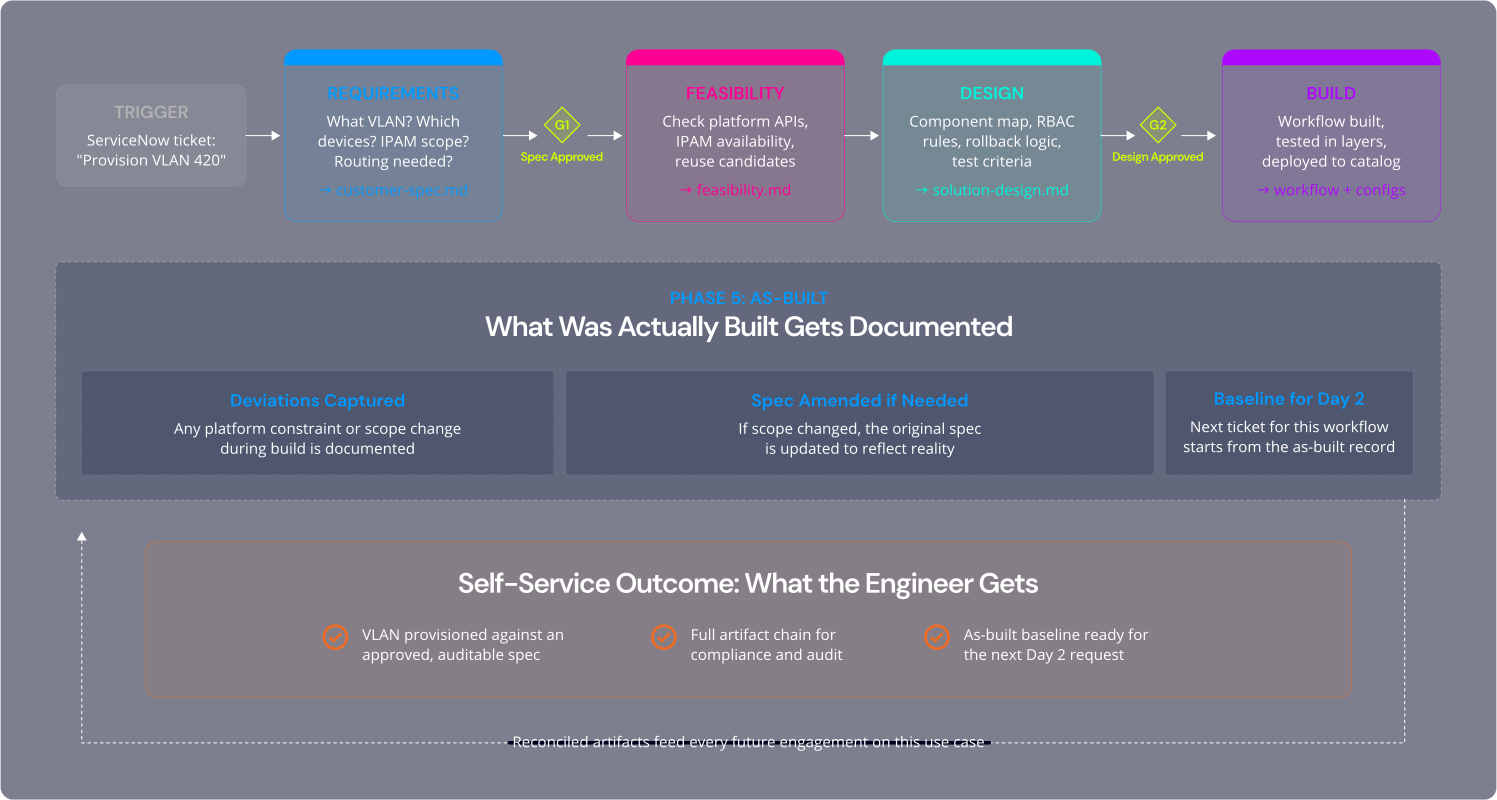
The as-built phase closes the operating model cycle. After delivery, the implemented automation is compared against the approved solution design. Differences are documented; what changed, why it changed, and what platform-specific conditions required adaptation. The solution design is updated with an as-built section. If scope changed, the spec is amended to reflect the actual delivered scope. Original artifacts are preserved. As-built documentation is added additively – the approved spec and approved design remain in the record alongside the as-built amendments. The reconciled artifacts become the authoritative baseline for any future work on the same network automation use case.
Approval Gates – The Phase Enforcement Mechanism
An approval gate is a formal decision point at which progress through the operating model requires an explicit, recorded approval based on a specific artifact. In SDD, approval gates are not status meetings or informal check-ins. They are the mechanism that enforces phase boundaries – making the operating model structural rather than aspirational.
Gate 1: Requirements
Between Requirements & Feasibility
Gate 1 marks the boundary between requirements and feasibility. The requirements spec has been reviewed and formally approved. After Gate 1, the spec is the authoritative record of intent. Feasibility assessment may begin – all scoped by and answerable to this approved spec. Feasibility findings that conflict with the spec surface as tradeoffs requiring a formal decision, not silent scope changes.
Gate 2: Design
Between Design & Build
Gate 2 marks the boundary between design and build. The solution design has been reviewed and formally approved. After Gate 2, the design is the execution contract. Build may begin. The component inventory, dependency order, reuse decisions, and acceptance criteria govern how the build proceeds. Conditions encountered during build not addressed in the approved design are surfaced as deviations, not treated as in-scope design decisions.
On gate criteria: Approval gates are effective only when criteria for approval are defined in advance. For network automation, Gate 1 criteria should address whether the spec adequately captures what the automation must do, which systems it integrates with, and what the acceptance criteria are. Gate 2 criteria should address whether the solution design reflects an implementable plan covering the approved requirements within the constraints discovered during feasibility. Criteria that are vague or unenforced reduce gates to formalities rather than governance.
Operating Logic
Core Principles
The following principles define the operating logic of Spec-Driven Development for network and infrastructure automation. Each addresses a specific structural failure mode in informal network automation practice.
The solution design is an execution contract.
Once approved at Gate 2, the solution design is not a living document. It is the plan the build must follow. Deviations are surfaced and documented in the as-built phase, not resolved through unreviewed engineering judgment in the network automation codebase.
Reuse is designed, not discovered during build.
The solution design explicitly identifies which components are net-new and which existing network automation assets will be reused. Reuse decisions are made during design, when the full inventory of available assets can be assessed – not during build, when time pressure makes comprehensive reuse assessment impractical.
Build sequence follows dependency order.
Network automation components are built in dependency order: command templates, configuration primitives, and parsing logic before composite orchestration; child workflows before parent workflows. This isolates failures at the component level and ensures higher-level orchestration is assembled from validated components.
As-built documentation is required, not optional.
Every network automation engagement produces reconciled artifacts. As-built documentation is not appended when time allows – it is a required phase. Without it, the operating model does not produce organizational knowledge that compounds, and every future engagement on the same use case must rediscover what the previous one resolved.
Phase transitions are artifact-based, not conversation-based.
Each phase transition is authorized by a specific artifact – the approved spec at Gate 1, the approved solution design at Gate 2. Not by a meeting outcome, verbal agreement, or email thread. This ensures the basis for each approval decision is recorded and referenceable in subsequent phases.
Execution & Reconciliation
How Builds Stay Governed: Execution & Reconciliation
Structured Execution Against the Approved Design
The build phase operates against the approved solution design as its sole authority. The design specifies the component inventory, the dependency order, the reuse decisions, and the acceptance criteria for the network automation being built. The build function is to implement that design – not to interpret it, extend it, or make design decisions not addressed before Gate 2.
When build encounters conditions not covered by the approved design – network platform behavior that differs from feasibility findings, missing upstream inputs, device-specific constraints creating implementation incompatibilities – those conditions are surfaced as documented deviations. They are not resolved through ad-hoc engineering judgment. The deviation is recorded, its impact assessed, and if a design change is required it is treated as a gate decision rather than an in-build adaptation.
Layered Testing for Network Automation
Testing in SDD follows the same dependency order as the build sequence. Leaf components – command templates, configuration primitives, parsing logic – are validated before they are referenced by higher-level network workflow components. Child workflows are tested independently before they are nested into parent orchestration. End-to-end network automation validation occurs after each layer of dependencies has been independently confirmed.
This approach limits the blast radius of failures, enables precise fault isolation, and ensures confidence in the delivered automation is built incrementally – not asserted in a single end-to-end test that validates the full system simultaneously.
As-Built Documentation & Reusable Truth
After the network automation is delivered and verified against acceptance criteria, the implemented automation is compared to the approved solution design. Differences are documented – what changed, why it changed, and what network platform or device-specific conditions required adaptation. The solution design is updated with an as-built section. If scope changed, the spec is amended. Original artifacts remain intact. As-built documentation is added additively – the approved spec and approved design remain in the record alongside the as-built amendments.
The reconciled artifacts – the amended spec and the as-built solution design – become the authoritative baseline for future work on the same network automation use case. This is how Spec-Driven Development converts each engagement from a one-time success into a reusable starting point for the next team, engineer, or iteration.
Time to Value
How SDD Accelerates Time to Value
The first objection most teams raise when they see SDD is a reasonable one: this looks like more steps, not fewer. A requirements phase before discovery. A design gate before build. A reconciliation phase after. That is more structure than most teams currently have, and more structure sounds like slower outcomes.
It is not. The reason is where time actually disappears in informal automation practice – and it is not where most teams think.
Where Time Actually Gets Lost
In informal automation practice, the visible work – the build – looks fast. The invisible work is where time disappears: scope clarification that surfaces three days into build, design decisions that get made during implementation and then have to be revisited, late-stage changes because a stakeholder saw the demo and realized the original requirement was never fully captured. That rework is real, it is common, and it does not show up on any timeline because it is absorbed into “the build” rather than tracked as the scope failure it actually is.
SDD moves that cost to the front where it is cheap. A requirements conversation that happens before any environment access takes hours. The same conversation happening after two weeks of build takes much longer – and carries the cost of everything built on top of the wrong foundation.
TTV on Initial Development
Requirements approval and design review add time to the front of an engagement. In practice this is typically measured in hours to a day – not weeks. What they eliminate is the rework tail that informal practice accumulates during build. Net effect: time to a trusted, production-ready automation is shorter. More importantly it is predictable, which matters as much as speed when teams are making commitments to stakeholders.
TTV on Day 2: Where SDD Compounds
Initial build TTV is a one-time benefit. Day 2 TTV is where SDD compounds across the life of every automation it produces. Every workflow gets extended, debugged, modified, and handed off multiple times. Without SDD, every one of those engagements starts with reverse-engineering what was built, why it was built that way, and what changed between the original design and the current running state. That archaeology repeats every time the automation is touched. With SDD, every Day 2 engagement starts from the as-built record. A workflow touched ten times over its life pays back the as-built investment ten times over.
Where Your Time Actually Goes — Full Automation Lifecycle
Initial build plus three Day 2 engagements (extend, debug, modify)
The compounding effect is significant. A workflow touched ten times over its life pays back the as-built investment ten times over. An automation estate built consistently with SDD becomes progressively easier and faster to operate. One built without it becomes progressively harder – every Day 2 engagement costs more than the last because the archaeology gets deeper.
The acceleration caveat: SDD accelerates development. AI accelerates it further. But acceleration without a platform enforcing the operating model produces a specific failure mode: ungoverned execution dressed as governance. More artifacts generated faster, with gates that exist on paper but aren't enforced by anything, and as-built records disconnected from execution. The TTV gains SDD produces are only sustainable when the platform holds the model. That is what separates SDD as a practice from SDD as a governed system.
Application
SDD in Network & Infrastructure Automation
Why Network Automation Teams Need SDD
Network automation operates against production infrastructure where configuration errors, provisioning failures, and unvalidated changes carry operational consequences that application development does not. The SDD operating model addresses this directly. Requirements are approved before any network platform exploration begins. Solution designs are reviewed and approved before network automation workflows are implemented. As-built documentation is required after every engagement. The artifact chain from requirement through as-built documentation is what makes network automation trustworthy, auditable, and extensible over time.
SDD Across the Network Automation Lifecycle
Requirements approval and design review add time to the front of an engagement. In practice this is typically measured in hours to a day, not weeks. What they eliminate is the rework tail that informal practice accumulates during build. Net effect: time to a trusted, production-ready automation is shorter. More importantly it is predictable, which matters as much as speed when teams are making commitments to stakeholders.
Day 0
Design & Onboarding
Initial service design, device onboarding, and baseline configuration automation. SDD governs the requirements for the automation itself — what the network provisioning workflow must do, which systems it must integrate with (IPAM, CMDB, NMS, ticketing platforms), what validation it must perform, and what constitutes a successful provisioning outcome. The spec captures these requirements before any platform work begins. Feasibility identifies the specific integrations, APIs, and data models available in the target environment. The solution design maps approved requirements to discovered capabilities before a single workflow component is built.
Day 1
Service Activation
Network service activation, configuration deployment, and integration validation. New activation patterns requiring network automation development follow the full five-phase SDD cycle through as-built documentation. Operational requests against existing, reconciled network automation can proceed directly to execution with documented scope – bypassing the full requirements-through-design cycle because the prior engagement already produced an approved, reconciled baseline.
Day 2
Operations & Lifecycle
Ongoing network configuration management, compliance enforcement, change management orchestration, and health monitoring. This is where the value of as-built documentation is most directly experienced. Day 2 operations frequently involve extending, modifying, or debugging automation built in prior engagements. With reconciled solution designs and amended specs in place, the starting point for Day 2 work is the as-built reality of the automation – not the original approved design, which may no longer reflect what is actually running.
Day 2 Operations – Without SDD vs. With SDD
What an infrastructure engineer actually encounters when something needs to change
Without SDD
A Day 2 ticket arrives
"Extend the VLAN provisioning workflow to support QoS tagging"
✗No spec — what did the original request actually ask for?
✗No design — why was it built this way?
✗No as-built record — what actually got deployed?
✗Engineer who built it is gone — knowledge is gone too
Result: Reverse-engineer the workflow.
Risk extending something you don't fully understand.
With SDD
A Day 2 ticket arrives
"Extend the VLAN provisioning workflow to support QoS tagging"
✓Spec on file — original scope and intent documented
✓Solution design available — architecture decisions recorded
✓As-built record — what actually runs, not just what was planned
✓Next engineer starts from truth — not from the workflow code
Result: Start from the as-built baseline.
Extend with confidence. Audit trail complete.
Where SDD Is Most Critical in Network Automation
Multi-Domain Network Provisioning & Service Activation
Network workflows spanning multiple systems – IPAM, CMDB, NMS, device platforms, service ticketing – require precise coordination across integration boundaries. Undocumented scope decisions in any one system create cascading inconsistencies. SDD's requirements spec and solution design govern cross-system requirements before any integration work begins.
Configuration Compliance & Network Drift Detection
Network compliance automation requires precise definition of what "compliant" means before any comparison logic is built. Informal specification of compliance criteria produces automation that enforces an undocumented interpretation – one that may not align with the network policy it is supposed to implement.
Network Change Management & Rollback Orchestration
Change automation carries operational risk in proportion to the clarity of its scope. What constitutes a successful network change, what triggers rollback, what validation is required before promotion – these decisions must be captured in the requirements spec and reflected in the solution design before any change workflow is built.
Self-Service Network Operations & Platform Engineering
Self-service network automation – workflows that execute without direct engineer involvement – requires more rigorous governance than engineer-driven automation, because there is no human judgment in the execution loop to catch edge cases. SDD's approval gates ensure that self-service workflows are built against explicitly approved requirements and tested in layers before handling production requests.
Organizational Impact
What SDD Changes Across the Organization
The benefits of Spec-Driven Development extend beyond the engineering teams building automation. For every team that depends on infrastructure – application teams, security operations, NOC, DevOps, and business units requesting network services – SDD changes what it means to work with infrastructure automation in three significant ways.
Before SDD
Opaque
Ticket goes in. Something happens. Consumer finds out at deployment whether it matched what they asked for.
Before SDD
Heroics
Consistent delivery depends on who is available. Knowledge lives with the engineer who built it.
Before SDD
Cost Center
Infrastructure absorbs tickets. Outputs are hard to measure. Value is assumed, not demonstrated.
SDD Mechanism
Gate 1 spec = agreed contract. As-built = proof of delivery.
SDD Mechanism
Artifact-based handoffs replace individual knowledge.
SDD Mechanism
Measurable process: TTV, reuse rate, deviation rate.
After SDD
Transparent
Consumer reviews and approves the spec before build starts. As-built record closes the loop. No surprises at deployment.
After SDD
Repeatability
Any engineer starts from the reconciled baseline. Consistent outcomes regardless of who handles the request. Scales without scaling headcount.
After SDD
Strategic Partner
Delivery is measurable. Compliance is provable through artifact chains. Infrastructure becomes a trusted, auditable service the business can rely on.
Organizational Layer
Without SDD
With SDD
Engineer
Building & operating automation
Practitioner layer
Interprets requirements informally. Makes design calls during build. Knowledge leaves with the engineer.
Works from approved spec & design. Deviations documented, not absorbed. As-built record persists after delivery.
Infrastructure Team
Managing the automation estate
Team layer
Tribal knowledge. Key-person risk. Hard to measure. Hard to scale. Each engagement starts from scratch.
Transferable artifacts. Any engineer onboards fast. TTV, reuse rate, deviation rate measurable. Each engagement compounds on the last.
Business Consumer
App teams, NOC, DevOps, security
Black box. Discovers scope at deployment. No visibility. No audit trail.
Approves spec before build. Sees as-built after. Full artifact chain. Compliance-ready.
From Opaque to Transparent
In most organizations, infrastructure automation is a black box from the consumer’s perspective – a ticket goes in, something happens, and the result either matches what was requested or it doesn’t. Gate 1 changes this. The consumer reviews and approves the spec before any work begins. The as-built record closes the loop. Surprises at deployment disappear because scope was locked before build started.
From Heroics to Repeatability
Today, consistent delivery depends on who is available – the engineer who knows the environment, the person who remembers what was decided last time. SDD replaces that dependency on individuals with a dependency on artifacts. Any engineer – or any AI agent – can start from the reconciled baseline, which means infrastructure teams can scale without scaling headcount proportionally.
From Cost Center to Strategic Partner
When infrastructure teams operate informally, they are difficult to measure and hard to justify. SDD defines the operating model that makes automation measurable – time from approved spec to delivery, deviation rate, reuse rate, compliance coverage through artifact chains rather than manual audit. A governed, deterministic execution platform produces those measurements automatically. That shifts how the business views the infrastructure team: from a cost center absorbing tickets to a strategic partner delivering trusted, auditable automation at scale.
By Role
What SDD Changes By Role
Spec-Driven Development changes the operating conditions for everyone involved in network and infrastructure automation – from the engineers building network automation workflows to the leaders accountable for their reliability and the executives who depend on their scale.
Practitioners
Network & Infrastructure Engineers
→Approved requirements spec before any network environment access – no interpreting informal service tickets
→Approved solution design before build – no undocumented design decisions made under time pressure
→Explicit reuse identification – no rebuilding network automation assets that already exist
→Layered testing – failures isolated at the component level, not discovered at end-to-end network validation
→As-built documentation – future work on the same network use case begins from accurate, reconciled records
Engineering Leaders
Network Automation Managers & Leads
→Phase separation – clear ownership at each stage, auditable transitions between them
→Scope visibility – changes captured at approval gates, not discovered at network deployment
→Reuse by design – automation asset inventory assessed during solution design, not rediscovered during build
→Measurable process – time to approved spec, deviation rate, reuse rate, reconciliation completeness
→Transferable knowledge – as-built artifacts enable onboarding without dependency on prior network engineers
Leadership
VPs, Directors & CTOs
→Governed AI – AI agents operate within defined, approved boundaries rather than producing unaccountable network changes
→Audit trail – artifact chain from requirements through as-built documentation supports compliance and incident investigation
→Compounding returns – each engagement produces organizational knowledge that improves future network automation
→Agentic readiness – SDD is the prerequisite for autonomous network operations; early adoption builds the trust foundation for agentic scale
→Reduced key-person risk – network automation knowledge is in artifacts, not in individuals
The operating model changes above apply to SDD practiced today – by human engineers working through the five phases with the governing framework in place. The same operating model is what makes AI acceleration governable. When AI agents execute the phases, the spec is still the boundary of their authority. The approval gates still require human sign-off. The as-built record still produces the organizational knowledge the next engagement starts from. SDD doesn’t change when AI enters the picture, it becomes more important.
AI & SDD
AI-Driven SDD
AI-Driven Spec-Driven Development (AI-SDD) is Spec-Driven Development in which AI agents execute the operating model phases for network and infrastructure automation – generating the requirements spec, conducting feasibility assessment, producing the solution design, implementing automation components, and producing as-built documentation – under human oversight at each approval gate.
AI-SDD is distinct from AI-assisted network automation development in a critical way: in AI-assisted development, AI tools accelerate specific tasks within an informal process. In AI-SDD, AI agents execute a governed process. The SDD operating model determines what the AI agent does, in what sequence, with what inputs, and subject to what approvals. The agent operates within the boundaries of the model, it does not define the model.
The Agent Layer
In the AI-SDD model, three agents execute the five phases. The Spec Agent handles requirements, producing and refining the customer spec through structured conversation – no environment access until Gate 1 is passed. The Solution Architecture Agent runs feasibility and design, querying the network platform, mapping integrations, identifying reuse candidates, and producing the solution design. The Builder Agent executes build in dependency order and produces the as-built record after delivery. Human engineers govern both approval gates.
The critical distinction: In AI-SDD, the AI agent executes the operating model. Human engineers govern the approval gates. AI does not advance between phases without human approval. The spec is the boundary of the agent's authority. The solution design is the contract the agent builds against. As-built documentation ensures the record reflects what the agent actually did.
The Ungoverned Execution Problem: Why the Platform Is Non-Negotiable
AI makes it trivially easy to generate spec-shaped documents, design-shaped documents, and automation that looks governed but isn’t. A language model can produce a well-formatted spec in minutes. It can generate a solution design that reads like an execution contract. It can produce an as-built record that describes what was built. None of that is SDD unless a governed, deterministic execution platform enforces the gates between phases, connects the spec to execution, and makes the as-built record authoritative rather than descriptive.
Without platform enforcement, AI-assisted SDD degrades into ungoverned execution with better documentation. The artifacts exist. The gates get bypassed. The as-built record is produced but disconnected from anything that governs the next engagement. The operating model is present in name and absent in practice.
In a governed implementation, the Spec Agent doesn’t just produce a document – it produces an artifact the platform gates execution against. The Builder Agent doesn’t just build – it builds against an approved design the platform enforces as the execution contract. The as-built record isn’t a post-engagement write-up – it becomes the authoritative baseline the platform references for future work on the same use case. That is the difference between SDD as a methodology and SDD as a governed system.
Why SDD Is Required for AI-Assisted Network Automation
AI agents that operate on network and infrastructure environments without a governing operating model produce automation faster, but they reproduce the same structural failures that informal human practice produces: undefined requirements, undocumented design decisions, no as-built reconciliation. The output is generated at AI speed, which means structural problems compound faster than any network operations team can manage reactively. SDD provides the operating model. A governed, deterministic execution platform is what makes it enforceable.
What a governed execution platform actually does: It enforces Gate 1 as a system boundary — no feasibility access until the spec is formally approved. It enforces Gate 2 as the execution contract – the approved design is what the build phase answers to, not the engineer's interpretation of it. It produces the as-built record as a required phase output, not a document someone writes afterward. And it gates agentic operations within those same boundaries – so agents operate at machine speed within constraints engineers defined and can audit. That is the difference between SDD as a practice and SDD as a governed system. Guide 3 covers how this works in full.
Agentic Operations
Agentic SDD & Autonomous Network Operations
Agentic operations – network and infrastructure automation driven by AI agents that reason, plan, and act with reduced human involvement in the execution loop – represents the next evolution of network infrastructure management. Spec-Driven Development is the prerequisite for agentic network operations, not a parallel track.
An AI agent operating on production network infrastructure without a governing operating model is not autonomous network management. It is unaccountable automation. The agent makes decisions at machine speed, with no structured record of the requirements it is acting against, no approved design constraining its implementation choices, and no as-built reconciliation producing a record of what it changed and why. The result is automation that may function in the short term but produces an infrastructure estate that is impossible to audit, extend, or trust.
SDD as the Governance Layer for Agentic Network Operations
In the agentic SDD model, the requirements spec functions as the operating boundary for the AI agent – what the agent is authorized to do, in what environment, under what constraints, and subject to what acceptance criteria. The solution design functions as the agent’s execution plan. As-built documentation functions as the agent’s accountability record – the artifact trail of what the agent built, where it deviated from the approved design, and what the post-execution state of the network environment is.
Agentic network operations without SDD produces fast, ungoverned automation. Agentic network operations with SDD produces governed autonomy — AI agents operating at machine speed within boundaries that network engineering teams have defined, approved, and can audit. This is the distinction between agentic operations as a productivity advance and agentic operations as a production-worthy network infrastructure capability.
The Agentic SDD Progression
Stage 1
AI-Assisted SDD
AI drafts specs and designs. Engineers review, approve, and execute each phase. AI accelerates the work within the operating model — humans remain in the loop throughout all phases and gates.
Human-in-loop throughout
Stage 2
AI-Driven SDD
AI agents execute all five phases. Engineers govern the approval gates. Execution is AI-driven; governance is human-maintained. The operating model boundary is enforced at each gate.
Human-at-gates
Stage 3
Agentic SDD
Agents execute the full SDD operating model for pre-approved network automation patterns autonomously. Human oversight is applied at the policy level — defining what use cases agents are authorized to handle — rather than at the individual request level.
Human-at-policy level
The progression from Stage 1 to Stage 3 is a trust advancement as much as a capability advancement. Network automation organizations earn the right to delegate more of the SDD operating model to AI agents by demonstrating that AI-executed phases produce accurate specs, sound solution designs, and reliable as-built documentation. The artifact-based nature of SDD makes that demonstration possible – each phase produces a reviewable output that can be assessed for quality before trust is extended to the next level of autonomy.
Guide 3 in this series – Agentic SDD & Autonomous Network Operations with Itential – covers the technical and organizational architecture of agentic SDD in detail, including how Itential’s FlowAI platform operationalizes the SDD operating model for governed autonomous network operations.