Define golden configuration standards for any CLI device, API-managed service, or cloud resource. AI agents query compliance posture, detect drift, and generate remediation workflows via Spec-Driven Development, all governed with pre/post validation, approval gates, and immutable audit trails.
Compliance shouldn’t stop at the CLI. Itential enforces golden config standards across every infrastructure type your teams operate, CLI-managed devices and API-managed services in the same compliance model. One standard. One audit report. One governed remediation pass. Every domain, every device, every change.
Golden Config is the structured definition of what good looks like for every device, controller, and cloud resource in your infrastructure. Build the standard once, apply it across vendors and regions, and let inheritance handle the rest. Every compliance check, drift detection, and remediation workflow runs against the same source of truth.
Define a root golden config standard once. Child nodes inherit automatically. A regulatory change at the parent cascades to every device underneath, no per-device rebuilds, no template sprawl.
A single template adapts across Cisco, Arista, Juniper, and any other vendor in your environment. Region-specific values, device-specific attributes, and conditional logic all live in one template. One standard, every variant.
Some configurations are compliant only if the order is right. ACLs, route policies, firewall rules: line order determines security. Golden Config validates not just what’s there, but in what sequence, with the precision compliance audits require.
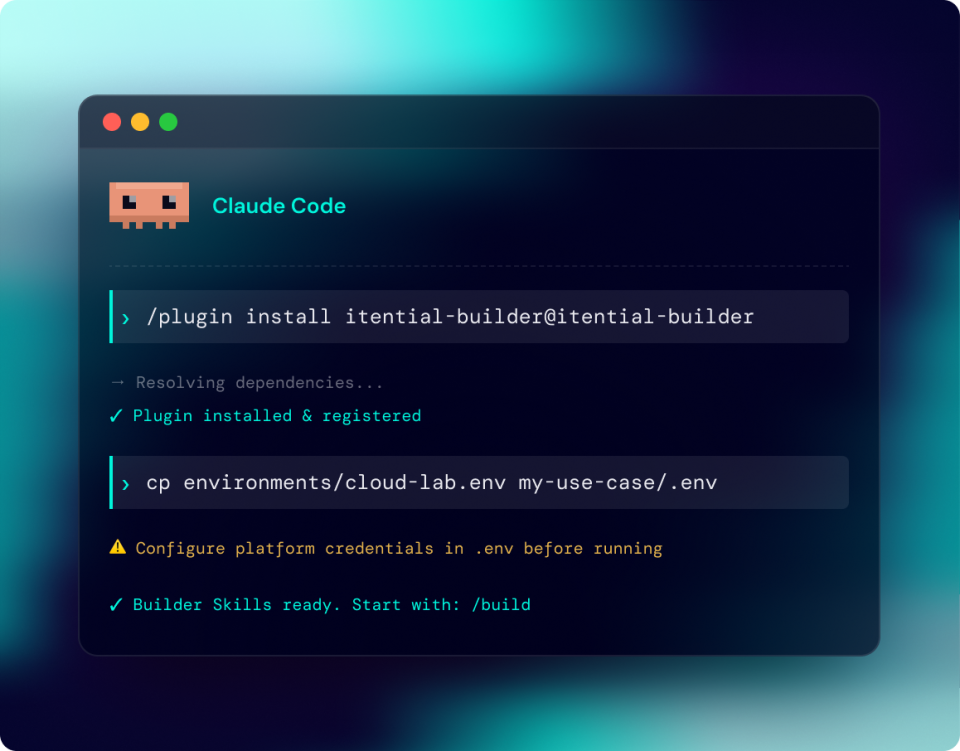
Itential Builder Skills are AI agent skills available on the Anthropic Marketplace that turn plain-language specs into real Golden Config templates. Every Golden Config capability is exposed as a documented REST API endpoint. Describe a compliance requirement in plain language: a security policy, a regulatory standard, a config baseline. The Builder Skill constructs the template via those APIs directly. Commit to Git, deploy through CI/CD, ready to enforce against live infrastructure. The output is identical to a hand-built standard: same schema, same governance, same enforcement behavior.
AI agent skills that generate real, production-ready Golden Config templates through the platform’s REST APIs. Available today, installable in minutes.
Every Builder-Skill-generated template commits to GitHub, GitLab, or Bitbucket. CI/CD picks it up and deploys automatically: version-controlled, auditable, and ready to enforce from the first compliance check.
Builder-Skill-generated templates run through the same compliance enforcement engine as anything built manually. Same RBAC, same approval gates, same audit logging, same drift detection. No separate path, no special handling, no governance gap.
CLI devices need line-level validation, including ordered checks for ACLs and route policies. API-managed services need JSON property validation, including array entries and conditional values. Itential runs both through the same compliance engine, producing one unified audit report. The mechanism adapts. The model stays consistent.
For CLI-managed routers, switches, firewalls, and load balancers across any vendor, golden config templates validate the running configuration line by line. Specific configuration statements, ACL entries, route policy lines, and ordered lists where sequence determines compliance, all caught at the exact point of deviation.
For API-managed SD-WAN controllers, cloud networking services, and any system managed via REST API, golden config templates validate the JSON response field by field. Specific properties, values, array entries, and conditional logic, all checked against the structured schema that defines compliant.
CLI devices and API-managed services produce a single unified compliance report per execution. Same compliance plan, same severity grading, same remediation routing. Auditors get one evidence package, not five. Engineers get one remediation pass, not five.
Proposed changes are validated against golden config standards before they execute. Non-compliant changes blocked before they reach production. Running configurations are continuously compared against golden standards, with drift detected at the attribute level the moment it occurs. Remediation workflows trigger automatically for routine drift, or surface for human-in-the-loop review for high-risk deviations. Every check, deviation, and remediation is logged immutably.
Every proposed change validated against the applicable golden config standard before execution. Non-compliant changes never reach a device.
Running configs compared against golden standards at the attribute level: specific config lines, ACL entries, JSON properties. Drift detected the moment it occurs.
Routine drift triggers automatic remediation workflows. High-risk deviations surface for human review before any change executes.
FlowAgents interact with configuration validation in two ways. As analysts, they query compliance posture, identify drift patterns, and generate remediation proposals. As execution engines, they call compliance and remediation workflows as governed tools, at scale, across thousands of devices simultaneously. Every agent-initiated compliance action flows through the same governed execution layer as human-initiated actions. Agents can propose. They cannot bypass governance.
FlowAgents query current compliance score, violations, and drift patterns across CLI and API-managed devices in one structured query. One question, complete posture.
Every compliance check and remediation workflow lives in the FlowAgent’s allowlisted tool library: structured inputs, defined outputs, governed execution enforced automatically. Agents call, the platform enforces.
When no remediation workflow exists yet, a FlowAgent triggers Spec-Driven Development to generate one, then calls it as a governed tool. Advisory to fix in minutes.
See how teams are using Itential to enforce compliance across CLI devices, API-managed services, and cloud infrastructure today. Different triggers, different scales, same governance, same audit trail on every check and every remediation.
ACLs, route policies, and firewall rules pass compliance only if the order is right. A walkthrough of building Golden Config rules that validate ordered CLI configurations at the line level, catching sequence violations that traditional compliance tools miss entirely.
An engineer prompts an AI assistant to check compliance. The Itential MCP Server exposes compliance posture, drift patterns, and remediation workflows as callable tools. The agent queries state, identifies violations, and triggers governed remediation, all through the same compliance model that humans use. AI-native, fully governed.
A new Cisco PSIRT publishes. A compliance plan runs against every affected device in the network estate automatically, identifying which devices are vulnerable, which configurations need remediation, and producing a unified audit report. Hours of triage become minutes.
App teams need to ship fast, security teams need to enforce standards. Itential lets compliance teams define the Golden Config standards once, then expose self-service compliance checks and remediation as callable services for app teams. Velocity for developers, control for security.
Most existing compliance and config management tools share two limitations. First, they’re CLI-centric. NetBrain, SolarWinds NCM, and Gluware focus on CLI-managed network devices and don’t natively extend to API-managed controllers, cloud networking services, or JSON-configured infrastructure. Second, they separate detection from remediation. They identify non-compliance but executing governed remediation, with pre/post validation, approval gates, blast-radius controls, and rollback, requires exporting to other tools. Nautobot is excellent as a network source of truth and IPAM platform but is a data platform, not an execution platform. Itential closes both gaps. The full loop from detection through governed remediation executes on the same platform. Compliance covers CLI devices, API-managed services, SD-WAN controllers, and cloud resources simultaneously. FlowAgents query compliance posture and generate remediation workflows via Spec-Driven Development, extending compliance into AI-driven closed-loop remediation. These tools can work alongside Itential. Nautobot can serve as inventory source of truth, NetBrain or NCM can provide visibility, and Itential executes governed compliance across what they track..
Yes. Every compliance plan execution produces a structured audit report automatically: which devices were checked, which standards applied, which violations were found, what was remediated, when, by whom, with before/after configuration state for every affected device. CLI-managed devices and API-managed services appear in the same unified report. Reports map directly to SOX, HIPAA, PCI-DSS, NERC-CIP, and other frameworks requiring configuration compliance evidence. Auditors get one evidence package per execution. Engineers get one remediation pass per execution. No manual report generation, no piecing together CLI logs and cloud API responses, no last-minute compliance scrambles.
For CLI-managed devices, the platform continuously compares the running configuration, captured via CLI, against the golden config template defined for that device’s group. Comparison happens at the line level: specific configuration statements, ACL entries, route policy lines. For API-managed services, the platform continuously queries the current configuration state via the service’s REST API, retrieving the JSON response, and compares it against the JSON schema-based golden config template. Drift is detected at the JSON property level: specific fields, values, array entries. Both device types run through the same compliance enforcement model. The mechanism adapts to the device’s management interface, but the compliance model, audit trail, and remediation governance are identical.
Yes. Every compliance check and remediation workflow is automatically registered as a callable tool in the platform’s tool library, covering both CLI and API-managed device types. FlowAgents include them in their allowlisted skill set and call them with structured inputs: device scope, compliance plan identifier, remediation parameters. External AI systems and LLMs access the same tools through the Itential MCP Server, schema-validated, RBAC-enforced, and audited before anything executes. Every compliance action initiated by an agent flows through the same governance layer as human-initiated actions. Agents can query, propose, and execute across CLI and API-managed infrastructure. They cannot bypass compliance governance.
Yes. Itential is built to extend what teams already use, not replace it. Existing Ansible playbooks, Python scripts, and OpenTofu plans become callable workflow steps. Existing inventory sources of truth like NetBox or Nautobot feed FlowAgents with accurate device context. Existing observability tools and ticketing systems trigger governed remediation workflows. The platform handles the execution, RBAC, audit logging, and rollback layer your existing tools weren’t built to provide. Engineers keep their workflows. Compliance teams get the governance and unified audit trail.
Yes. Golden Config templates handle CLI syntax across Cisco, Arista, Juniper, and any other vendor in your network estate through Jinja2 variables and ordered list support. JSON schema-based templates handle API-managed services across AWS, Azure, GCP, SD-WAN controllers, and any system with a REST API. One compliance plan can validate a Cisco router via CLI, an AWS VPC security group via REST API, a Meraki network via its API, and a Palo Alto firewall via its API, all simultaneously. Multi-vendor and multi-cloud aren’t special cases. They’re the default.
See how configuration validation enforces golden config standards across CLI devices, API-managed controllers, and cloud services – with AI-native remediation, governed execution, and always-current audit evidence.