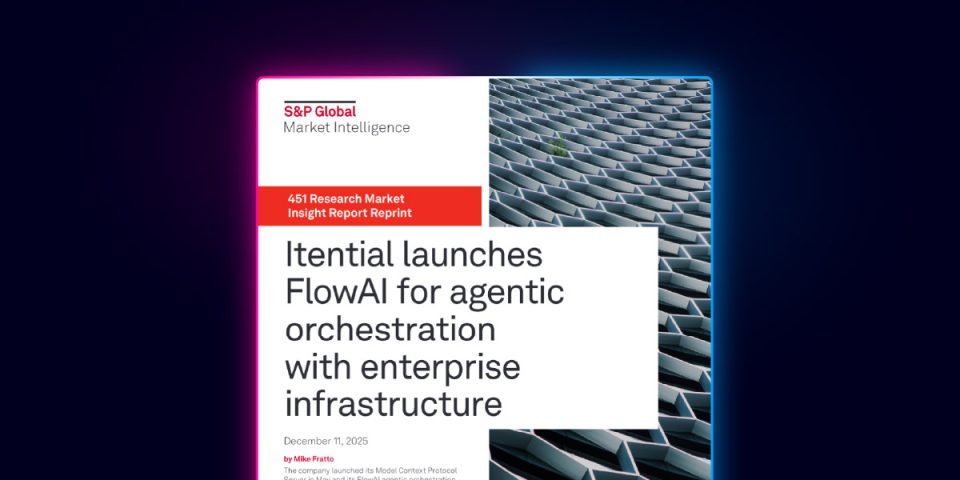
Traditional automation can’t reason, adapt, or make context-aware decisions at the speed modern infrastructure demands. The Itential Platform gives infrastructure teams the foundation to deploy FlowAgents that interpret intent, reason through operational challenges, and execute safely, with governance, auditability, and rollback built in.
Static scripts and runbooks can’t adapt to dynamic conditions, edge cases, or multi-step scenarios requiring context-aware decision-making.
Point AI solutions bypass established workflows, approvals, and audit trails, creating uncontrolled blast radius and compliance exposure.
AIOps insights, LLM recommendations, and observability alerts generate recommendations but can’t safely execute changes across production infrastructure.
Even with automation, human operators must interpret context, coordinate across domains, and manually initiate multi-step remediation – limiting operational velocity.
Most enterprises still rely on rigid, script-based automation that requires constant human intervention. These deterministic-only approaches create bottlenecks, fail to adapt to changing conditions, and prevent organizations from realizing the operational velocity promised by AI. To unlock agentic infrastructure operations, teams need systems that can reason, decide, and act, with governance built in from the start.
AI agents that act on infrastructure without governance aren’t agentic operations, they’re a liability. The organizations operationalizing AI safely are the ones that built the agentic operations platform first. Governance isn’t the constraint. It’s what makes autonomy possible.
Agentic operations isn’t a feature you turn on. It’s a new operating model with measurable differences in how teams work, how AI participates, and how the business scales. Here’s what shifts.
Agentic operations isn’t a single product you install. It’s an operating model that gets built in three stages: building FlowAgents your org trusts, making execution deterministic so it’s safe in production, and connecting reasoning to action across every system you run. Itential is the platform that makes every stage production-ready.
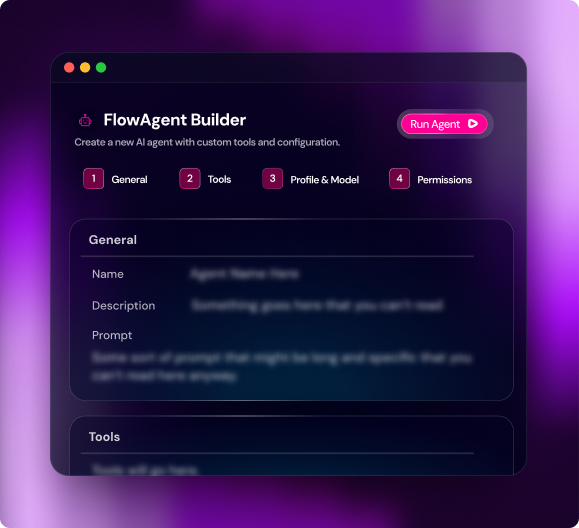
Before FlowAgents can run in production, the org needs to trust what they do. That trust isn’t a feature you turn on, it’s the result of building agents with defined goals, explicit tool access, and operational boundaries that your security, compliance, and engineering teams sign off on. Build them visually in FlowAgent Builder or describe what you need in plain language and let Spec-Driven Development generate them automatically via the platform’s REST APIs.
Define each FlowAgent’s goal, reasoning model, and operational responsibilities. Granular RBAC controls exactly what it can see, propose, and execute.
Describe the FlowAgent you need. Spec-Driven Development generates, versions, and deploys it through the platform’s REST APIs. Same governance from the first run.
FlowAgents reason against live topology, device configurations, and operational state, so they adapt to real infrastructure conditions before proposing any action.
The hard part of agentic operations isn’t the reasoning. It’s making sure what runs after the reasoning is predictable, auditable, and reversible. Itential’s deterministic execution engine is the foundation every FlowAgent action runs through. Policy enforcement, approval gates, pre/post validation, rollback, and audit logging applied to every step. AI reasons through the problem. Deterministic execution makes sure the answer runs the way your org needs it to.
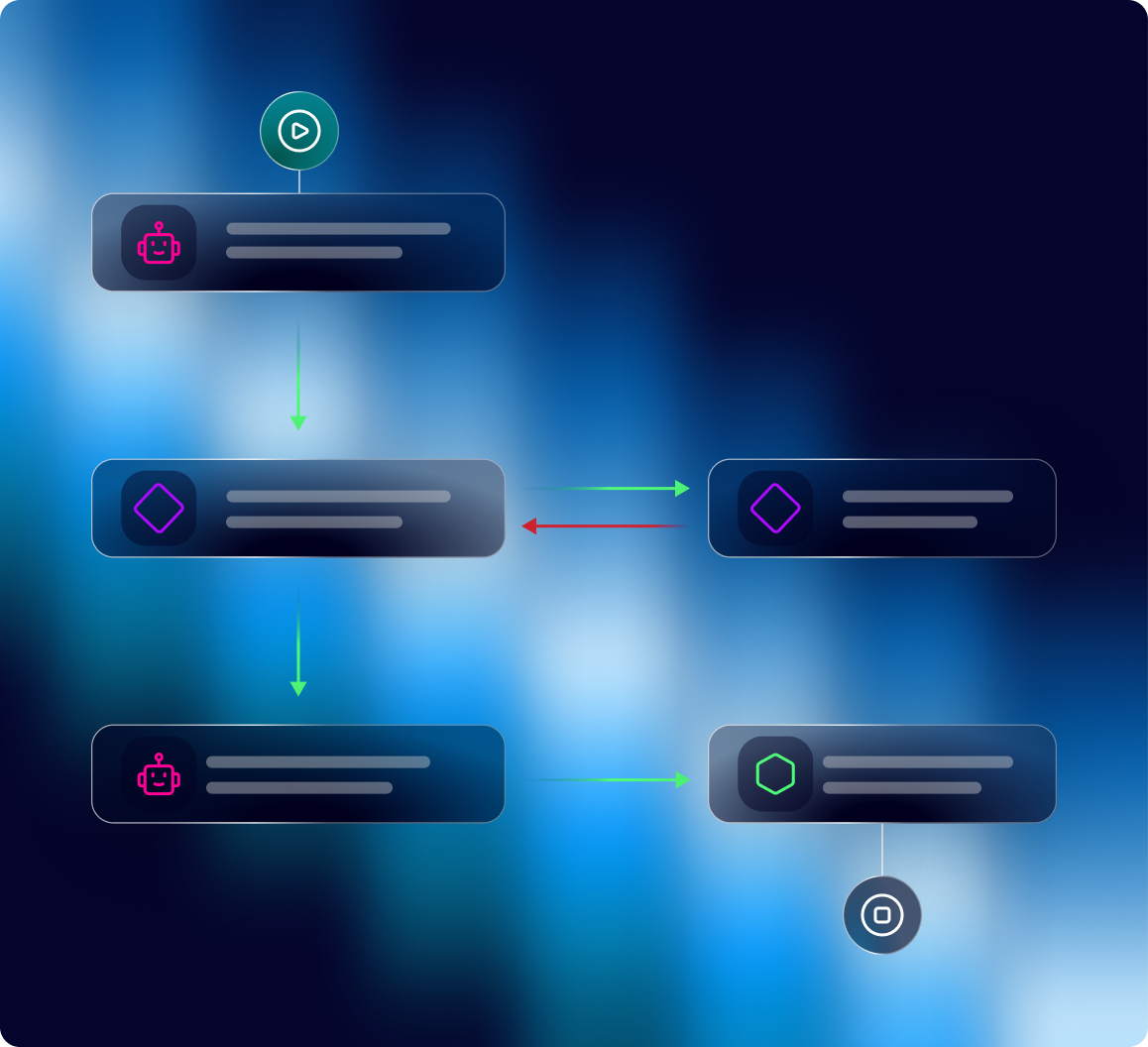
FlowAgents reason through goals, interpret context, and select tools, without deviating from defined operational boundaries. Reason, act, observe, repeat until the goal is met.
Predictable, step-by-step execution where the outcome must be certain. Policy enforcement, approval gates, pre/post validation, and rollback built in.
Require approval before execution for high-risk actions. Monitor and intervene after for routine operations. You define where humans stay in control. The platform enforces it.
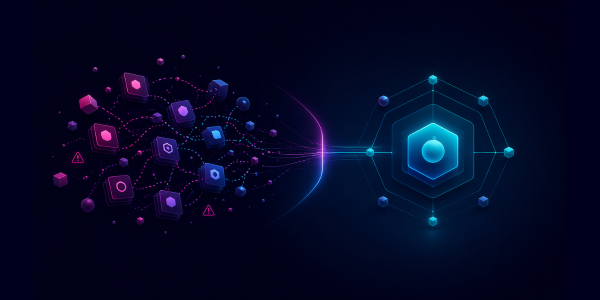
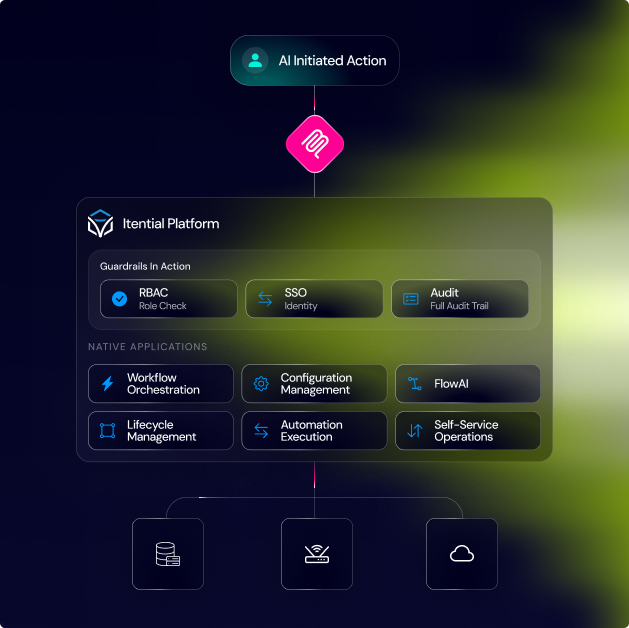
Agentic operations only matters if it runs on your real environment. Your FlowAgents need to reach actual network devices, cloud resources, ITSM tickets, and observability data. Your external AI systems, ChatGPT, Claude, AIOps platforms, need a safe way to act on the same infrastructure. And when an alert fires or a config drifts, detection has to connect to remediation automatically. Itential is the one governed path that connects all of it. Every action, every AI system, every event reaches production through the same policy-enforced engine, under the same RBAC, audit trail, and rollback.
1,000+ pre-built integrations across network, cloud, security, observability, and ITSM. FlowAgents reach your actual production environment, not a sandbox.
ChatGPT, Claude, Gemini, AIOps platforms with embedded AI, and custom agents. They all act through the same governed engine as your FlowAgents, under one set of controls.
When alerts fire, tickets open, or configs drift, detection triggers governed execution automatically. No manual handoffs. Full audit trail and rollback on every step.
The hard part of agentic operations isn’t the agents. It’s everything around them. RBAC, secrets management, policy enforcement, approval gates, audit trails, rollback, encryption, SSO, compliance evidence, HA/DR. None of that is optional. All of it is what your security team will ask about before any agent runs on production infrastructure. Itential is the platform that ships with all of it.
Agentic operations delivers measurable improvements across velocity, resilience, efficiency, and innovation capacity.
Let’s help you operationalize FlowAgents safely across your infrastructure, with governance that ensures trust, security, and compliance.
Most teams start with a contained, high-value use case where the operating model shift is most visible: incident triage with a FlowAgent, governed self-service for a specific change type, or closed-loop remediation against a recurring alert. The point isn’t to boil the ocean. It’s to prove the model in production on something that matters, then expand. Most customers see meaningful results from a first use case within 30 to 60 days.
Most enterprise customers see measurable results from their first use case within 30 to 60 days, faster MTTR on a specific alert pattern, eliminated manual work on a recurring change, or governed self-service deployed to an internal team. Broader impact (consolidating tools, expanding agent coverage, deploying across multiple teams) compounds over the next 6 to 12 months as the operating model takes hold.
Agentic operations is cross-functional by design. Engineering owns the FlowAgents and workflows. Architecture defines the standards every agent operates within. Security and compliance sign off on the governance model. Operations consumes the self-service. AI and platform teams build the connections to external LLMs. The good news: Itential gives each team what they need without requiring everyone to use the same interface. Engineers build. Operations consume. Security audits. All under one governance model.
Every FlowAgent action flows through Itential’s deterministic execution engine, never directly to infrastructure. RBAC controls what each agent can access. Approval gates can be inserted at any point. Pre-execution validation, post-execution checks, and rollback are built into every workflow. AI reasons through the problem. Deterministic execution makes sure the answer runs the way your org needs it to.
Yes. The Itential MCP Server enables secure integration with external LLMs and AI systems through the open Model Context Protocol. These systems can request actions, but execution flows through the same governed workflows as your internal FlowAgents, with full RBAC, audit, and rollback applied automatically.
No. FlowAI connects to and extends your existing automation ecosystem, including Ansible, OpenTofu, Python scripts, and vendor APIs. Your existing automation runs as-is, with governance, RBAC, and audit added on top. Most customers expand from existing scripts and playbooks into FlowAgents over time, not all at once.