
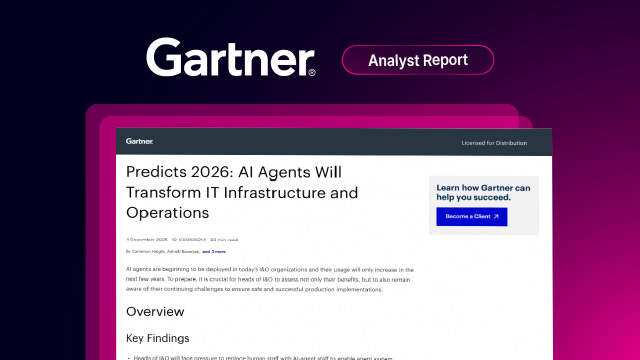
After a decade of fragmented automation efforts – scattered scripts, inconsistent playbooks, and infrastructure-as-code that promised more than it delivered – the network operations landscape is reaching an inflection point. In this video, John Capobianco builds off of his blog to expand on his predictions for how AI agents and orchestration platforms will fundamentally reshape network operations in 2026.
What John Predicts:
- MCP Was the Bridge; Agents Are the Destination
Model Context Protocol normalized how context is shared between models and tools. Production-grade agentic orchestration like FlowAI will be the foundation that enables specialized agents to connect to MCPs and coordinate across routing intent, telemetry analysis, change validation, and remediation. - Orchestration Becomes the Center of Gravity
The wild west of scattered scripts and duplicated playbooks is ending. Centralized orchestration with governance, lifecycle control, and policy enforcement becomes non-negotiable as AI agents move into production environments. - Agent-Driven Operations Replace Static Runbooks
AI agents ingest real-time telemetry and configuration state to determine not just what failed, but why. Instead of following linear checklists, they explore multiple hypotheses and coordinate corrective actions through orchestrated workflows. - The Skills Divide Will Become Structural
Engineers who embrace automation, understand orchestration, and can reason about agent behavior will thrive. Those who resist these shifts will find fewer opportunities as the industry moves forward without them. - Networking Becomes Intent-First, Not Device-First
Engineers define outcomes while agent-driven systems determine optimal execution across vendors and domains. The combination of MCP, agents, and orchestration makes true intent-driven infrastructure operationally viable at scale.
Why It Matters:
- 2026 is when agentic operations move from experiments to production
- Teams building on orchestration platforms today elevate engineers from tactical execution to strategic oversight
- This is augmentation, not displacement – domain expertise makes agent prompts exponentially more effective
- The future combines AI capability with human judgment, but only for teams willing to adapt
Demo Notes
(So you can skip ahead, if you want.)
00:00 Introduction
00:43 Prediction 1: MCP Bridge
03:26 Prediction 2: Orchestration Gravity
04:55 Prediction 3: Dynamic Runbooks
06:58 Prediction 4: Skills Divide
09:13 Prediction 5: Intent-First Networking
11:30 Wrap Up & VibeOps Community
View Transcript
John Capobianco • 00:05
Hi, my name is John Capobianco, and I’m here making a quick video talking about some of my 2026 predictions in an article that I wrote talking about network predictions in 2026 from automation experiments to agent-driven operations. For like more than a decade, network automation was always seen as the future. And we tried to replace manual changes with scripts. Playbooks promised some consistency. Infrastructure as code brought some discipline. But over the last three years, we’ve seen artificial intelligence accelerate that momentum dramatically. I don’t write this blog from the sidelines.
John Capobianco • 00:43
I’ve been heavily involved in this for the past four years. And I think we’ve crossed over into a more consequential threshold now. Networking is moving from fragmented automation efforts into more of an agentic-driven approach with a lot more orchestration. Okay. So my 1st prediction was that MCP was the bridge and that agents are the destination. We don’t get to AI agents without model context protocol. And model context protocol is experiencing a similar sprawl as network automation did.
John Capobianco • 01:18
Meaning, I have my set, you have your set, Kristen has her set, Jessica has her set, Andrew has his set. Starting to fragment, and no one has the same set of tools. Some people want to participate using these tools, but they’re not centralized. They’re not made readily available. There’s no guardrails or security or orchestration. Sounds a lot like network automation with Ansible playbooks, Python scripts, Terraform stuff all over the place, different versions. We tried to use Git, but that didn’t really coordinate or orchestrate.
John Capobianco • 01:50
What we need is a platform, the FlowAI platform as an agentic orchestration layer where we can bring in those MCPs centrally, reuse them and promote them as tools for agents to simply connect to. You saw me build my 1st agent with FlowAI. The PyETS MCP was loaded into the platform, and in the wizard to build my agent, I simply added the PyTS tools that I wanted. I use natural language to do this. So, a fully functional network interface health agent in two minutes-not a proof of concept or a demo, like a production-ready agent that collects the live state from the devices, dynamically generates the health tests. I didn’t write a single test. Those tests for interfaces used to be hundreds and hundreds of lines of PyETS code.
John Capobianco • 02:42
This is based on the actual config and the data that it found. It dynamically writes the tests and runs the tests. We execute the tests. We get a detailed diagnostic report with actionable recommendations delivered via Slack and via email. Again, all I did was pick a deterministic workflow that knew how to send Slack and knew how to send email via MCP, and I bound it to my agent. Okay, so what we’re going to see is a specialized swarms of agent, agents that understand routing, understand telemetry, validate change risks, coordinate remediation, does security posture, does compliance check-in. And we need agent-to-agent coordination now more than ever.
John Capobianco • 03:26
You’ve seen the stories of over 1.5 million agents forming a social network of their own over the weekend. Okay, your enterprise is going to explode with agents, digital co-workers, and you need a platform. You need somewhere to host them, to organize them, to put guardrails around them. So my 2nd prediction is that orchestration is going to become the center of gravity here. We can’t have the Wild West with agents because they are so powerful. We need serious programs to not repeat the mistakes of the automation era with sprawling scripts and everyone has their own version and no one’s reusing code, no one’s sharing their code. A platform centralizes all of this and gives you the guardrails, the orchestration, the lifecycle management, the configuration validation, self-service operations.
John Capobianco • 04:20
And you can still bring in your Ansible Terraform and PyETS code. You can still bring those constructs in. In fact, this helps make use of them even better because they’re not hidden away on some developer’s laptop. They are in the platform and they can be attached to agents. So think about that. Reasoning and action React agents that can reason and call tools could call deterministic workflows as a tool. The deterministic workflow could be that PyETS job or that Ansible playbook.
John Capobianco • 04:55
No problem. So there’s no more duct tape here. There’s no more works on my laptop. There’s no more same teams working on the same workflows in different areas of the network. No more unauditable, ungoverned agent actions. Orchestration is not optional in the agentic infrastructure age. These agents are going to completely erase those static runbooks by making them dynamic.
John Capobianco • 05:21
It doesn’t eliminate human oversight. It elevates it. Now you’re going to be overseeing the agents’ actions. What humans used to do, we can now offload to those agents to do, elevating our status, elevating our career, elevating engineers into strategy, into planning, into governance, right? So think about the dynamic test generation. Connect to the device, discover the interfaces dynamically, generate health tests based on what it found, analyze those tests in real time, and produce recommendations and notifications. There was no pre-written assertions, no brittle test logic that breaks when something changes on the platform, or when there’s a new type of interface like an SVI or a tunnel interface.
John Capobianco • 06:06
In the old days, those used to be more tests you had to write and maintain. Now it’s adaptive, intelligent validation, and we’re talking about just one use case. That could be test your firewall rules, test your compliance, do a discovery and do intelligent documentation. So through FlowMCP Gateway, we can totally integrate our agents with Selector AI, with Kentik, with IP Fabric, with Forward Networks. These agents don’t just have to react to failures. They could reason out root cause, reason out multiple hypotheses, valid data against live data, and coordinate the corrective actions through that orchestrated workflow. Now, humans are still in the loop by design, but we are going to move to human on the loop and human completely out of the loop.
John Capobianco • 06:58
Now, my hot take in all this is that the skills divide will become structural. The time to adapt has passed. We have 10 years, a decade of proven, sound, repeatable, safe-to-use, secure network automation. Two years of retrieval augmented generation improvements and stability. One year of model context protocol. In 2026, the enterprise’s patience is going to run out. And here’s the analogy: why I think this is true.
John Capobianco • 07:31
Because your leadership may not have ever heard of network automation. Do you ever hear about it on the radio, on the TV, on the news, on your social networks? Maybe on LinkedIn, someone like me talking about network automation. How many people are talking about artificial intelligence? It is on the news. It is on the TV. It is everywhere on LinkedIn, everywhere on social networks.
John Capobianco • 07:53
It is a big pie. Okay, not a single little sliver of pie, the niche that was network automation. Your enterprises are going to be clamoring for this capability. So I don’t think there’s time anymore. To drag your feet on artificial intelligence, the industry is going to move forward with or without those people. Okay, it’s not going to slow down because one network engineer refuses to try MCP. That engineer probably needs to start thinking about what they’re going to be doing after the network engineering career.
John Capobianco • 08:29
Okay, this is my hot take. You really should get onto this. Some of us have been talking about it for four years, but now that agents are a real thing built on model context protocol and RAG and other techniques, there’s no denying it. My 5th prediction is that networking is going to become intent 1st , not device 1st . And what I mean by that is that interface health test agent could have run on any platform, not just the Cisco iOS XE, and none of that was hard-coded. If it’s in your testbed.yaml file, we can test your interfaces with the agent. How many tests did that save me having to refactor that code for another platform and test for their specific JSON?
John Capobianco • 09:13
What I’m trying to get at is that I didn’t write a single line of Python. What I did write was: you are a network interface health expert responsible for validating interface state, error conditions, utilization metrics, and operational anomalies. You have the PyTS MCP tools at your disposal. Please send me a Slack, an email, and a comprehensive report identifying the health of the interfaces on this device. That’s it. Vendor agnostic execution. That could be anything.
John Capobianco • 09:43
That could be anything at all you want to test. So the future is already here. The best time to start is now and today. You can’t do anything about yesterday. Tomorrow’s not here yet. Right now, you can start exploring these technologies because the future is already here. There are enterprises using Itential’s technology to completely close the loop on network automation.
John Capobianco • 10:08
Agents are first-class actors. And FlowAI provides the framework for that. Orchestration is the backbone of this. The Itential platform provides that foundation. Agentic-driven operations with dynamic reasoning and actions are going to replace the old runbooks. Skills are going to evolve, and we’re trying to make it accessible and democratic for you to apply your domain-specific knowledge. We are not trying to displace you.
John Capobianco • 10:38
We are saying we can augment you. If you have 25 years in a CCIE, your prompts will be better than mine. Your natural language, your thoughts. This is an augmentation, not a displacement. So it actually is the best of both worlds: the speed, and the clarity, and the tool set, and the capability of the AI, plus you, the expert, the human, guiding the prompts. And intent infrastructure is here 1st . Using that natural language, you can much better describe your intent than through YAML.
John Capobianco • 11:13
Finally, I’d encourage you to join the VibeOps Forum, where over 400, almost 500 people in two to three weeks have joined this safe, accessible, inclusive space. No one’s going to call your work slop. No one’s going to mock you for sharing your AI ideas or your work. If you’re a beginner, there’s an AI beginner’s room full of community members trying to help. Okay, I really encourage you to join this thriving, vibrant community of incredibly brilliant people. All right. And Itential is a proud backer and sponsor of that VibeOps forum.
John Capobianco • 11:53
And we are actually available directly to you. The developers of FlowAI are one Slack message away. We are paying attention to the community. We’re listening to the community. We want the community to be involved in the direction and the way we shape this tool. So, I encourage you to join. I encourage you to reach out, and even me, if you want to send me a message directly, if you’d like some time, if you have some questions, if all of this is overwhelming to you and you’re looking for a place to start, please reach out to me with a message on LinkedIn or other platforms.
John Capobianco • 12:26
I’d be more than happy to try to help you. Read the article. I know it’s a little provocative, but from what I’ve seen, and with just less than three weeks here and building a few agents on my own, I think you’re going to be impressed and excited about this capability.