

AI Agents for Infrastructure:
A Practical Taxonomy of Agent Types, Paradigms, & When to Use Each
Understanding the four paradigms and ten agent types that are reshaping infrastructure operations.
Table of Contents
●
Overview
PART 2
AI Infrastructure Engineering Design: A Taxonomy of 10 Agent Types
The canonical taxonomy of AI agent types originates with Russell and Norvig’s Artificial Intelligence: A Modern Approach – the standard academic reference, which defines five foundational agent types. The ten types presented in this guide extend that foundation with modern, practically oriented categories.
🔗 Collaborative Agents: Coordinating at Scale
These agents hold explicit goals, plan sequences of actions to achieve them, and in some cases divide that work across multiple specialized agents working in concert.
This group represents the core of what most infrastructure teams mean when they talk about agentic orchestration – closed-loop automation that can reason, plan, execute, and verify without human intervention at every step.
Goal-Based Agent
Type 7Holds explicit objectives and plans sequences of actions to achieve them – the foundation of closed-loop automation. Eliminates the human-in-the-loop for well-defined remediation scenarios, dramatically reducing MTTR.
Automated remediation workflows: detect → reason → plan → execute → verify → close
✓ Eliminates human-in-the-loop for well-defined remediation scenarios, dramatically reducing MTTR
✗ Goal specification is hard – poorly defined goals produce confident but wrong actions
Planning Agent
Type 8Extends goal-based agents with explicit multi-step planning and dependency reasoning across complex, interdependent tasks. Adapts the plan to the specific characteristics of each change — not just executing a fixed runbook.
Data center migrations involving 200 VMs with dependency graphs
Intelligent change window management
✓ Adapts the plan to the specific characteristics of each change
✗ Planning complexity grows exponentially with task interdependency
Multi-Agent System
Type 9Deploys multiple specialized agents that collaborate, mirroring the structure of a human NOC team with defined roles. Drammeh (2025): 100% actionability for multi-agent incident response vs. 1.7% for single-agent — same underlying model, different architecture.
Orchestrator + network analysis + log correlation + change correlation + metrics + remediation planning
✓ Architectural decomposition enables specialization at a scale no human team can match
✗ Coordination overhead – agent communication, conflict resolution, and shared state management add significant architectural complexity
📈 Adaptive Agents: Getting Better Over Time
These agents improve their own behavior based on experience, feedback, and new observations. They are the most powerful agent type in this taxonomy and the most operationally demanding; because an agent that can learn correct behaviors can also learn incorrect ones.
Human oversight at the behavior-pattern level, not just the action level, is non-negotiable.
Learning Agent
Type 10Improves its own behavior over time based on experience, feedback, and new observations. Continuously improves accuracy as the environment evolves – reduces alert fatigue over time.
Adapting to changing traffic patterns
Learning that Monday morning spikes are normal and should not trigger alerts
✓ Continuously improves accuracy as the environment evolves, reduces alert fatigue
✗ Can learn the wrong things, requires ongoing human oversight at the behavior-pattern level
APPENDIX
Further Reading
01
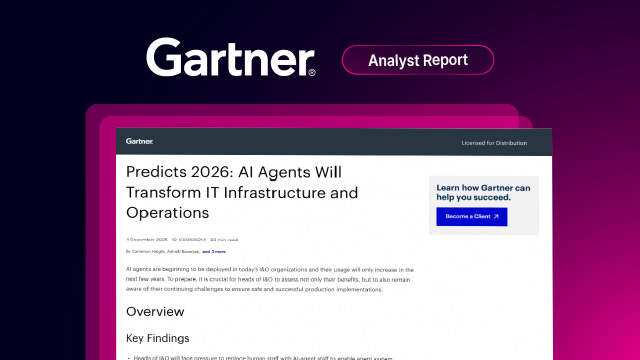
Gartner Predicts 2026: AI Agents Will Reshape Infrastructure & Operations
02
The Practical AI Adoption Guide for Infrastructure Teams
03
The AI for Infrastructure Journey: From Experimentation to Autonomous Operations
04
AI Reasoning for Network Automation
05
Itential FlowAI Overview
06
Agentic Operations for Infrastructure
Ready to Start Your AI Journey?
See how Itential FlowAI enables governed, production-ready agentic operations for infrastructure.
Frequently Asked Questions
AI infrastructure engineering is the discipline of designing, selecting, and operationalizing AI agent systems within IT and network infrastructure – including decisions about which AI paradigm and agent type is appropriate for each operational domain.
The four paradigms are predictive AI (pattern recognition and forecasting), generative AI (content and configuration synthesis), conversational AI (advisory interfaces), and agentic AI (autonomous action and closed-loop automation).
Reactive agents respond to conditions in real time with no memory or context – fast and deterministic. Adaptive agents learn from experience and improve their own behavior over time – more powerful, but requiring closer human oversight at the behavior-pattern level.
Conversational AI is appropriate when the goal is advice, synthesis, or drafting. Agentic AI is appropriate when the goal is action – executing changes, verifying outcomes, and iterating toward a defined state without human intervention at every step. Deploying the wrong paradigm is the most common source of AI underperformance in infrastructure.
Itential FlowAI is an agentic automation platform for infrastructure teams, enabling governed, production-ready AI agents to manage network configuration, provisioning, and operations with appropriate human oversight built in.
Sources
01 What AI Means for Your Digital Infrastructure in 2026 — Coevolve
13 Real-Time Anomaly Detection for Multi-Agent AI Systems — Galileo
02 Agentic AI in Infrastructure: Top 5 Practical Use Cases to Deploy in 2026 — Itential
14 Agents in AI — GeeksforGeeks
03 Gartner Predicts 2026: AI Agents Will Reshape Infrastructure & Operations — Itential
15 What Is a Rational AI Agent? — Domo
04 Networking Predictions in 2026: From Automation Experiments to Agent-Driven Operations — Itential
16 Agentic AI Strategy — Deloitte Insights
05 AI Agents Will Manage Infrastructure Autonomously in 2026 — tFiR
17 The Enterprise AI Stack in 2026: Models, Agents, and Infrastructure — Tismo AI
06 Fluid: Claude Code for Infrastructure — Winbuzzer
18 AI Agent Orchestration Patterns — Microsoft Azure Architecture Center
07 Measuring AI Agent Autonomy in Practice — Anthropic
19 Choose a Design Pattern for Your Agentic AI System — Google Cloud
08 What Is a ReAct Agent? — IBM
20 Intelligent Agent — Wikipedia
09 ReAct Agents — Salesforce
21 Itential FlowAI — Itential
10 The Hidden Superpower Behind Modern AI Agents: The ReAct Pattern — Hexstream
22 Itential Unveils FlowAI, Delivering Agentic Orchestration for Infrastructure Operations — PR Newswire
11 Multi-Agent LLM Orchestration Achieves Deterministic, High-Quality Decision Support for Incident Response — arXiv, Drammeh (2025)
23 Artificial Intelligence: A Modern Approach — Russell, S. & Norvig, P.
12 How SREs Are Using AI to Transform Incident Response — Cloud Native Now