Quick Summary
Distributed infrastructure, spanning enterprise networks, multi-cloud, edge, and AI workloads, has outpaced the automation models built to manage it. Traditional tools fragment. Scripts don’t scale. The answer is a hybrid infrastructure automation approach built on an orchestration layer that connects AIOps insight, AI reasoning, and policy-driven execution into a single governed framework.
Every few years, the infrastructure landscape shifts in ways that fundamentally change how organizations operate. Today, we are in the middle of one of those shifts. Not because of a single technology trend, but because of the collision of several all at once. Distributed applications, multi-cloud architectures, remote workforces, edge computing, AI-driven workloads, and a growing reliance on global connectivity have created a world where infrastructure is everywhere. And for the first time, the operational models we have used for decades cannot keep pace with how distributed, dynamic, and interdependent these environments have become.
In the past, infrastructure teams could rely on a contained stack. A core datacenter. A predictable network perimeter. A few controlled vendors. Automation in that world was task specific and domain oriented. Scripts worked. Manual processes were manageable. Legacy tools delivered enough visibility. That is no longer true.
Today, distributed infrastructure is breaking traditional automation. The patterns that guided operational consistency for years do not scale across hybrid and multivendor infrastructure. In fact, they create the opposite effect. Fragmentation. Drift. Duplication. Operational debt. And ultimately, slowdown at the exact moment organizations need speed, predictability, and responsiveness.
This is where the new conversation is heading, and it is why leaders are reassessing how they manage hybrid infrastructure automation at scale.
Hybrid Is the Default, Complexity Is the Cost of Entry
The modern enterprise now spans four distinct infrastructure domains: enterprise networks, datacenter fabrics, public cloud networking, and telecom or service provider overlays. Each domain has its own APIs, abstractions, configuration models, telemetry formats, and failure patterns. Each is evolving at a different rate. And each has operational expectations that are increasing, not decreasing.
It is no longer possible for a script, a runbook, or a handful of domain-specific automation tools to serve as the connective tissue across this estate. Even mature Infrastructure as Code (IaC) approaches do not solve the problem. IaC is powerful for provisioning and repeatability, but it was never intended to orchestrate real-time, policy-driven operations across multiple vendors and environments.
The result is predictable. Teams face the same symptoms regardless of industry:
- Automation exists, but only in pockets
- Tools do not speak a common language
- Telemetry is visible, but action is manual
- Policy is defined, but rarely enforced through automation
- AI-based detection cannot reliably trigger cross-domain change
When every environment behaves differently, the operational surface area expands. And when everything is distributed, the margin for error shrinks.
Traditional Automation Was Not Built for Distribution
Automation historically solved two problems: speed and scale. Speed for individual tasks. Scale for repetitive actions. But distributed infrastructure introduces challenges that traditional automation was never designed to handle.
First, distributed systems are stateful at multiple layers. A change in cloud networking might impact a WAN route. A shift in application behavior might impact a firewall policy. A latency pattern in a region might require a redistribution of workloads. Automation that operates within one domain cannot account for upstream or downstream implications across others.
Second, dependencies are now asynchronous and multi-directional. Traditional automation relies on linear instruction paths. Distributed architectures operate as complex graphs. The actions required to maintain consistency are dynamic, non-linear, and often triggered by real-time telemetry.
Third, governance has become a prerequisite. With environments operating across jurisdictions, compliance frameworks, and risk thresholds, automation cannot simply execute. It must validate, enforce, and audit.
These realities require a new operational model. And this is where AI-driven automation and orchestration become essential.
The Orchestration Layer Is Becoming the Control Plane for Distributed Infrastructure
As environments become more distributed, leaders are converging on a single architectural requirement. They need an orchestration layer that unifies the disconnected pieces of the infrastructure stack. One layer that can normalize data, enforce policy, connect disparate tools, and execute deterministic workflows across any vendor or environment.
Orchestration sits between insight and action. It turns observability into something operationally meaningful. It creates the guardrails necessary for AI-driven reasoning. And it allows global policy to dictate local change without human intervention.
This is not theoretical. It is what the most advanced organizations are already building.
Greg Freeman from Lumen Technologies, who has been pushing the boundaries of automation at scale, captured this idea clearly.
“A few years ago, we wanted 80 percent of all our configuration changes to be machine-to-machine by 2025. We are exceeding that goal. Itential is helping us do that.”
He also shared a reality every leader should pay attention to:
“We are early in our journey with AI agents. We are seeing value, but AI is non-deterministic, and we need to make it deterministic. I have gotten great results from deterministic workflows with Itential.”
That is the orchestration story. Deterministic execution built on top of non-deterministic intelligence. Insight connected to action. Distributed infrastructure brought under a single operational model.
How Itential Bridges the Gap Between Distribution & Control
At Itential, we have been designing our platform for exactly the world the industry is moving into. Distributed, hybrid environments require more than standard automation. They require orchestration that understands context, enforces policy, integrates intelligence, and adapts to change. This is why our recent AI advancements are not bolt-on features. They are foundational.
The first foundation is our deep integration with AIOps and observability platforms. These systems generate the telemetry, correlation, and insights that modern environments rely on. But on their own, they stop short of execution. By connecting them directly to Itential (via API or MCP), organizations can translate detection into governed workflows that span network, cloud, and application infrastructure. This is where closed-loop operations begin: insight becomes action, and action is fully controlled.
The next layer is how we enable safe interaction with AI agents and large language models. Through our adoption of the Model Context Protocol, AI systems can request data, evaluate infrastructure state, and propose changes through a controlled interface rather than through ad hoc scripts or unsupported API calls. Itential MCP gives enterprises a structured way to let AI participate in operations while ensuring every interaction is visible, validated, and policy aligned.
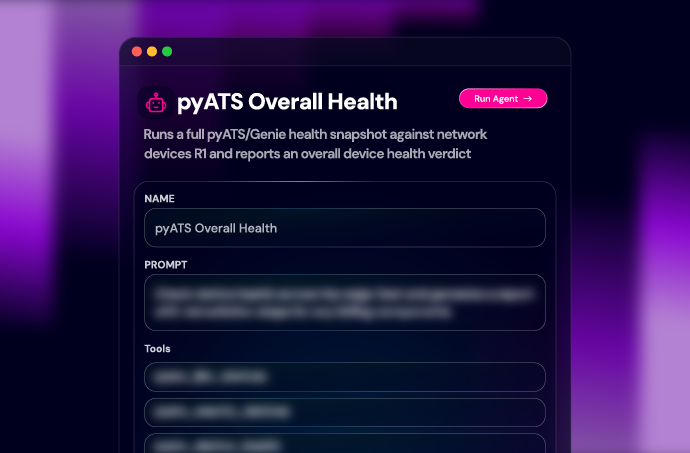
On top of this, we have introduced FlowAI, our own agentic orchestration capability that brings intelligence directly into the workflow layer. FlowAI augments how teams design, refine, and execute automation. It can assist in building workflows, analyze existing logic, recommend improvements, and extend decision-making inside orchestrated processes. But critically, FlowAI does all of this within the deterministic constraints that enterprises require. It does not bypass policy or governance; it strengthens them.
Together, these capabilities form an hybrid orchestration architecture that supports both human-led and AI-assisted operations. Whether a signal originates from an observability platform, an AIOps engine, an LLM, or a reasoning agent, Itential ensures it moves into structured workflows that are compliant, auditable, and safe across hybrid and multivendor environments.
This is why leaders at organizations like Lumen trust Itential. As Greg Freeman said in the Futuriom report:
“AI is non-deterministic, and we need to make it deterministic. I have gotten great results from deterministic workflows with Itential.”
This is the core value we deliver. We give enterprises the operational foundation to adopt AI at scale without giving up control, consistency, or safety. Distributed environments demand orchestration. AI demands guardrails. Itential brings both together into a single platform capable of running the next generation of infrastructure.
Why Leadership Must Own the Next Step
The growth of distributed infrastructure is not slowing down. AI-driven workloads are increasing. Multi-cloud adoption is rising. Edge computing is expanding. Application architectures are becoming more ephemeral. And the operational surface area continues to widen.
Leadership must recognize that traditional automation will not scale to this world. The risks are too high. The fragmentation is too real. The cost of slow or inconsistent operations is too great.
Distributed environments demand distributed awareness, unified orchestration, and policy-driven execution. That is the architecture future-ready organizations are building.
The shift is not optional. It is already underway.
The Path Forward
The Futuriom report reinforces what many leaders already sense. The next generation of infrastructure operations will not be defined by more automation tools. It will be defined by the orchestration platforms that can unify automation, observability, policy, and AI-driven reasoning into a single operational framework.
Distributed infrastructure is here. The question is whether your operational model is ready to run it.
If leaders focus on building the orchestration foundation now, everything sitting on top of it – automation, cloud, networking, observability, security, and AI – becomes more powerful, more consistent, and more predictable.
That is how organizations turn distributed complexity into strategic advantage.
Explore FlowAI and agentic orchestration with Itential →


 Build Build agents & workflows visually, with AI, or bring your own.
 Integrate Connect every system, tool, agent, & AI in your stack.
 Execute Execution for agentic & deterministic operations.
 Secure & Govern Govern every action with built-in RBAC, audit & approval gates.
 Operate Self-service operations & real-time visibility.







 Agentic Operations Connect AI to infrastructure for trusted, automated actions.
 Infrastructure Modernization Transform legacy networks into modern, AI-ready infrastructure.
 Infrastructure as a Product Deliver network and infrastructure services on demand - self service, governed, & consumed like cloud.
 Hybrid & Multi-Cloud Orchestration Unify hybrid & multi-cloud infrastructure through agentic orchestration.
 Governed Change Management Execute every infrastructure change with pre/post validation, audit evidence, & rollback, human or AI-initiated.