
TL;DR: What You Need To Know
What it is:
Agentic Operations for Hybrid Infrastructure combines AI agents (for reasoning and planning) with orchestration platforms (for governed execution). Agents interpret intent and propose workflows; orchestration enforces policy, approvals, and auditability.
Why it matters:
Infrastructure teams need both speed and safety. Pure AI autonomy is too risky for production. Pure manual operations can’t scale. Agentic operations bridges the gap.
Key insight:
This isn’t about replacing automation – it’s about making automation more valuable by adding intelligent planning while maintaining deterministic, governed execution.
Autonomous AI Meets Enterprise Reality
Infrastructure teams are facing a paradox.
You are expected to move faster than ever, across more domains than ever, with less tolerance for outages, drift, or compliance violations than ever.
Hybrid infrastructure does not forgive improvisation.
And yet, the scale and complexity of modern operations has outgrown purely human-driven execution. The tension between speed and safety is why Agentic Operations for Hybrid Infrastructure is emerging as the next evolution of infrastructure operations.
This is not about replacing engineers with AI. It’s about separating cognitive work (understanding intent, reasoning about context, planning actions) from execution work (implementing changes safely across hybrid environments with governance and auditability).
What is Agentic Operations for Infrastructure?
Agentic Operations for Hybrid Infrastructure is an operating model where AI agents can interpret intent, reason over operational context, and plan infrastructure actions, while execution is performed through a governed, deterministic automation and orchestration control plane that enforces policy, approvals, auditability, and verification across hybrid environments.
Core Principle: agents reason, orchestration executes.
It is not a chatbot running your network.
It is not giving an AI agent direct credentials to production systems.
It is an agent-driven planning layer paired with a production-grade execution and governance layer that ensures every action is safe, auditable, and reversible.
Why Agentic Operations Matters Now
Infrastructure and operations leaders are seeing the same pressure from different angles.
NetDevOps
Rapid change demand, config drift, vendor sprawl, multi-domain dependencies that require coordination across network, security, and cloud teams.
Platform Engineering / SRE
Toil reduction targets, fragmented tooling, slow incident remediation, brittle runbooks that break when context changes.
IT Ops / NOC
Alert storms that overwhelm teams, escalating triage load, inconsistent response quality across shifts.
DevOps / Infrastructure Engineering
CI/CD pipeline bottlenecks, infrastructure provisioning delays, environment drift between dev/staging/prod, manual approval gates that slow deployments.
Cloud Operations
Multi-cloud complexity, cost optimization pressures, governance and compliance across diverse environments, security policy enforcement at scale.
CIO / VP Infrastructure
Cost pressure to do more with less, audit risk from manual processes, reliability expectations that require 24/7 coverage, skills gaps as experienced engineers retire.
At the same time, agentic AI is rising fast – and so is the risk.
Gartner predicts over 40% of agentic AI projects will be canceled by the end of 2027 due to escalating costs, unclear business value, or inadequate risk controls.
Infrastructure is where this matters most because the cost of unsafe execution is not theoretical:
- Production outages that impact revenue and customer trust
- Security exposure from unvalidated changes
- Compliance failures that result in audit findings
- Loss of trust in automation after a single bad change
The path forward is not “more AI.”
It is more governable AI-to-action execution.

How Agentic Operations Differs from Automation, Orchestration, & AIOps
Infrastructure teams need shared language before they design systems. Here’s how agentic operations relates to (and depends on) existing approaches:
| Approach | What It Does | Where It Excels | Where It Fails |
|---|---|---|---|
| Infrastructure Automation | Executes predefined, deterministic tasks using scripts, templates, or automation tools | Repeatability, speed, consistency | Can’t adapt when context changes, intent is unclear, or cross-domain coordination is required |
| Orchestration | Coordinates multiple automated tasks across systems using ordered workflows, approvals, retries, and error handling | Safe change, cross-domain workflows, lifecycle operations | Can’t determine the correct sequence when it depends on situational context or when workflow logic must adapt dynamically |
| Closed-Loop Automation | Automation plus verification and feedback, enabling detect → decide → act → verify loops | Resilience, drift correction, compliance enforcement | Decision logic is often too brittle, can’t reason across multiple data sources |
| AIOps | Applies analytics and ML to operational data (logs, metrics, events) to detect anomalies and recommend actions | Detection, triage acceleration, root cause hypotheses | Doesn’t execute actions, doesn’t enforce governance during remediation, struggles with multi-domain changes |
| Agentic AI | AI systems that interpret goals, break down tasks, select tools, plan multi-step actions, and adapt based on feedback | Intent interpretation, dynamic planning, adaptation | Unsafe when allowed to act directly against production, can’t reliably verify outcomes, doesn’t produce audit-ready evidence |
| Agentic Operations for Infrastructure | Combines agentic reasoning with governed orchestration: agents interpret and plan, orchestration executes deterministically with policy, approvals, verification, and audit trails | Production-safe AI-to-action across hybrid domains | Fails when execution lacks governance, verification, or auditability |
The key distinction: Agentic operations separates reasoning (AI agents) from execution (orchestration platform).
Agents propose. Orchestration governs and executes.
This separation ensures that AI agents never directly manipulate infrastructure. Instead, they generate workflow plans that are validated, approved, and executed through a trusted orchestration platform.
Why Automation & Orchestration Become More Valuable, Not Less
A common misconception is that agents “replace automation.”
In reality, agents make automation and orchestration more valuable, because they create more demand for safe, governed execution.
Agents are probabilistic by nature.
Even when agents are accurate, their reasoning can be non-deterministic. The same prompt might generate slightly different plans each time.
Orchestration Provides Determinism, Governance, & Evidence
When you put an orchestration layer between agents and infrastructure, you gain:
- Predictable behavior: Workflows execute the same way every time, with defined sequences, retries, and error paths
- Policy enforcement: Changes must comply with defined policies before execution; agents can’t bypass controls
- Controlled permissions: Orchestration integrates with RBAC and identity systems; agents don’t hold infrastructure credentials
- Auditability: Complete record of what changed, when, why, by whom, and what the outcome was
- Retry logic and rollback: Failed steps can be retried or rolled back using deterministic compensating workflows
- Verifiable outcomes: Post-checks confirm that changes had the intended effect on service health
This is the difference between demos and production.
Organizations that skip the orchestration layer discover this gap when:
- An agent makes a change that can’t be rolled back
- An audit asks “who approved this?” and there’s no record
- A change fails halfway through with no recovery path
- A compliance violation occurs because policy wasn’t enforced
How Agentic Operations for Infrastructure Works
Agentic operations creates a two-layer architecture that leverages the strengths of both AI reasoning and deterministic orchestration:
Layer 1: The Reasoning Layer (AI Agents)
AI agents operate at the intent and planning level:
- Interpret natural language requests from operators, tickets, or monitoring alerts (“provision secure connectivity for the new finance application across AWS and our data center”)
- Reason over operational context including current infrastructure state, topology and dependencies, policies and constraints, historical patterns and incident data
- Generate execution plans that break complex requests into sequenced workflows across multiple systems and domains
- Adapt dynamically to changing conditions, failures, or new information during execution
Layer 2: The Execution Layer (Orchestration Control Plane)
A governed orchestration platform handles all actual infrastructure changes:
- Enforces policy and approval gates before any action affects production systems – agents can’t bypass these controls
- Provides deterministic execution with predictable outcomes, defined error handling, and retry logic
- Maintains complete audit trails of what changed, when, why, and by whom – automatically captured as a byproduct of execution
- Enables verification and rollback to ensure every change can be validated and reversed if needed
- Spans hybrid infrastructure connecting networks, clouds, security tools, and IT systems through a unified control plane with standardized integrations
This separation ensures that AI agents never directly manipulate infrastructure. Instead, they generate workflow plans that are validated, approved, and executed through a trusted orchestration platform.
The Agentic Operations Journey: From Experimentation to Autonomous Operations
Agentic operations is not binary – it’s a journey that moves organizations from supervised experimentation to autonomous operations across five distinct phases. This progression acknowledges a fundamental truth: organizations don’t jump straight to autonomous AI operations. They build confidence through measured steps, each phase expanding the scope of AI involvement while maintaining governance and control.
This framework follows the principle of moving humans progressively from IN the loop (approving every action) to ON the loop (monitoring boundaries) to OUT of the loop (strategic oversight only).
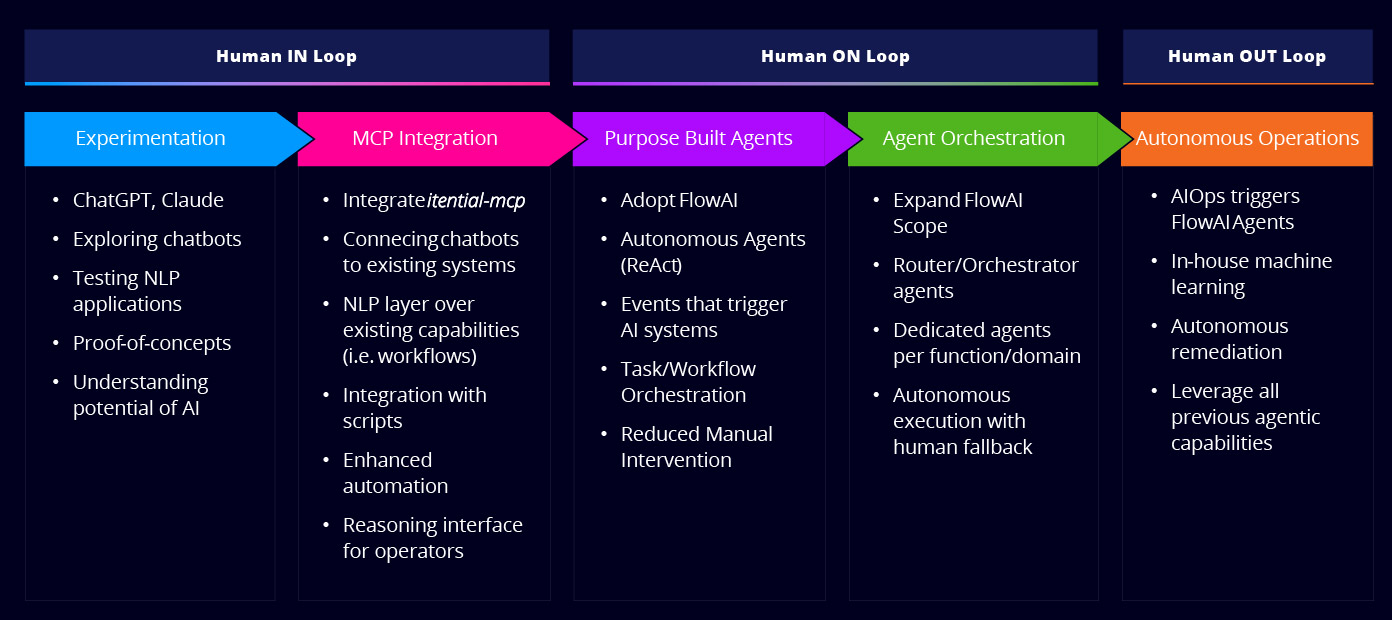
Phase 1: Experimentation
(Human IN the Loop)
What happens: AI operates in read-only mode, analyzing infrastructure and providing recommendations without taking action.
Examples:
- AI answers questions about current network state and configurations
- Analyzes device configs and identifies potential issues
- Provides operational visibility and troubleshooting guidance
- Explores configuration options without execution risk
Value: Organizations build confidence in AI capabilities while AI learns organizational context, naming conventions, and infrastructure patterns. Teams gain familiarity with AI reasoning without execution risk.
Human role: Complete oversight – AI observes, interprets, and advises; humans execute all changes.
Best for: Organizations beginning their AI journey, proving value in low-risk scenarios.
Key principle: “Trust doesn’t come from promises; it comes from proof. That’s why the first step isn’t to hand over the keys – it’s to start read-only.”
Phase 2: MCP Integration
(Human IN the Loop → Human ON the Loop Transition)
What happens: AI agents connect to infrastructure through structured, governed interfaces (Model Context Protocol). AI can reason through workflows and recommend actions, but human approval remains mandatory for execution.
Examples:
- AI prepares configuration changes and explains proposed workflows
- Recommends appropriate automation templates based on intent
- Analyzes job execution data and helps navigate decision trees
- Generates workflow inputs with full parameter visibility
Value: Powerful collaborative model where AI augments human expertise. Significant time savings from AI handling analytical and preparatory work that previously consumed engineer hours.
Human role: Explicit approval required for all actions – AI prepares, humans execute.
Best for: Organizations with established orchestration workflows ready to add AI-assisted planning.
Key integration: Through Itential’s MCP Server, AI agents interact with infrastructure in a controlled manner with workflow-level governance enforced by the orchestration platform.
Phase 3: Purpose-Built Agents
(Human ON the Loop)
What happens: Organizations deploy specialized agents with deep domain expertise, tailored to specific operational needs. Agents execute routine operations within defined boundaries while humans maintain oversight.
Examples:
- EVPN deployment specialist guides engineers through complex design decisions
- Compliance validation expert automatically checks configurations against security policies
- Troubleshooting expert applies diagnostic techniques for specific infrastructure components
- Cost optimization agent identifies underutilized resources and proposes rightsizing
Value: Focused expertise in specific domains. Routine operations execute with increasing autonomy while complex scenarios escalate to humans.
Human role: Define boundaries and monitor outcomes rather than approving every action – humans set policies, AI operates within them.
Best for: Organizations with mature orchestration and clear operational domains that benefit from specialization.
Key shift: Instead of approving every action, humans define the boundaries within which agents can operate, then monitor their decisions and outcomes.
Phase 4: Agent Orchestration
(Human ON the Loop)
What happens: Multiple specialized agents work together, coordinated by router/orchestrator agents. Agent-to-agent collaboration handles complex, multi-step scenarios while maintaining governance.
Examples:
- Anomaly detection agent identifies unusual traffic → Configuration analysis agent examines device configs → Remediation planning agent proposes solutions → Compliance validation agent ensures changes meet security requirements → Router agent coordinates and synthesizes outputs
- Change planning agent designs multi-domain workflow → Impact analysis agent evaluates blast radius → Approval routing agent determines required approvals → Execution agent implements through validated workflows
Value: Handles complex operational scenarios that require multiple areas of expertise. Routine multi-step operations execute autonomously; humans maintain oversight for high-risk or novel scenarios.
Human role: Orchestrator – defining agent collaboration patterns and escalation criteria rather than executing individual tasks.
Best for: Organizations with comprehensive workflow libraries and mature agent deployment experience.
Key capability: Platform maintains governance throughout orchestration – every agent-to-agent communication follows defined protocols, every proposed action passes through validated workflows.
Phase 5: Autonomous Operations
(Human OUT of the Loop)
What happens: Closed-loop automation where specialized agents detect, diagnose, and resolve issues with minimal human intervention. The culmination of the journey where agents continuously maintain infrastructure health.
Examples:
- Detect config drift → Diagnose root cause → Remediate using approved patterns → Verify successful resolution → Document for audit
- Detect routing instability → Stabilize using proven techniques → Verify service health → Update topology documentation
- Detect policy violations → Revert to compliant state → Capture incident record → Analyze for pattern prevention
Value: Infrastructure that’s as reliable and transparent as compute or storage, delivered like a service. Humans focus on strategic oversight rather than operational execution.
Human role: Strategic – defining policies (what agents can/cannot do), reviewing exceptions (unusual cases outside established patterns), continuous improvement (refining operational procedures based on agent performance).
Best for: Organizations with comprehensive instrumentation, mature policies, proven agent performance, and high operational maturity.
Key principle: This isn’t about eliminating human expertise – it’s about elevating it. Infrastructure becomes programmable, governed, and consumable by intelligent agents.
Agentic Operations Use Cases Across the Infrastructure Lifecycle
Day 1: Provision & Change Execution
An operator submits a request: “Deploy network connectivity for the new customer portal in AWS and Azure with segmentation for PCI compliance.”
An AI agent:
- Interprets the requirements and compliance constraints
- Queries current network topology and security policies
- Identifies required changes across network, firewall, DNS, and cloud
- Generates a multi-domain workflow with pre-checks and validation steps
The orchestration platform:
- Presents the plan for approval with change window enforcement
- Executes the workflow: provisions VPCs, configures firewall rules, updates DNS, validates connectivity
- Captures evidence at each step for compliance audit
- Provides rollback if any validation step fails
Result: Intent-driven provisioning with enterprise-grade governance
Day 2: Operate, Remediate, & Optimize
Incident Response & Remediation
When a monitoring alert fires – “database replication lag exceeding threshold”
An AI agent:
- Analyzes symptoms and correlates with recent changes
- Reviews incident history for similar patterns
- Proposes remediation steps with blast radius analysis
The orchestration platform:
- Executes the approved plan: rolls back a recent configuration change, clears cache, validates database health
- Documents every action for the post-incident review
- Captures evidence automatically for RCA documentation
Result: Faster mean time to resolution with complete audit trail
Cloud Resource Optimization
A request to “reduce cloud costs in our development environments” triggers
An AI agent:
- Analyzes usage patterns across environments
- Identifies underutilized resources with rightsizing recommendations
- Generates a workflow with approval requirements based on environment criticality
The orchestration platform:
- Schedules changes during defined maintenance windows
- Requires approval before any production-adjacent resources are modified
- Executes rightsizing with pre/post cost validation
- Captures savings evidence for finance reporting
Result: Autonomous optimization with policy guardrails
What Agentic Operations for Infrastructure is NOT
If you’re evaluating vendor claims or designing systems, these are red flags that indicate unsafe or immature implementations:
❌ “Just connect an agent to your network devices” – Direct agent-to-infrastructure access bypasses all governance
❌ “Autonomous remediation with no approvals or rollback” – Autonomy without guardrails leads to trust collapse after the first bad change
❌ “Trust the AI to figure it out” – Production infrastructure requires deterministic execution, not probabilistic exploration
❌ “We replaced change management” – Mature organizations need change governance more than ever, not less
❌ “The agent executes directly through credentials” – Credential management becomes unmanageable; audit trails are incomplete
❌ “Audit is handled by logs somewhere” – Audit-ready evidence must be captured automatically as part of execution, not reconstructed later
Serious infrastructure teams will not accept this level of risk.
Why Agentic Operations Fails in Production (& How to Prevent It)
1. Unsafe execution paths
What breaks: Agents execute directly against production without orchestration layer
Mitigation: Never allow direct-to-prod agent execution; use orchestration as the control plane between agents and infrastructure
3. Weak governance
What breaks: No approval gates, policies exist but aren’t enforced, changes bypass change windows
Mitigation: Encode approvals, change windows, segregation of duties, and RBAC into the execution model—make guardrails default, not optional
4. Poor data quality
What breaks: Agents plan based on inaccurate CMDB, stale topology, or incomplete dependency maps
Mitigation: Treat context as a product; improve CMDB and topology accuracy over time; implement feedback loops from execution outcomes to data quality
5. No rollback strategy
What breaks: Changes fail partway through with no recovery path; manual intervention required
Mitigation: Build rollback as a first-class workflow path, not an afterthought; test rollback procedures regularly
6. Trust collapse after one bad change
What breaks: A single high-visibility failure destroys confidence in the entire program
Mitigation: Roll out maturity levels deliberately; start with low-risk use cases; prove reliability with evidence before expanding scope; communicate wins and lessons learned
Implementing Agentic Operations: What You Need
Building an agentic operations model requires investment in three areas:
AI Agent Capabilities
- Natural language understanding and intent recognition
- Reasoning over operational context and constraints
- Workflow planning and task decomposition
- Integration with your orchestration platform’s APIs
Orchestration Control Plane
- Multi-domain integrations across your hybrid infrastructure (network, cloud, security, ITSM)
- Policy engine for governance and approval workflows
- Deterministic workflow execution with error handling and retry logic
- Complete audit logging and change tracking automatically captured
- Human-in-the-loop integration for approvals and escalations
- Verification and rollback capabilities
Organizational Readiness
- Defined policies for AI agent authority and approval requirements
- Clear escalation paths for agent-generated plans that exceed policy boundaries
- Training for operators on working with AI-augmented workflows
- Metrics and monitoring for agent performance and governance compliance
- Operating model clarity: who owns workflows, policies, validation, audit
The orchestration platform becomes the foundation – the trusted control plane that AI agents use to safely interact with your infrastructure. This architecture ensures that even as AI capabilities evolve, your governance, auditability, and reliability requirements remain intact.
How Itential Enables Agentic Operations for Hybrid Infrastructure
Itential has been building the orchestration foundation that makes agentic operations production-safe since 2013. While many vendors are adding “AI features” to existing tools, Itential provides the deterministic execution and governance layer that enterprise infrastructure requires – the control plane that sits between AI reasoning and infrastructure action.
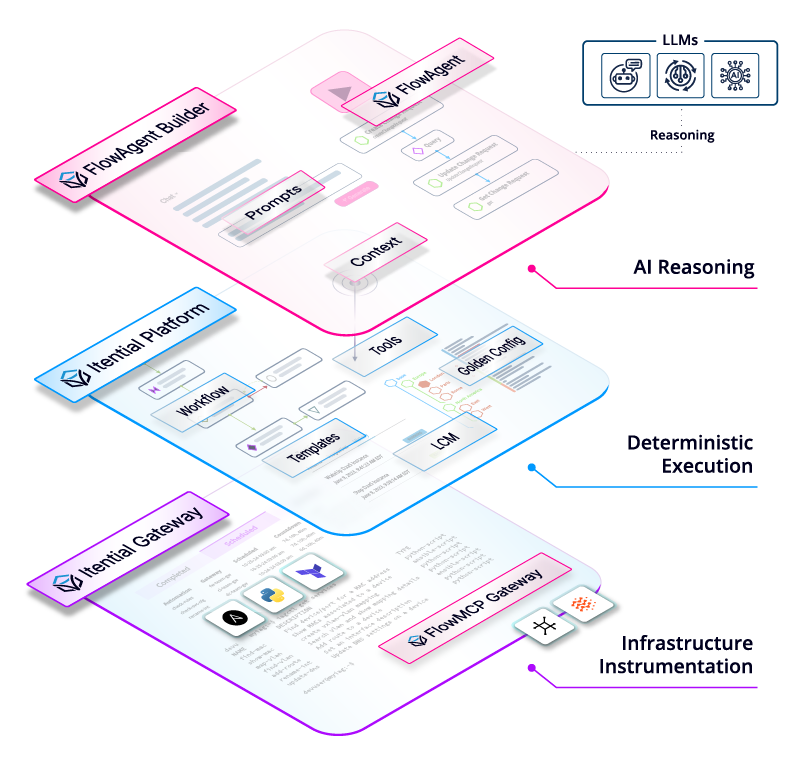
The Three-Layer Architecture That Makes the Journey Possible
Itential’s platform enables the architectural separation that allows organizations to progress through each phase of the agentic operations journey with confidence:

Reasoning Layer: FlowAI & Intelligent Agents
Itential FlowAI enables organizations to build, deploy, and govern purpose-built AI agents tailored to their operational needs. FlowAgent Builder allows teams to create specialized agents for specific domains – EVPN deployment, compliance validation, troubleshooting, cost optimization – each with defined reasoning styles and access to specific workflows.
These agents operate in the reasoning layer, interpreting intent and generating plans, but never executing directly against infrastructure.

Deterministic Execution Layer: Itential’s Orchestration Platform
This is where production safety happens. Itential’s workflow engine and orchestration platform provide:
- Deterministic execution with strict contracts, validation, and governance – the same input always produces the same result
- Policy enforcement and approval gates that agents cannot bypass
- Role-based access controls integrated with enterprise identity systems
- Complete audit trails captured automatically as a byproduct of execution
- Verification and rollback capabilities built into every workflow
- Multi-domain workflow orchestration across network, cloud, security, and IT systems
This is the layer Itential has been refining for over a decade – the proven orchestration capabilities that customers already rely on for business-critical operations. AI reasoning extends and enhances these workflows but never bypasses them.

Infrastructure Instrumentation Layer: Pre-Built Integrations & FlowMCP Gateway
Itential provides extensive pre-built integrations and adapters across multi-vendor environments, giving AI agents the operational data and execution capabilities they need. With the addition of the FlowMCP Gateway, apart of the Itential Automation Gateway, Itential extends this instrumentation to the growing ecosystem of MCP-compatible tools, enabling agents to access both Itential’s native integrations and external MCP servers while maintaining platform-level governance.

Architecting Hybrid AI for Infrastructure Operations
How Itential FlowAI brings together hybrid reasoning, orchestration, and safe infrastructure execution.
Why Itential’s Approach Differs
Governance by Design, Not as an Afterthought
Many vendors are adding AI agents to existing automation tools and hoping governance “just works.” Itential built the orchestration control plane first, then layered in agentic capabilities with governance enforced at the platform level.
The result: AI agents can innovate in the reasoning layer while the execution layer maintains unwavering governance. The separation means AI can evolve without requiring changes to core workflows, and workflows can be enhanced without disrupting AI capabilities.
Production-Proven at Enterprise Scale
Itential’s orchestration platform is already running mission-critical operations for Fortune 500 enterprises, global service providers, and large financial institutions. These organizations trust Itential with their most sensitive infrastructure changes – network provisioning, security policy updates, compliance enforcement, incident remediation.
Adding agentic capabilities to this foundation means organizations get AI-powered operations without sacrificing the reliability, auditability, and governance they already depend on.
Open, Extensible, & Future-Proof
Itential’s MCP Server implements the Model Context Protocol, an open standard developed by Anthropic. This means organizations aren’t locked into a single AI vendor or agent architecture. They can:
- Use any MCP-compatible AI agent (Claude, ChatGPT, custom agents, future models)
- Connect to external MCP servers through the FlowMCP Gateway Build their own specialized agents using FlowAI Integrate with emerging AI tools as the ecosystem evolves
The orchestration control plane remains constant while AI capabilities advance.
Real-World Implementation:
From Read-Only to Autonomous
Itential customers are progressing through the agentic operations journey today:
Phase 1-2
Using Itential’s MCP Server to give AI agents read-only access to infrastructure state, then progressing to AI-assisted workflow planning where agents prepare changes and humans approve.
Phase 3
Deploying specialized FlowAgents for routine domains – compliance validation, configuration drift remediation, credential rotation – with bounded autonomy within defined policies.
Phase 4
Coordinating multiple agents for complex scenarios – incident response, multi-domain provisioning, optimization campaigns – while maintaining workflow-level governance.
Phase 5
Selected organizations running closed-loop operations for specific use cases – golden config enforcement, automated compliance remediation, self-healing infrastructure – with human oversight focused on policy refinement and exception handling.
Getting Started with Itential
Organizations implementing agentic operations with Itential typically follow this path:
Foundation: Deploy Itential’s orchestration platform and build your “golden workflows” for top operational use cases with governance and verification built-in.
AI Integration: Connect AI agents via Itential’s MCP Server, starting with read-only analysis and progressing to AI-assisted workflow preparation.
Specialized Agents: Use FlowAI to build purpose-built agents for specific operational domains, each operating within defined boundaries.
Agent Orchestration: Enable multi-agent collaboration for complex scenarios while maintaining platform-level governance.
Autonomous Operations: Expand autonomous execution to mature use cases with proven reliability and comprehensive verification.
The key is that each step builds on production-proven orchestration capabilities, not experimental AI features.