

Share this
Table of Contents
- Agentic Operations is Not a Future Concept, It’s a Near-Term Reality
- The Hidden Challenge: Most Agent Projects Fail Because They Cannot Safely Act
- AI-to-Action is the Real Operating Model Shift
- Where Itential & FlowAI Fit: Orchestrating Agentic Operations with Control
- Three Practical Steps for I&O Leaders to Get Started Now
- The Agentic Era Belongs to Teams that Can Act Safely at Scale
AI has officially crossed a threshold. It is no longer just a tool that helps engineers work faster. It is becoming a system that can plan, decide, and execute work on their behalf.
For infrastructure and operations (I&O) leaders, that shift is bigger than any single technology wave we have seen in the last decade. It changes the work itself. It changes how teams are staffed and structured. It changes what buyers should demand from vendors. And it changes the definition of operational excellence.
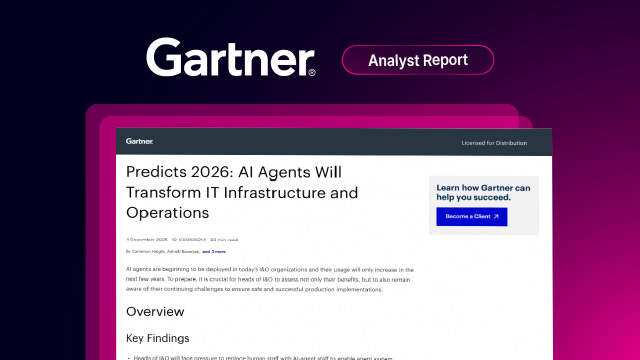
Gartner’s latest Predicts report, “AI Agents will Reshape Infrastructure & Operations,” makes the direction unmistakable: AI agents are moving “from tools that assist humans to platforms that replace manual effort for complex workflows.”
The takeaway is not that AI will help I&O. The takeaway is that agentic AI will become part of the operating model.
Agentic Operations is Not a Future Concept, It’s a Near-Term Reality
Most teams already feel the pressure that is driving this change. Infrastructure complexity continues to grow across hybrid networks, cloud platforms, and security tooling. Tool sprawl expands. Manual work still consumes time that should be spent on engineering improvements. And the cost of downtime keeps climbing.
Gartner estimates that only one-third of network tasks are automated today, and the adoption of AI networking is even lower.
That reality is colliding with a new expectation from leadership: deliver faster outcomes with fewer resources. The next step is obvious. If automation can execute tasks, and AI can interpret intent and make decisions, then AI agents become the bridge between business goals and operational execution.
Gartner is clear about the acceleration curve:
- By 2029, 70% of enterprises will deploy agentic AI in IT infrastructure operations, up from less than 5% in 2025.
- By 2028, human-in-the-loop involvement drops to 40%, down from 95% in 2025.
- By 2030, 50% of I&O organizations will be reshaped as leaders invest in AI agents for complex tasks.
This confusion is normal early in the hype cycle, but here’s the catch: if you let the noise overwhelm you, you’ll miss the real shift happening underneath.
The Hidden Challenge: Most Agent Projects Fail Because They Cannot Safely Act
Every new wave of technology brings a rush of optimism. It also brings an early wave of failures.
Gartner recently issued a public warning that over 40% of agentic AI projects will be canceled by the end of 2027, driven by escalating costs, unclear business value, or inadequate risk controls.
That warning matters because it highlights the core issue: many teams are trying to deploy agents without first solving the hardest part, which is not reasoning.
The hardest part is safe execution.
In infrastructure operations, the cost of a wrong action is not a bad user experience. It is an outage. It is a compliance failure. It is a security incident. That means agents cannot simply “operate.” They need to be governed. They need to be observable. They need to be constrained by policy and permissions. And their actions must be auditable.
So the question becomes: how do you move from AI hype to real infrastructure outcomes without losing operational control?
AI-to-Action is the Real Operating Model Shift
Agentic operations succeeds when teams treat agents as part of a system, not as a standalone feature. In practice, this means building an AI-to-Action operating model where agents can reason, but execution is orchestrated and governed.
Here is what that model looks like in enterprise infrastructure environments:
1. Reasoning & Planning
Agents interpret intent, evaluate context, and propose a sequence of steps to achieve a goal.
2. Orchestration
Workflows coordinate tasks across domains, systems, and teams. This is where enterprise infrastructure complexity becomes manageable.
3. Governance & Guardrails
Policies control what the agent is allowed to do, under what conditions, and with what approval path.
4. Execution Across Real Systems
Actions are carried out using deterministic automation integrated with network, cloud, ITSM, and security platforms.
5. Validation & Closed-loop Control
Outcomes are verified, exceptions are handled, and remediation is triggered when needed.
This is why governance is not a secondary concern. It is the foundation of scale.
Gartner explicitly recommends an agent governance framework that includes policy-as-code, approval ladders, observability of agent actions, and audit logging mapped to change controls, along with rollback plans and safety interlocks.
That is the blueprint for enterprise adoption.
Where Itential & FlowAI Fit: Orchestrating Agentic Operations with Control
FlowAI, the new agentic layer within the Itential Platform, brings agentic orchestration to infrastructure operations by translating intent into governed execution. It is designed to help teams move from experiments to production by connecting AI-driven planning to safe execution across the enterprise stack.
This aligns with Gartner’s view that infrastructure roles evolve from hands-on operators to leaders who supervise systems. Gartner describes a shift away from purely manual execution and toward a new model grounded in “prompt engineering, policy definition, and workflow orchestration.”
Itential’s orchestration platform already provides the backbone that enterprise teams need for this transition:
- Cross-domain workflow orchestration across network, cloud, ITSM, and security systems.
- Enterprise governance including RBAC, approvals, and audit-ready logging.
- Reusable automation assets that create consistency and speed at scale.
- Closed-loop control to validate outcomes, handle exceptions, and remediate issues reliably.
- Integration depth that makes multi-vendor, hybrid environments operationally achievable.
In other words, FlowAI enables the agentic interface. Itential’s Platform delivers the enterprise-grade execution, control, and governance layer that makes it safe to adopt.
Because agentic operations is not just about agents. It is about turning intent into outcomes with confidence.
Three Practical Steps for I&O Leaders to Get Started Now
If you are an I&O leader looking at agentic AI, here are three pragmatic ways to begin:
1. Establish a governed AI-to-Action control plane before increasing autonomy.
Agentic AI only scales when it is connected to an execution layer that enforces policy, permissions, approvals, and auditability. Build the orchestration and governance foundation first, including RBAC, approval ladders, rollback paths, and end-to-end visibility. That way, as agents take on more responsibility, every action remains secure, repeatable, and compliant.
2. Start with atomic, high-value use cases.
Target workflows where automation already exists, but decision-making and coordination still rely on humans. Examples include change execution, incident remediation, compliance validation, and provisioning orchestration.
3. Implement an orchestration platform that connects agentic reasoning to secure, deterministic execution.
AI agents can plan and recommend, but enterprises need an execution layer that applies policy, permissions, approvals, and audit logging before anything touches production systems. Choose a platform that translates agent intent into governed workflows and repeatable automation across network, cloud, and ITSM environments.
The Agentic Era Belongs to Teams that Can Act Safely at Scale
Agentic operations is coming fast. Gartner’s predictions make that clear. But the winners will not be the teams who deploy agents first. The winners will be the teams who build an operational model where agents can act with governance, orchestration, and control.
That is why the future of agentic I&O is not just about intelligence. It is about execution.
If you want to understand what Gartner predicts is coming next, download the full report and see how Itential and FlowAI help you move from AI hype to governed infrastructure action.
Download the Gartner Predicts report →
Explore FlowAI and agentic orchestration with Itential →

Kristen H. Rachels
Chief Marketing Officer ‐ Itential
Kristen serves as Chief Marketing Officer for Itential, leading their go-to-market strategy and execution to accelerate the adoption and expansion of the company’s products and services.