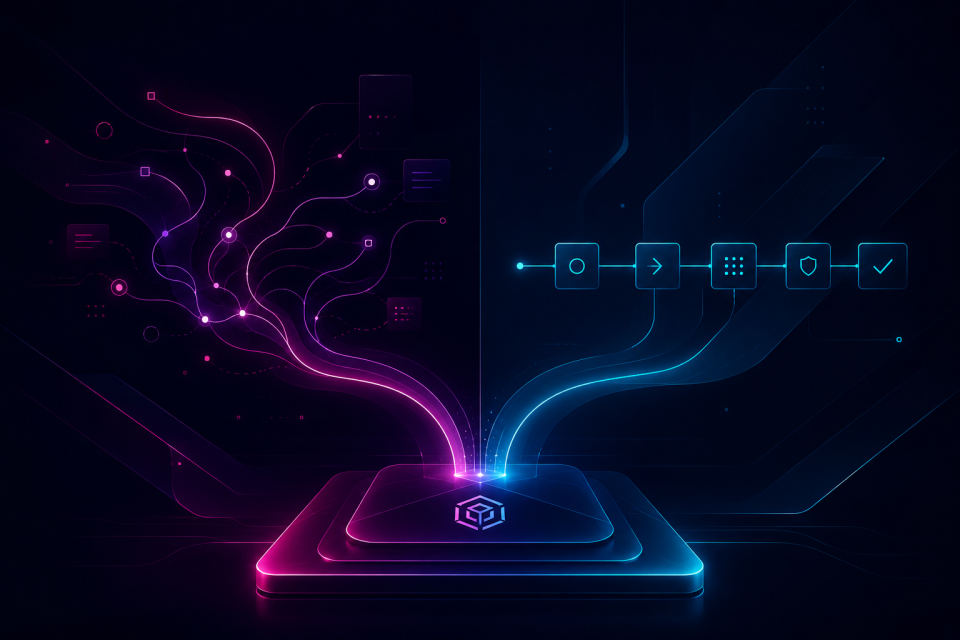
Agility without compromising stability. If you have followed Itential for any length of time, you know that sentence could have been lifted from our own messaging. It wasn’t. That is the point.
We Didn’t Bolt AI On, We Built Toward It
FlowAI did not appear out of nowhere in 2026. It is not an AI feature wedged into a platform that was never designed for it, and it is not tucked at the end of a portfolio you have to buy your way through. A decade of deterministic orchestration came first: the industry’s long, hard climb from scripts to APIs to programmability, from automating devices to orchestrating across every domain and vendor. That climb earned us the trust to execute on production infrastructure for hundreds of the most demanding operators in the world.
Then the pieces landed in sequence. The Itential MCP Server was open-sourced in May 2025. FlowAI entered private preview that November and reached general availability in July 2026.
Two things in the architecture are, I would argue, why this profile exists.
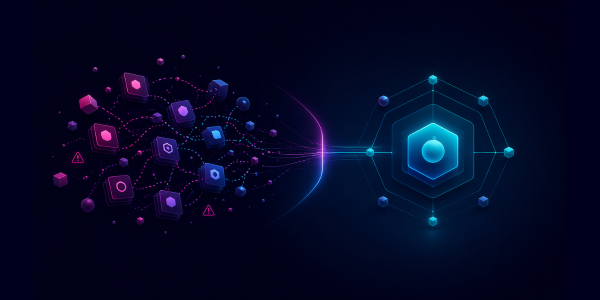
First, control is designed in before an agent ever runs. Every FlowAgent is scoped at build time by natural language skills that define its purpose, its boundaries, and its guidelines, and it acts only through tools from an authorized list. The agent cannot wander, because the architecture never gave it anywhere to wander to. Then execution itself is not one mode but three: deterministic, agentic, and hybrid, all running through the same governed engine. Predictable workflows where precision matters most, agentic reasoning where judgment is needed, and hybrid where agents reason while deterministic automation carries out the change.
Second, agents do not stay probabilistic forever, and that matters for more than repeatability. When a FlowAgent proves out an approach, spec-driven development converts it into a repeatable, deterministic workflow. That answers the question the whole industry is quietly avoiding: what do you do with agentic output you cannot reproduce? You harden it. And hardening it changes the economics. Reasoning is the expensive part of agentic AI; it is where the tokens go. Every proven approach that converts to a deterministic workflow stops consuming reasoning and starts running for a predictable cost. Your agents keep exploring the unsolved problems. Your solved problems stop running a tab.
Agility, from the reasoning. Stability, from the execution. That is not a feature we added for the AI era. It is the architecture we spent ten years building, meeting the moment it was built for.
The Criteria Are the Story
The badge is nice. What matters is what the recognition reveals: the criteria the market now uses to judge this space. When Gartner names deterministic guardrails, granular context, and disciplined AI economics as what separates viable agentic software from chatbots, it is telling every enterprise buyer what questions to ask. We are delighted with those questions. We have spent a decade making sure our answers are proven in production.
One More Thing ICYMI
The same month this research published, Gartner also named Itential a Representative Vendor in five 2026 Market Guides spanning cloud, network, and infrastructure operations. Only two vendors in the world appear in all five. The other covers that map with a portfolio of separately acquired products. We do it with one platform.
So yes, it is still cool to be cool. Cooler, honestly, now that everyone was eligible and the product had to be real.
Learn more about the Coolest Vendor Innovations in Agentic AI for Enterprise Networking here. And if you want to see what “agentic reasoning with deterministic implementation controls” actually looks like on your infrastructure, come see FlowAI.


 Build Build agents & workflows visually, with AI, or bring your own.
 Integrate Connect every system, tool, agent, & AI in your stack.
 Execute Execution for agentic & deterministic operations.
 Secure & Govern Govern every action with built-in RBAC, audit & approval gates.
 Operate Self-service operations & real-time visibility.







 Agentic Operations Connect AI to infrastructure for trusted, automated actions.
 Infrastructure Modernization Transform legacy networks into modern, AI-ready infrastructure.
 Infrastructure as a Product Deliver network and infrastructure services on demand - self service, governed, & consumed like cloud.
 Hybrid & Multi-Cloud Orchestration Unify hybrid & multi-cloud infrastructure through agentic orchestration.
 Unified Change Management Unify network & infrastructure changes across every team, tool, & domain.