Itential logo
Build

Build the Agents, Workflows & Standards That Run Your Infrastructure

The Itential Platform is where infrastructure teams build the agents, workflows, configuration standards, and resource models their operations run on.

Build Without Limits

Build Visually, Generate with AI, or Bring Your Own from Git

The Itential Platform supports every way infrastructure teams build the agents, workflows, configuration standards, resource models, and automations their operations run on. Choose the build mode that fits each task, the platform handles execution, governance, and audit the same way regardless.

Build Agents

Build FlowAgents That Reason, Act, & Adapt

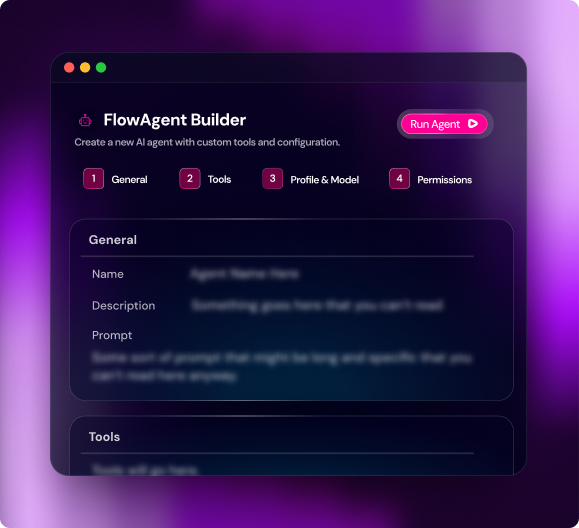
FlowAgent Builder defines what each agent does, the tools and skills it can call, and how autonomously it acts. Build visually or describe the agent in plain language and let Spec-Driven Development generate it. Either way, agents reason, act, and observe results in a loop until the goal is met. Every action runs through the same governed execution engine.

Scoped Tool Access

Each agent gets an explicit allowlist of platform capabilities, defined at build time. Agents can call only the tools they’ve been granted, with anything outside that scope blocked at runtime.

Build Once, Reuse Everywhere

Build agents once, reuse them everywhere. FlowAI enables you to construct reusable, modular, and actionable agents with structured instructions, prompt templates, routing logic, and output schemas. Encode expertise once, and any FlowAgent can invoke it.

ReAct Reasoning Loop

Agents reason through a goal, take an action, observe what happened, and reason again. They adapt to real-time conditions while staying within the autonomy thresholds and approval gates you set at build time.

When you’re operating infrastructure at Lumen’s scale, the question was never whether AI could help – it was whether we could trust it in production and Itential’s FlowAI answered that. Our teams were building production-ready agents in minutes, within the same governance and access controls we already rely on. As we build the next digital backbone for AI, this is the next evolution in our journey with Itential and it’s redefining how we operate networks at scale.
Image of Greg Freeman
Greg Freeman
Vice President, Network and Customer Transformation, Lumen
Orchestrate Agents & Workflows

Design & Orchestrate Agentic Workflows

Describe a workflow and an LLM generates it via the platform’s REST APIs. Or build visually on the Design Studio canvas, stitching together tasks, integrations, and agent steps. Both paths produce the same governed, version-controlled, auditable artifact. Every workflow becomes a modular component callable from any other workflow, agent, or system, so the toolset compounds with every release.

icon showing connections between nodes
Visual or AI-Generated

Drag-and-drop tasks, integrations, and agent steps on the low-code design studio canvas. Or describe the workflow in plain language with Spec-Driven Development. Either path produces the same modular, reusable workflow.

Branching Logic

Conditional pass, fail, and revert paths at every step. Workflows respond to real-time state, branching based on what they find rather than running a rigid sequence.

Icon of a checkmark
Validation & Rollback

Pre-checks before, post-checks after, and blast-radius controls in between, all configured at build time. When something fails, automated rollback recovers the system to its last known-good state.

Manage Config & Compliance

Define Golden Config Standards Once, Enforce Everywhere

Whether changes are agent-driven, machine-driven, or human-driven, they all need standards they operate within. Itential gives you the controls to define those guardrails once. Golden config standards cascade through a hierarchical tree where a root standard enforces across every child node. Jinja2 templates adapt across device types, vendors, and regions. The boundaries you set here apply to every device, every change, every actor.

Hierarchical Template Inheritance

Compliance plans can be created to provide multi-vendor compliance across diverse network infrastructure. Change a parent node once and every child inherits the update automatically, with no per-device rebuilds or copy-paste maintenance.

Dynamic Templates

Jinja2 variables adapt templates across environments and device types automatically. Intelligent ordering rules handle configs where line sequence matters for compliance, not just configs where it doesn’t.

AI-Generated Compliance

Describe a compliance requirement in plain language and Spec-Driven Development generates the template. The result enforces uniformly across every device and domain, no manual translation from policy doc to config logic required.

Bring Your Own Automation & Tools

Your Automations & Tools, Published as Governed Services

Your Python scripts, Ansible playbooks, & OpenTofu plans live in Git. The platform syncs automatically, wraps each automation in a decorator, and auto-generates a REST API. Personal assets become callable, governed services any authorized team can run, and engineers keep building in their IDE.

Git-Native

Connects to GitHub or GitLab. Every execution runs the latest committed version automatically, with no manual deploys, no version drift, and no separate platform sync to maintain.

Auto-Generated REST APIs

Decorators define inputs and outputs. The platform auto-generates a callable REST API for every automation, instantly usable by workflows, CI/CD pipelines, and AI agents calling it as a tool.

AI-Generated via Spec-Driven Development

Describe what you need in plain language and Spec-Driven Development generates the automation, commits it to Git, and CI/CD deploys it. Same governance from the first run, no separate AI build path.

Stateful Orchestration

Track Every Orchestrated Change on Infrastructure

Most workflow tools execute logic but forget what they did. Itential keeps a live state record of every device, service, and configuration the platform has ever touched, attributed to the workflow that changed it. Agents get the assembled picture of what they’re managing, devices, services, dependencies, and change history packaged as context. No token-burning rediscovery of data the platform already has stored.

Resource Models

Define the structure for any device or service once. Every real-world occurrence becomes a tracked instance with full property change history, queryable by any workflow, agent, or system that needs it.

icon showing connections between nodes
CRUD via Governed Workflows

Create, Update, and Delete actions run through governed workflows with approval gates and a full audit trail per action. The state record updates only when the workflow succeeds, so the platform’s view of reality stays accurate.

AI-Queryable State

FlowAgents query live infrastructure state before they act. Day 2 operations run on what’s actually deployed, not what was documented, so agents recommend upgrades, generate validations, and execute changes against real conditions.

Use Cases

What Teams Build on Itential

From provisioning agents that span domains to AIOps loops that close themselves, these are the operating patterns infrastructure teams are running in production on Itential, with agents, workflows, and existing code under one governance model.

Provisioning Agents for Multi-Domain Services

A FlowAgent reasons through a service request, calls workflows for SD-WAN, transport, and CPE configuration, and provisions the full service across all domains in minutes.
Day 2 Change Management Agents

A change request hits an agent. It queries live infrastructure state, identifies affected devices, executes the change through governed workflows, runs post-checks, and closes the ticket.

AIOps Agents That Gather, Diagnose, & Remediate

Alerts from observability and AIOps platforms trigger FlowAgents that gather diagnostic data, identify root cause, execute remediation through governed workflows, and feed results back. AIOps detection meets governed action, with no humans in the middle.

icon of a cog symbolizing automation, configuration, and settings
Continuous Compliance with Golden Config Standards

Define a golden configuration standard once. The platform validates every device against it on a schedule, flags drift in real time, and runs remediation workflows generated from the standard itself.

Existing Automations as Governed Services

Your Python scripts and Ansible playbooks live in Git, get auto-published as callable REST APIs, and run through the same governance as everything else. Engineers keep building in their IDE.

Keep Learning

Dive Deeper into Building with Itential

Build the Agents Your Operations Run On

See how teams build, deploy, and govern infrastructure agents on the Itential Platform.

Talk to an Expert

Frequently Asked Questions

+

No, and that’s the point. Itential is the orchestration layer that sits above your existing tools and makes them work together. Your Ansible playbooks, Python scripts, and Terraform plans become governed, reusable services any team can consume, without rewriting a line. Most Itential customers keep running the tools they already have. They just stop managing them manually.

+

Every platform capability is exposed as a REST API. The MCP Server exposes those APIs as skills any connected LLM can call. Describe the agent or workflow in plain language, the LLM generates it by calling the platform’s APIs directly, producing version-controlled output that deploys in the same step. The LLM generates. The platform governs and executes.

+

A workflow is deterministic, a step-by-step orchestration with validation, approval gates, and rollback built in. An agent is a reasoning layer above workflows: it interprets a goal, queries current infrastructure state, selects the right tools, and decides which workflows to execute. Agents are adaptive. Workflows are predictable. They work together, the agent reasons, the workflow executes.

+

Workflows execute logic but don’t retain state after they finish. Stateful orchestration adds persistent resource models, so after a workflow updates a device, that change is recorded against the instance and stays queryable. The platform always knows the current state of every tracked resource, who changed it, and when. That live state is what makes AI agents trustworthy, they query what’s actually running before acting.

+

You don’t change how you build. Engineers keep writing Python, Ansible, and Terraform in their IDE, committed to Git. The platform pulls from your repo, wraps automation as a governed service, and handles execution, secrets, RBAC, and logging automatically. CI/CD pipelines can also push directly into the execution layer so deployment is part of your existing workflow.