[vc_row][vc_column][vc_row_inner][vc_column_inner][vc_column_text]Throughout my time at Itential helping customers get the most out of their automation efforts, Iu2019ve had the chance to meet with IT and network teams at many organizations to talk about their network automation needs and goals. In this time, Iu2019ve seen a shift start to happen firsthand u2014 more and more network engineers are starting to build their own automations to help keep up with the number of network requests. Teams are developing Python scripts, Ansible Playbooks, and Terraform Plans to automate specific tasks like pushing config to a certain device type or ordering a service on AWS. But thereu2019s still a ways to go. To be honest, I donu2019t think teams are getting the most out of the scripts and Playbooks they build. Even with the automation work theyu2019ve done, most teams are still performing the majority of activities manually, and the time between a network service request and service delivery hasnu2019t been reduced as much as teams expected. The challenge? Making the jump from domain-specific automations to network orchestration, where a workflow can coordinate a change process start to finish. Successful orchestration solutions can onboard those domain-specific automations and coordinate them with key processes like validation, remediation, and integration, along with the ITSM (e.g. ServiceNow, Jira) steps that surround every single network change.[/vc_column_text][vc_column_text css=”.vc_custom_1709225996694{margin-top: 3% !important;}”]
When Scripts Arenu2019t Enough
[/vc_column_text][vc_column_text]The thing is, building an automation, like a Python script to push config to a set of servers, is just one small step in a much longer process. Team members tasked with implementing domain-specific automations arenu2019t necessarily experts when it comes to the entire process end to end. Responsibilities for each system might lie with different teams, each with their own skillsets, and getting every link along the chain that makes up a network change to work together is a much bigger challenge than just automating a single task or set of tasks with a script. Thatu2019s because often, the value of a script is limited to just the engineer who built it. Others on the team might not be able to run it, and you might even have a situation where multiple network engineers build their own scripts all to achieve very similar things. So once an engineer builds an automation, how should it be exposed to users? End users shouldnu2019t just be handed a script to execute themselves. Thatu2019s simply not scalable. Features like input validation and role-based access control need to be baked in to ensure automations are run securely and successfully across every step of the network change. Itu2019s at this point in the automation journey when teams often hit a barrier. Itu2019s possible to build orchestration with DIY tools alone, but itu2019s a mammoth software development effort that doesnu2019t practically suit 99% of network teams. Iu2019ve seen companies where they tried to build their own orchestration solutions for a year, two, three, and it often ends up as a big money pit. Instead, teams and organizations should look to commercial orchestration solutions that complement their high-code automation work, allowing low-code network engineers to get value out of automation while empowering the people who build scripts today. Of course, you canu2019t just ask teams to throw away all the work theyu2019ve done to adopt a commercial solution that might not even work in the exact way theyu2019ve built their scripts to. Plus, itu2019s a hard sell to ask organizations to re-invest time and money into use cases theyu2019ve already tried to solve. Any commercial solution must work with the tech stack an organization already has and must be able to onboard any script automations the team builds.[/vc_column_text][vc_column_text css=”.vc_custom_1709225953132{margin-top: 3% !important;}”]
How Script Decoration Powers Up Your Network Automations
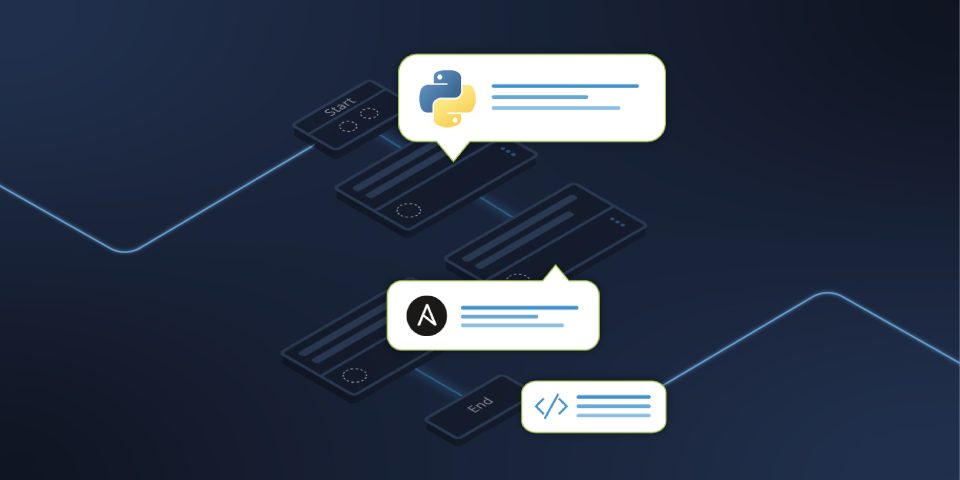
[/vc_column_text][vc_column_text]This is where an integration-focused network orchestration platform comes in. At Itential, weu2019re always talking about using the u201cright tool for the right job.u201d NetOps teams have to employ different tools to solve for different automation needs. Scripts, Ansible Playbooks and Terraform plans are each examples of different tools network engineers use to solve for specific use cases, and often skillsets varyu2014some people might be proficient with Ansible, and others with Python. A network orchestration platform needs to accommodate these disparate tools and enable collaboration. Itu2019s not enough to say that a single tool can solve for every networking use case. We need to go further and allow integration of all the different tools needed to automate and orchestrate different networking activities. That flexibility and integration is exactly what the Itential Automation Platform delivers. Our platform allows users to onboard their existing automation assets directly into the platform without requiring a re-implementation effort. Using Itential Automation Gateway (IAG), users can onboard their automation assets and decorate them using a JSON schema. That allows a script to be exposed to another user as a form, with input validation for expected arguments. In addition, users can attach API endpoints to their scripts for streamlined consumption. And you can go a step further. With the orchestration capabilities of the Itential Automation Platform, teams can go a step further and leverage these scripts in a workflow. That means a CLI automation can be coordinated with API-driven activities in a workflow that drives an entire IT process, end to end u2014 transforming the way the network drives operational efficiency.[/vc_column_text][vc_column_text css=”.vc_custom_1709225946169{margin-top: 3% !important;}”]
From Pockets of Scripts to Integrated Workflows
[/vc_column_text][vc_column_text]This supercharges the automations you already have, extending their capabilities by allowing them to be plugged into any number of end-to-end orchestration workflows as the need demands. Script decoration also allows you to build in an input validation layer, alerting end users who may not be familiar with the script (or even with Python or YAML themselves) as to what variable type is needed in each field. The script decoration capability that Itential provides puts the power in your hands to really get the most out of automations youu2019ve already built. Theyu2019re no longer just siloed automations that live on one system to accomplish one task. Now, they can be leveraged by anyone in the network team to build orchestration workflows with a simple drag-and-drop interface. Plus, the nature of the decoration capability is such that, as business needs change, the decoration can be easily adjusted to reflect different validations and variables required by the script u2014 one person changes the script on the backend, and the end users still get a simple form in which they can input variables. The Itential Automation Platform delivers a workflow-based approach to end-to-end network orchestration that allows customers to democratize existing automation assets, leveraging the full potential of automation work thatu2019s already been done. Script decoration expands the reach, applicability, and efficiency of existing and future assets that arenu2019t maximized in the outdated silo model. To get your hands on a free demo and see how things work, sign up for a test drive here. You can also check out my recent demo showing step-by-step how you can integrate your existing automation assets into a low-code orchestration workflow.[/vc_column_text][vc_single_image image=”57268″ img_size=”full” onclick=”custom_link” img_link_target=”_blank” link=”https://www.itential.com/resource/demo/integrating-python-scripts-ansible-playbooks-with-itential-for-network-automation/”][/vc_column_inner][/vc_row_inner][/vc_column][/vc_row]


 Build Build agents & workflows visually, with AI, or bring your own.
 Integrate Connect every system, tool, agent, & AI in your stack.
 Execute Execution for agentic & deterministic operations.
 Secure & Govern Govern every action with built-in RBAC, audit & approval gates.
 Operate Self-service operations & real-time visibility.









 Agentic Operations Connect AI to infrastructure for trusted, automated actions.
 Infrastructure Modernization Transform legacy networks into modern, AI-ready infrastructure.
 Infrastructure as a Product Deliver network and infrastructure services on demand - self service, governed, & consumed like cloud.
 Hybrid & Multi-Cloud Orchestration Unify hybrid & multi-cloud infrastructure through agentic orchestration.
 Unified Change Management Unify network & infrastructure changes across every team, tool, & domain.