...
Itential Platform Pricing Explore flexible plans and options for your team

Itential logo
Open-Source Itential Builder Skills

Write the Spec. Your Coding Agent Builds the Rest.

Itential Builder Skills is an open-source agentic delivery framework for the Itential Platform. Use it with GitHub Copilot CLI, GitHub Copilot in VS Code, Claude Code, Cursor, or Codex. Write a plain-language spec. AI agents build the workflow, form, resource, or FlowAgent – governed, tested, and documented inside the Itential Platform.

Open source. Built for Itential Platform 6 & Itential Gateway 5.
Icon symbolizing a tool
What It Is

An open-source skills framework for GitHub Copilot CLI, Copilot in VS Code, Claude Code, Cursor, and Codex. It gives coding agents Itential-specific guidance to build platform assets from specs.

Flow structure icon
What It Builds

Workflows, Operations Manager entries, command templates, configuration and compliance assets, Lifecycle Manager resources, Itential Gateway services, and FlowAgents.

How You Use It

Write a spec or start from one of 22 pre-built specs. Invoke the right skill in your coding harness, then move through requirements, feasibility, design, build, test, and as-built. Review and approve each gate.

From Spec to Asset

Spec-Driven Development for Itential Platform Assets

Workflows, Configuration Manager assets, Lifecycle Manager resources, Itential Gateway services, and FlowAgents all follow one governed path from requirement to as-built record. See how the process works, what you can build, and where to start.

How It Works

Six Stages. Four Agents. Engineer Approval at Every Gate.

Builder Skills runs the spec-driven development lifecycle for infrastructure automation. Each stage produces a named artifact. Each artifact requires human approval before the next begins. The agents handle defined tasks. Engineers retain control of the requirements, design, test plan, and final acceptance.

Agent Responsibilities

  • spec-agent owns Requirements. It refines the use case into a customer spec for engineer approval.
  • solution-arch-agent owns Feasibility and Design. It assesses the Itential environment, identifies constraints, and produces a solution design before build begins.
  • builder-agent owns Build. It implements the approved design and hands the result to the test stage.
  • qa-agent owns Test and As-Built. It prepares the test plan, runs approved checks, records results, and documents what was delivered.

Four agents keep responsibilities clear across the six stages. Each artifact gives the next stage a concrete, reviewable starting point.

What It Builds

From Spec to Working Itential Assets

Builder Skills supports the assets teams build and operate on the Itential Platform:

  • Workflows, Forms & Command Templates
    Build orchestrated workflows with task sequencing and error handling, Operations Manager entries and forms for self-service use, and command templates with validation rules.
  • Configuration & Lifecycle Assets
    Build Configuration Manager assets for golden configuration, compliance, and drift remediation; Lifecycle Manager resource models and actions; and Itential Gateway 5 services using Python, Ansible, or OpenTofu.
  • FlowAgents With the Same Discipline
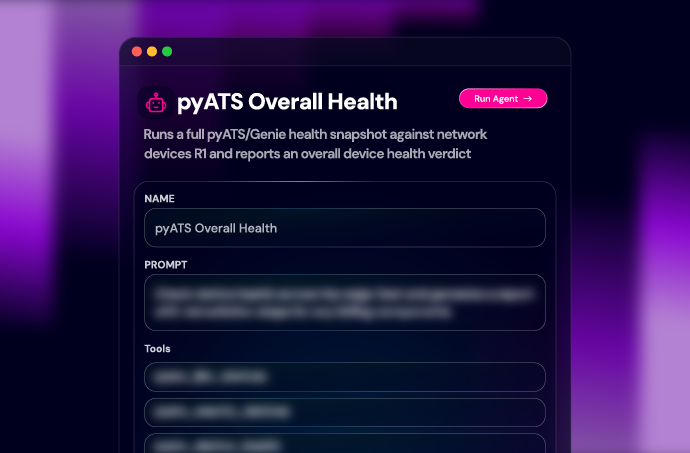
    Define agent missions, tools, and provider configuration through the same spec-driven lifecycle used for other Itential assets. Document the resulting design and tests for future changes.

The same delivery path also produces design, test, and as-built documentation. What ships should be explainable to the next engineer who touches it.

Where to Begin

Pick the Starting Point That Matches Your Work

Every delivery starts with a spec. Pick the path that matches the work in front of you.

  • Start From Scratch
    Write a requirement or choose one of the 22 example specs. spec-agent refines it into an approved customer spec, then the work moves through feasibility, design, build, test, and as-built.
  • Bring a FlowAgent into the Delivery Path
    Use flowagent-to-spec to turn exploratory agent work into a requirements spec. Then move through the same review and delivery stages as any other Itential asset.
  • Document an Existing Project
    Use project-to-spec to examine the assets in an Itential project and produce requirements and design documentation. Establish a clear baseline before the next change.
One Framework. Five Ways In.

Choose Your Coding Harness

Pick the harness your team uses. After install, copy an environment template from the repo, add your Itential Platform credentials, and run spec-agent to start your first delivery. Full setup steps are in the GitHub quickstart.

–+

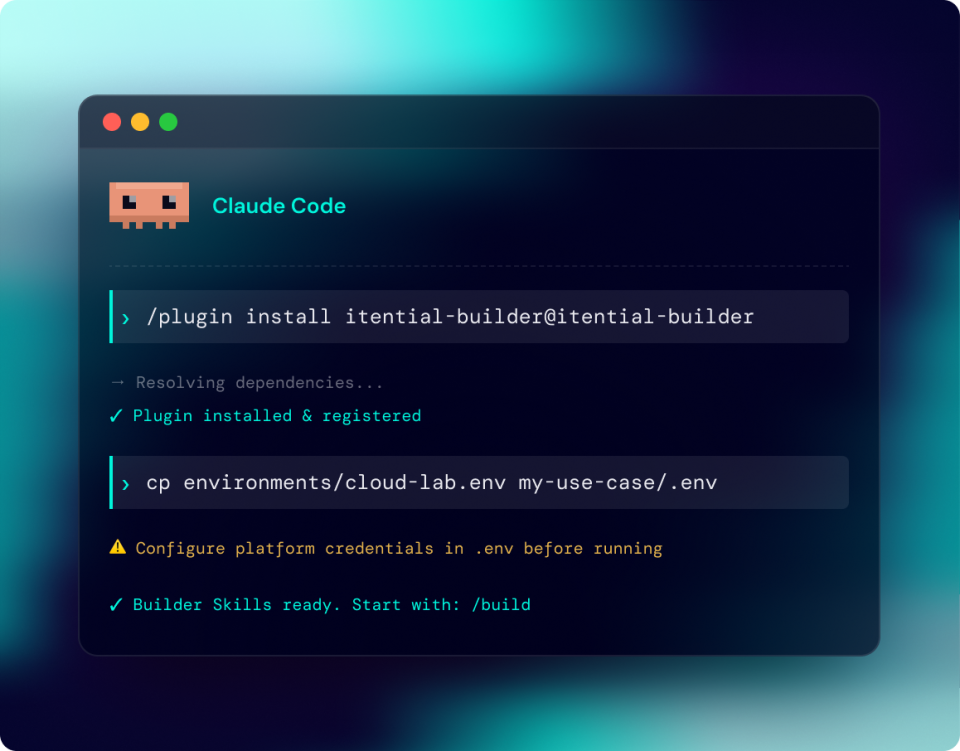
Install Builder Skills as a plugin from the Itential marketplace.

Install:

/plugin marketplace add itential/builder-skills
/plugin install itential-builder@itential-builder

Then restart Claude Code.

Check it worked: Run /plugin and confirm itential-builder is listed, or type /itential-builder: to see the skills.

Run a skill: /itential-builder:spec-agent

Update: Automatic. To update manually, run /plugin update itential-builder@itential-builder, then restart.

–+

Add the Itential marketplace and install the plugin from the Codex CLI.

Install:

codex plugin marketplace add itential/builder-skills && codex plugin add itential-builder@itential-builder

Check it worked: In Codex, type /skills.

Run a skill: $spec-agent

Update:

codex plugin marketplace upgrade itential-builder && codex plugin add itential-builder@itential-builder
–+

Install the skills with the GitHub CLI. Requires a recent version of gh.

Install:

gh skill install itential/builder-skills --agent github-copilot --all

Check it worked: copilot skill list

Run a skill: /spec-agent

Update: Run the install command again with --force.

–+

Install from source in VS Code, or open a clone of the repo.

Install: Open the Command Palette (⇧⌘P on Mac, Ctrl+Shift+P on Windows), run Chat: Install Plugin From Source, and enter itential/builder-skills. Or clone the repo and open it:

git clone https://github.com/itential/builder-skills.git && code builder-skills

Check it worked: In Copilot Chat, type /, or open Configure Skills.

Run a skill: /spec-agent

Update: Plugin installs: reinstall from source. Cloned repo: run git pull.

–+

Open a clone of the repo in Cursor, or install the skills with the GitHub CLI.

Install:

git clone https://github.com/itential/builder-skills.git && cursor builder-skills

Or:

gh skill install itential/builder-skills --agent cursor --all

Check it worked: In chat, type /.

Run a skill: /spec-agent

Update: Cloned repo: run git pull. gh skill installs: run the install command again with --force.

Walkthrough

Watch the Claude Code Install

See how to add the Itential marketplace, install the Builder Skills plugin, and activate it in Claude Code.

What Comes in the Repo

Skills, Examples, & Setup Guidance in One Place

The open-source repository includes delivery and platform skills, environment templates, example specs, implementation references, and setup documentation. The 22 example specs cover networking, operations, security, and infrastructure use cases. Adapt them to your environment, adapters, and approval process.

Who It’s For

Built for the People Who Build the Network

Builder Skills meets infrastructure teams where they work. Pick the path that fits the problem in front of you, then use your preferred coding harness to move through the same reviewable delivery process.

Chat icon with lock inside
Network & Infrastructure Engineers

Start from a spec instead of a blank file. Build automation with requirements, testing, and as-built documentation connected to the result.

Learn More
Navigation icon
Platform & Automation Leads

Give engineers a consistent delivery path across teams and coding harnesses. Standardize the artifacts and approval gates without forcing everyone into one AI tool.

Learn More
Flow structure icon
Automation Architects

Carry feasibility and design decisions through all six stages. Approved artifacts show what the solution needs to do, what the platform supports, and why the build took its final shape.

Learn More
box with organizational lines below icon
Operations & SRE Teams

Use project-to-spec to document automation already running in Itential. Give the next engineer a clear baseline for support, change, and handoff.

Learn More
Keep Learning

Dive Deeper into Spec-Driven Development

Get Started

Spec In. Governed Assets Out.

Open source and ready to run. Install Builder Skills in your coding harness, connect to Itential Platform 6, and take your first spec from requirement to as-built record.

Frequently Asked Questions

–+

An open-source set of skills and delivery guidance for building Itential Platform assets from specs, in the coding harness your team already uses. It guides requirements, feasibility, design, build, test, and as-built documentation through reviewable artifacts.

–+

The supported experiences are GitHub Copilot CLI, GitHub Copilot in VS Code, Claude Code, Cursor, and Codex. Setup and skill invocation follow each tool’s native conventions. Check the GitHub quickstart for current steps.

–+

They are two ways to use GitHub Copilot. Copilot CLI runs in a terminal; Copilot in VS Code runs in the editor’s chat experience. Both can use project skills, though setup and invocation appear in different interfaces.

–+

No. Describe the task in plain language and your coding harness selects the right skill. Native commands and skill pickers are there when you already know which skill you want.

–+

It covers workflows, Operations Manager entries, forms, command templates, Configuration Manager assets, Lifecycle Manager resources, Itential Gateway 5 services, and FlowAgents. The exact implementation depends on the approved design and the capabilities available in your environment.

–+

Itential Platform 6 is the target platform. Itential Gateway 5 is required for Gateway-specific skills.

–+

The repository includes delivery and platform skills, 22 example specs, environment templates, implementation references, and setup guidance.

–+

Builder Skills is an open-source community project, not a supported Itential product feature. There is no SLA. Use GitHub issues and discussions for feedback and contributions.

–+

Yes. The skills, stages, and artifacts are the same in every supported harness, so one engineer can work in Claude Code while another uses Copilot or Cursor, and the delivery record stays consistent.