At Lumen’s Innovation Summit in Tempe, Arizona, I led a workshop where 31 engineers ran 40 different FlowAgents against a lab network in the busiest 45-minute stretch. They checked interfaces, explored inventory, investigated configuration drift, and experimented with changes across 149 agent sessions.
FlowAI had only become generally available on July 1, 2026. For most participants, this workshop was their first hands-on experience with it. After a short tour, they were experimenting with agents inside the Itential Platform. Their network knowledge gave them a starting point, and FlowAI let them put it to work quickly. That was workshop one.
That is a memorable workshop result. What makes it interesting is the work that came before it, and what those engineers could see themselves doing next.
Lumen already has years of experience building and operating automation with Itential. The summit brought that operational foundation together with FlowAI, Itential Builder Skills, and engineers who know exactly where their teams need help. Over two days with more than 200 Lumen employees, we explored how much further that combination could take them.
Lumen operates a complex network shaped by years of acquisitions and modernization. Its teams have had to connect different systems, reconcile operational processes, and make changes consistently across network domains.
The published customer stories describe how Lumen built reusable actions and composed them into workflows, with documentation, permissions, checks, and rollback. Teams made those capabilities accessible through systems people already used, including ServiceNow. That work created an operational foundation that AI can now draw on.
Explore Lumen’s Network Automation Journey →
Think about the network tasks you repeat: collect device state, check an interface, compare a configuration, execute a change, verify the result. When those capabilities are integrated and governed, another engineer can reuse them. So can an agent, within the access and controls you define.
Lumen’s summit deployment overview put numbers behind that foundation: 1.09 million hours saved in 2025 and another 802,000 hours through July 2026 across its Itential deployment. Autopilot Enterprise was processing more than 8 million jobs per month, and the Enterprise IT platform alone connected more than 90 systems.
One example makes the value easy to understand. IP disconnect work that previously took 45 to 75 minutes was reduced to 5 minutes, including checks before and after execution and IP address reclamation. The overview attributes 48,000 hours and $666,000 saved in 2024 to that use case.
The published operational confidence story also reports a 21% reduction in construction-related customer-impacting incidents through proactive monitoring tools running on Itential. The ability to perform work repeatedly, measure it, and verify its results matters when you begin connecting AI to infrastructure.
How Lumen Built Operational Confidence with Itential →
Greg Freeman set a practical direction for the summit: focus on how to make things work. On day two, he reinforced it with another instruction: start with the need rather than your favorite solution.
Lumen teams demonstrated AI experiences for employees, field technicians, and customers. They also showed the business discipline behind the experimentation. Its combined Workflow Development & Orchestration teams reported 298,000 efficiency hours, $22.8 million in value delivered, and 234 completed projects through Q3 2026. Those are results across the combined teams’ work, giving a broader view of the program in which the Itential partnership operates.
People in the room had specific operational needs in mind. They understood the systems involved and the results they wanted. Our workshops gave them ways to turn that knowledge into something they could build and inspect.
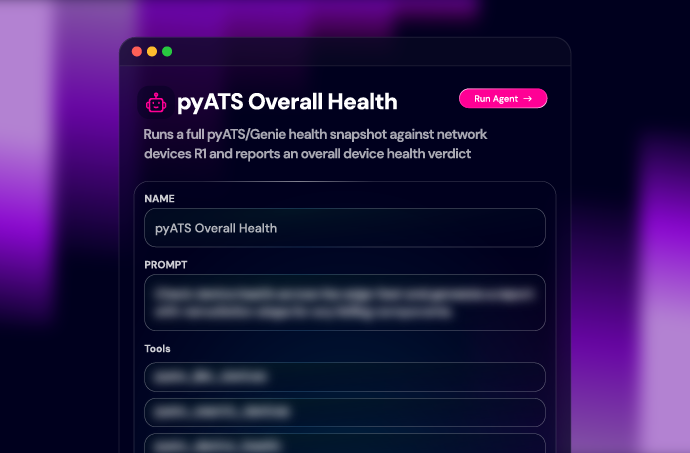
Our first workshop introduced FlowAI and a hosted Itential Cloud lab. We walked through the model registry, agent projects, sessions, and Work Center for human approvals. Read-only examples gave participants a starting point, including pyATS device snapshots, NetBox inventory snapshots, and agents that compared the results.
Across the workshop records, 33 Lumen engineers built or ran an agent. The busiest 45 minutes produced 149 sessions across 40 distinct agents. The range of work was revealing:
| Agent category | Distinct agents |
|---|---|
| Interface and device status | 13 |
| Inventory discovery and topology | 9 |
| Configuration changes | 7 |
| Drift and source of truth audits | 5 |
| Business process workflows | 2 |
| Email and notification | 2 |
| Learning and reporting | 2 |
One participant chained a collector, an auditor, and a risk analyzer into a three-agent router assessment. Another agent returned a network map and findings table. Nine engineers ran more than one agent in the window.
These are problems network engineers already understand. Their experience helped them decide what to ask, which data mattered, and what a useful answer should contain.
The session outcomes also show the experimentation involved: 127 completed, 19 failed, and 3 were canceled. A completed session still needs to be assessed against the intended task. The lab’s ACL deployment agents included checks and rollback, while a firewall assistant proposed a rule for human review. Those controls belong in the story alongside the speed of building.
The second workshop explored Itential Builder Skills and Spec-Driven Development in Claude Code and related development environments. We could work through natural language without making Python package troubleshooting, virtual environments, or repeated navigation between dashboards the focus of the session.
Karan demonstrated the structured path: requirements, feasibility, design, build, and as-built documentation. I also showed a more exploratory approach for proofs of concept and quick experiments. Both have a place. The structured process gives a team the artifacts it needs for collaboration, review, reuse, and ongoing ownership.
Then a participant asked a question I particularly liked: could we do this in reverse?
He had inherited 7 workflows after a reorganization. They varied in complexity and importance, and he needed to understand them. With the workflow-to-spec skill, he could point Claude Code at an existing workflow and get back a Markdown specification readable by both a person and an agent, even for a complex workflow.
Every engineer who has inherited an automation estate knows that problem. Before you can improve something, you have to understand what it does, which systems it touches, and what assumptions its author made.
That Markdown file gives you something concrete to read, inspect, and discuss with a copilot. You can ask questions about the workflow, work through its behavior, and prepare changes with a specification in front of you.
It also connects the new development approach directly to Lumen’s existing investment: the work already running becomes easier to understand and extend.
For the third workshop, we brought multi-agent orchestration and design principles together. Using Claude Code and Itential Builder Skills, I demonstrated creating a six-agent team for human-approved loopback provisioning in about 15 minutes.
The team had a coordinator and five specialists: a planner, an implementer, a tester, a communications agent, and a gate reviewer. Each had a defined role in the operation.
The planner read live pyATS evidence and prepared a specific loopback plan. The implementer was restricted to the frozen plan after human and decision-gate approval. The tester checked the address, interface state, connected route, and self-ping, as well as whether existing interfaces remained unchanged. The communications agent handled approval and result emails.
The example incorporated Jev decision support at defined gates, alongside an actual human approval in Work Center. It also used different models for different roles. The architecture let us discuss what each specialist needed, how decisions were reviewed, and which actions were permitted.
If you want to explore decision models further, I documented a separate lab build in Jev Told My FlowAgents to Roll Back. I Kept That in the Demo. You can also watch the walkthrough to see Jev evaluate evidence, proposed changes, and results, with runs both with and without a human approval task.
The coordinator called its specialists as tools within the platform.
That composability opens up useful possibilities: a communications agent can serve another project, and a loopback provisioning operation can become a tool another agent calls.
The network knowledge still matters throughout. You have to know what evidence to collect, what a valid plan looks like, and how to verify the change. Builder Skills gave us a way to express that expertise and turn it into assets quickly.
At the summit, Lumen’s production estate was described as 395 deterministic workflows. The summit deployment deck separately identifies approximately 120 workflows exposed as AskGreg tools. The counts describe different scopes, but both point to a substantial base of operational capabilities available to support AI experiences.
AskGreg provides a natural language interface into Lumen systems. Lumen also shared an upcoming customer-service experience built around email. A customer could request live diagnostics and receive findings about their circuit or service without an operator manually handling the exchange. Agentic reasoning and communication would connect to deterministic workflows in Itential to perform the underlying work.
The example extended to requesting failover to an alternate path by email. Before proceeding, the customer would receive information about the expected outage time and impact, along with diagnostics of the target path. Secondary customer confirmation would be required before failover.
That progression makes the connection between reasoning and execution tangible. An agent can interpret a request and communicate findings. The infrastructure action still needs the right workflow, permissions, checks, and approval path.
Karan’s mainstage presentation also explored the economics of those choices. Reasoning is useful when a task requires interpreting context or investigating an unfamiliar condition. A known, repeatable sequence can run through a deterministic workflow. A larger operation can combine both, choosing where reasoning earns its cost.
The roadmap went a step further: recurring patterns from agent sessions could inform specifications and, through Spec-Driven Development, become deterministic assets. As a task becomes better understood, the team has a path to encode what it has learned.
I joined Karan Munalingal for these two days. Greg and the Lumen teams gave us a room full of people with operational experience, questions, and ideas worth testing.
The most useful conversations connected the new capabilities to familiar work: understanding an inherited workflow, reconciling intended and actual device state, preparing a controlled change, or turning an existing operation into a service another agent could consume.
Lumen’s orchestration foundation gives those ideas somewhere to go. FlowAI gives engineers another way to apply existing capabilities. Builder Skills and Spec-Driven Development help them document, build, and extend the work.
40 agents in 45 minutes is an exciting workshop result. The larger opportunity is to put that ability in the hands of people who know the infrastructure, backed by the operational discipline Lumen has already developed.
Pick a task you know well. Define the outcome, the constraints, the evidence, and the checks. Look at what your existing workflows can already do. Then build from there.
I also need to tell you what was moving around the room. Lumen had three mobile AI concierge units, complete with cameras, microphones, speakers, and animated characters. A panda chef could help with meal questions, a raccoon with workshop questions, and an owl with everything else. The units used attendee QR codes to personalize the experience and ran locally on NVIDIA DGX Sparks.
Then there was TCB, the interactive “Taking Care of Business” lightning bolt, and an AI photo booth that could turn you into one of six characters. One of the options was me. I was not expecting to become a photo-booth option at a customer event, but here we are.
Those experiences made the event feel like a place to explore. Lumen teams were putting their own ideas on display, letting people interact with them, and showing how much fun there is in building something and seeing what people do with it.
Have a network task you want to tackle?
🤖 Explore Itential FlowAI to see how agents connect reasoning to governed infrastructure execution.
Join me in the VibeOps Forum to ask questions, share what you’re building, and work through ideas with other practitioners. Bring your network knowledge and a problem worth solving.
See how Itential connects AI reasoning to governed execution across your entire infrastructure.