...
Itential Platform Pricing Explore flexible plans and options for your team
Itential logo
Blogs

How We Evaluate & Test AI Models in the FlowAI Agent Harness

Headshot of Ankit Bhansali, Principal Architect of AI Solutions and Strategy at Itential, designing automation and orchestration solutions for complex networking challenges.
Ankit Bhansali
Principal Architect – AI Solutions & Strategy
Last updated October 9, 2026

Key Takeaways

    • FlowAI is the agent harness within the Itential Platform, connecting model reasoning to infrastructure tools and automation.
    • Bring Your Own Model support gives teams flexibility to choose compatible models through supported provider integrations. Evaluation should reflect the workflows those agents will perform.
    • Model performance includes required actions, verification, approval and rollback behavior, and accurate reporting. A polished final response alone does not establish successful execution.
    • Our initial DNS comparison across five model configurations revealed differences in verification-step adherence, notification quality, and token usage.
    • Choose models against explicit operational acceptance criteria. Repeated testing across representative scenarios is needed to assess consistency, while cost and speed require separate measurement.

“Which model should we use?” It is one of the first questions prospects and customers ask when they start exploring infrastructure agents. Answering it starts with AI agent evaluation: understanding where the model fits and what the agent needs to do.

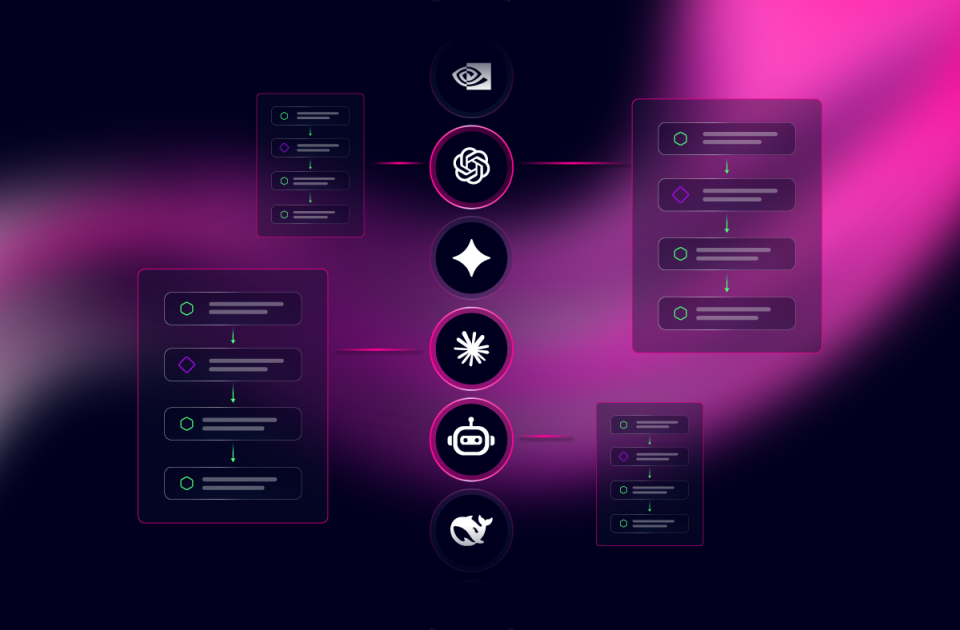
FlowAI is the agent harness within the Itential Platform. It connects model reasoning to infrastructure tools and automation, giving teams an environment to build agents, define the capabilities they can access, and inspect their execution. The model supplies reasoning; the harness provides the setting in which that reasoning becomes operational action.

FlowAI supports bringing your own model through supported provider integrations, including commercial services and locally hosted models. Teams can choose a compatible model for their requirements rather than commit their infrastructure automation to one provider. That flexibility makes AI agent evaluation essential: model choice needs evidence from the work the agent will perform.

The Evidence

The Evidence Infrastructure Teams Need

For infrastructure operations, that evidence includes the actions taken, the resulting state, and the accuracy of the final report. We need to see whether the agent followed the required process, handled human decisions, and verified what changed.

To make that assessment concrete, we compared five model configurations running the same DNS A record agent through FlowAI. One recorded run produced a usable notification while omitting a required verification step. Here is what we tested, what we observed, and how to apply those findings to model selection.

Start With the Workflow

A DNS A record change is a useful test because the expected actions are concrete. Look up the record. Validate the request. Obtain approval. Create the record. Check the resulting state. Handle the provision-results decision and any required rollback. Report the outcome.

The study evaluated the same agent flow and task across model providers. It focused on tool-call sequence adherence and the quality of the resulting email, rather than execution time. Token usage was captured for all five configurations.

The recorded sequences included a provision-results decision followed by record deletion. This comparison therefore includes the handling of the change after creation. It should not be read as evidence covering every approval, rejection, or failure branch.

What the Recorded Runs Showed

The comparison below separates workflow adherence, notification quality, and captured token usage for the recorded runs.

Model configuration Post-creation verification Notification assessment Total tokens
GPT OSS 120B Omitted Concise and functional; limited context 21,102
Gemma 4 31B Included Clear and balanced 28,735
Claude Sonnet 5.5 Included Strongest presentation in the internal assessment 48,950
Nemotron Super-3 Included Detailed and traceable; more verbose 39,993
Nemotron Ultra-3 Included Structured and traceable; more verbose 40,255

Source: internal DNS A Record Agent Model Comparison. Results describe the recorded runs. Notification assessments are qualitative. Token usage is not a cost comparison. Execution speed was not evaluated. Nemotron Ultra-3 used 37,260 input tokens and 2,995 output tokens, for a total of 40,255.

The important difference was the second GETARECORDS call. Four runs performed it after CREATEARECORD. The GPT-OSS run moved on without that lookup.

A creation response tells you what the tool returned. A subsequent lookup checks the resulting state. In this workflow, that check was an expected action. Its absence is a process-adherence issue, even when the final email is concise and usable.

This does not establish that GPT-OSS will always omit verification, or that the other models will always include it. It identifies a behavior to investigate and a requirement to test explicitly.


Read the Notification Against the Evidence

The email assessments also differed. Claude Sonnet received the highest presentation score in the internal review. Gemma produced a clear, balanced summary. The Nemotron summaries emphasized traceability, with more detail than the review considered necessary for a standard notification. GPT-OSS was concise, with less formatting and context.

Those differences matter to the operator reading the result. But presentation should have its own assessment. A well-organized email cannot establish that an omitted tool call occurred.

For a broader evaluation, compare the final message with the recorded actions. Does it distinguish creation from verification? Does it reflect the human decision? Does it describe rollback accurately? Does the reported outcome agree with the evidence? That checks factual accuracy as well as readability.

Put Token Usage in Context

The lowest captured token count was 21,102. The highest was 48,950. Resource consumption differed, but the figures need to be read alongside the execution behavior.

The run using the fewest captured tokens omitted the verification step. The run using the most captured tokens received the strongest presentation assessment. Neither observation determines which configuration offers the best value.

An actual cost comparison needs the applicable pricing and billing details. An efficiency comparison also needs elapsed time, retries, failures, and human intervention. For an operational team, the useful measure is what it takes to achieve an accepted outcome.

The Harness Belongs in the Evaluation

These results describe models operating inside a particular FlowAI agent configuration. Instructions, available tools, tool responses, and approval interactions all belong in the test record. Without that context, a model name tells you very little about how an agent will behave on your task.

The Comparison

FlowAI provides the setting for this comparison.

The same operational task, with tool calls and outcomes available for inspection. The study does not isolate FlowAI’s contribution against another harness. It shows differences between the documented model runs within FlowAI.

The missed verification step also raises an execution-design question. If a check is mandatory, where is its completion enforced? A prompt can describe the requirement. The acceptance criteria still need to establish that it happened and define what follows if it did not.

That is a practical reason to benchmark. The findings can improve the agent instructions, tool design, and enforcement of required actions, as well as inform model selection.

Define What an Acceptable Run Looks Like

The DNS comparison examined sequence adherence and email quality, with token usage captured for all five model configurations. Extending it requires explicit acceptance criteria and repeated runs. We recommend assessing the following dimensions for a customer workflow.

Dimension Evidence to inspect
Required actions Presence and ordering of mandatory steps
Verified outcome Resulting state compared with intended state
Human decisions and recovery Actions after approval, rejection, or tool failure
Communication accuracy Final summary compared with the execution record
Efficiency Actual cost, elapsed time, retries, and human intervention
Consistency Repeated runs across representative scenarios

Test approval, rejection, verification failure, and rollback as distinct scenarios. Record the exact model version and configuration. Compare each run with the expected behavior, including evidence of final state. A successful run is useful evidence; repeated testing establishes how consistently that behavior occurs.

Put Model Choice to Work With FlowAI

Choosing a model is an architectural decision. You are choosing how an agent will reason through a task, select tools, respond to unexpected results, and communicate what happened. Those decisions need to work within your infrastructure processes.

Chose Your Own Model

FlowAI gives teams a framework for putting that choice into practice.

As the agent harness within the Itential Platform, it connects model reasoning to scoped infrastructure tools and existing automation. Teams can bring a compatible model through supported provider integrations, define the agent’s capabilities, and inspect its execution within the operational process.

That combination makes model testing useful. You can evaluate how a model handles the actions and decisions your use case requires, then use the findings to refine the agent, strengthen execution controls, or assess another model configuration.

Our DNS comparison shows why that matters. A usable notification accompanied a skipped verification step in one recorded run. Inspecting the tool sequence exposed a difference that the final response alone would not establish. It also identified a concrete requirement to investigate and enforce.

Start with the infrastructure task you want the agent to perform. Define the required actions, approvals, verification, and recovery behavior. Then test the model and agent configuration against those requirements across repeated runs.

FlowAI brings model flexibility, infrastructure integration, and execution visibility into that evaluation. The goal is a model choice backed by evidence and an agent configured around the operational outcomes your team needs.

Bring your infrastructure use case to the Itential team. Let’s define what successful execution requires and put it to the test in FlowAI.

Headshot of Ankit Bhansali, Principal Architect of AI Solutions and Strategy at Itential, designing automation and orchestration solutions for complex networking challenges.
Ankit Bhansali is a Principal Architect – AI Solutions & Strategy at Itential. Drawing on a strong research background in software and networking, he designs innovative solutions to address the industry’s most complex challenges. His strategic approach empowers businesses to achieve transformative growth through robust automation and end to end orchestration.
Keep Learning

The Latest in Agentic Operations

Frequently Asked Questions

–+

There was no single overall score. Four recorded runs included the expected post-creation verification call. Claude Sonnet received the strongest email presentation assessment. Token usage differed, and the study did not evaluate execution speed or actual cost. Choosing a model requires deciding which outcomes matter for the use case.

–+

It compared tool-call sequence adherence and the quality of the final email for the same DNS A record agent in FlowAI. It also captured input and output token usage for all five configurations. The workflow included approval, creation, post-creation verification, and rejection or rollback handling.

–+

A creation response reports what the creation tool returned. A subsequent lookup checks the resulting state. In this workflow, that lookup was a required step. Omitting it reduced the evidence available to establish that the record had been created as intended.

–+

The documented run does not support that conclusion. It shows an omission in this configuration on this task. The next step is to investigate the cause, strengthen the relevant instructions or execution controls, and repeat the test. Suitability needs evidence from the intended workload.

–+

This study does not establish that guarantee. The omitted verification call illustrates why teams should define how required actions are enforced and how missing evidence affects the outcome. An instruction to perform a check and evidence that the check occurred are separate things.

–+

Token usage is one input to cost. The applicable model pricing, billing rules, retries, and any human intervention also matter. This comparison captured usage rather than actual cost, so its token figures should not be presented as a cost ranking.

–+

They identify behaviors worth testing, but they do not establish performance across other tasks. Different instructions, tools, infrastructure states, and failure scenarios can change the result. Evaluate a representative workflow and test it repeatedly before drawing broader conclusions.

–+

Start with explicit acceptance criteria for required actions, final state, approvals, recovery, and communication accuracy. Record the model version and agent configuration. Run representative success and failure scenarios, then compare consistency, cost, and elapsed time alongside the operational outcomes.

Get Started

Agentic infrastructure operations starts here.

See how Itential connects AI reasoning to governed execution across your entire infrastructure.