...
Itential Platform Pricing Explore flexible plans and options for your team

Itential logo
Blog

Bring Your Own Model: Why FlowAI Lets You Control Your Own AI Destiny

Headshot of Joksan Flores, Principal Solutions Engineer at Itential, advancing infrastructure automation through AI-driven orchestration with 10+ years of networking architecture experience at Cisco.
Joksan Flores
Principal Solutions Engineer

Key Takeaways

    • Bring your own model means building your automation logic once and choosing – or changing – where the intelligence comes from, without rebuilding a single agent.
    • Commercial frontier models remain the highest-reliability default, and are almost always the right place to start an agentic automation journey.
    • The three drivers behind BYOM are controlling your own destiny, tokenomics, and data privacy and residency.
    • Across roughly 520 agent sessions over about six weeks of internal field testing, several open-weight models completed real agentic tool-calling workflows successfully.
    • NVIDIA’s Nemotron performed especially well at around 92% completion, and the 550B variant is my default recommendation for on-prem.
    • Models without strong tool-calling support specifically struggled with the human-in-the-loop steps in agentic workflows.

Every few weeks, I have the same conversation. I’m sitting across from an architect at an energy utility, or a platform lead at a bank, or an engineering director at a service provider, and we’re talking about agentic automation. They’re excited about what agents can do. And then the questions start.

“What model is this running on?”

“Where does our data go when the agent thinks?”

“What happens to our costs when we scale this to thousands of sessions a day?”

“Are we locked into whatever one vendor decides to do with their model next year?”

These aren’t skeptics trying to poke holes. These are smart people in regulated, infrastructure-heavy industries doing exactly what they should be doing – thinking about control, cost, and compliance before they commit.

And the answer I get to give them with FlowAI is one I actually enjoy giving: You choose. Bring your own model.

Commercial Models Are Excellent. Full Stop.

Let me be clear about something up front, because I don’t want this to read as “commercial bad, open-weight good.” That’s not the story.

The commercial frontier models – Anthropic’s Claude, OpenAI’s GPT family, Google’s Gemini – are outstanding. They’re reliable, they’re well-supported, and for most customers starting an agentic automation journey, they’re the safe, proven default. When someone asks me “what should we run this on,” a commercial API is almost always where I tell them to start. I have zero reservations about that.

So bring your own model isn’t about replacing those models. It’s about optionality. It’s about not having to re-architect your entire platform the day your cost, latency, compliance, or data-residency needs change.

Why “Bring Your Own Model” Actually Matters

The three themes I hear over and over map almost perfectly to why bring your own model exists.

  • Controlling your own destiny.
    Nobody in a regulated industry wants to be fully dependent on a single vendor’s model roadmap or hosting decisions. What if pricing changes? What if a model gets deprecated? What if a hosting region doesn’t meet their requirements? BYOM means the automation logic you build is yours, and the intelligence powering it is a decision you get to keep making.
  • Tokenomics.
    Agentic workflows are hungry. An agent that reasons, calls tools, checks results, and loops can burn a lot of tokens, and at scale those commercial API bills add up fast. For some workloads, running an open-weight model – one whose trained parameters are published, so you can download and run it on hardware you control – on infrastructure you already own changes the cost equation entirely.
  • Data privacy and residency.
    This is the big one for highly regulated industries like utilities and financial services. Sending prompts and context – which may contain sensitive operational or regulated data – to a third-party cloud API is a hard conversation with a lot of security and compliance teams. Being able to keep that data on-premise isn’t a nice-to-have. Sometimes it’s the only way.

Open-Weight Models Are Catching Up & No Longer a Compromise

Here’s the part that surprises people. Running open-weight models on-prem used to feel like settling for less. That’s changing fast.

I’ve been doing informal testing on our own Itential FlowAI platform and I want to be honest that this is field testing on an internal demo environment, not a formal benchmark study. But the results were striking enough that I keep bringing them up. Across about 520 agent sessions over roughly six weeks, several open-weight models completed real agentic tool-calling workflows successfully.

NVIDIA’s Nemotron stood out, performing especially well at around 92% completion. Of everything I’ve tested, the 550B Nemotron variant is the one I’d point to first. It’s quickly becoming my default recommendation when someone asks what to actually run on-prem.

I don’t want to overstate that; it’s field testing, not a controlled benchmark, and I’ll keep an open mind as more models come through. But it’s earned that spot.

What completed real agentic workflows in field testing:

Model Result
Nemotron (NVIDIA) Standout performer at around 92% completion; the 550B variant is my first recommendation for on-prem
Qwen (multiple variants) Held their own
gpt-oss-120b (OpenAI, open-weight) Completed real workflows
DeepSeek Completed real workflows
Kimi (Moonshot) Completed real workflows
1-billion-parameter model in Ollama Handled basic tool use locally, at edge scale

That last one tells you something about how far edge-scale models have come.

Now the honest caveats, because they matter. Not every open-weight model was reliable. And models without strong tool-calling support specifically struggled with the human-in-the-loop steps – the points where an agent pauses for a person to review or approve – in agentic workflows.

So the fair framing is this: commercial models are still the highest-reliability default. But a meaningful and growing subset of open-weight models are production-viable today for the right use case, and the gap is closing quickly. That’s a both/and story, and it’s a genuinely good one.

The Architecture Is What Makes This Real

Optionality is easy to say and hard to deliver. What makes bring your own model practical in FlowAI rather than theoretical is the plumbing underneath it.

A model-agnostic agent harness.

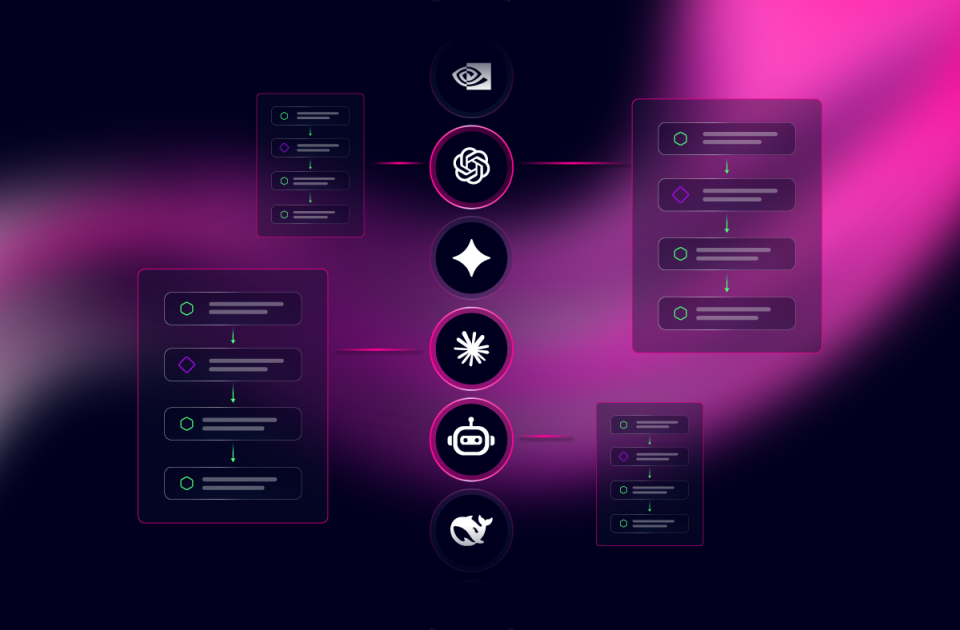
This is the foundation. Switching models is a configuration change, not a re-engineering effort. You build your agents once. The model is a setting, not a rewrite.

A model registry with broad provider support.

FlowAI’s registry supports OpenAI-compatible APIs with customizable endpoints, plus Anthropic, Google, AWS Bedrock, Ollama, and Mistral – with more providers on the way. Also, anything else that speaks an OpenAI-compatible API, you can point at it.

IG5 proxied LLM integration.

This is the piece that makes the data-residency conversation click for regulated customers. Itential Gateway 5 already maintains a secure TLS connection to Itential Cloud. That existing connection can be reused to proxy LLM API calls so they originate on-premise.

In practice, that decouples where the model lives from the communication path. Your model cluster – say, an NVIDIA NIM cluster – can run on-prem or in your own cloud. Or you can point at Microsoft Foundry, Anthropic, a GPT cloud endpoint, OpenRouter, whatever fits. The transport doesn’t care where the model actually lives.

That decoupling is the quiet superpower here. The model host and the communication path are two separate decisions, and you get to make each one on your own terms.

Run Once, Choose Where the Intelligence Comes From

When I bring all of this back to that architect at the utility, or the platform lead at the bank, the message lands like this: build your automation logic once, and choose – or change – where the intelligence comes from.

Start on a commercial cloud API because it’s the proven default. Move a sensitive workload to an on-prem GPU cluster when compliance requires it. Run a small local model at the edge where latency and cost matter most. Go hybrid and mix all three. And do all of that as your needs evolve, without rebuilding a single agent.

That’s what controlling your own destiny actually looks like. Not a bet against commercial models, and not a leap of faith on open-weight ones – just the freedom to put the right model behind the right workflow, today and whenever things change.

And for the industries I spend my days with, that freedom isn’t a luxury. It’s the thing that lets them say yes.

If you’d rather me show you than just tell you, watch this live demo I’m hosting with John Capobianco.

Headshot of Joksan Flores, Principal Solutions Engineer at Itential, advancing infrastructure automation through AI-driven orchestration with 10+ years of networking architecture experience at Cisco.
Joksan Flores is a Principal Solutions Engineer at Itential. Joksan’s passion for putting both systems and software together led him to spend 10 years as a Networking Architect at Cisco prior to Itential. Throughout his career, Joksan has supported enterprises and service providers with massive customer bases to solve their IT challenges, designing cloud peering connectivity, WAN, and data center networks. While helping organizations solve complex network challenges, Joksan has always found ways to leverage automation – either by devising methods to make work more streamlined or by helping customers achieve their project goals faster. Today at Itential, Joksan focuses on advancing infrastructure automation through AI-driven orchestration, helping organizations navigate the journey from experimental AI assistants to autonomous operations.
Keep Learning

The Latest in Agentic Operations

Frequently Asked Questions

+

It means the automation logic you build is yours, and the intelligence powering it is a decision you get to keep making. FlowAI uses a model-agnostic agent harness, so switching models is a configuration change rather than a re-engineering effort. You build your agents once and the model becomes a setting, not a rewrite.

+

Start with a commercial API. The commercial frontier models are reliable, well-supported, and the safe, proven default for most customers beginning an agentic automation journey. Bring your own model isn’t about replacing them – it’s about not having to re-architect your platform the day your cost, latency, compliance, or data-residency needs change.

+

A meaningful and growing subset of them are production-viable today for the right use case. But not every open-weight model tested was reliable, and models without strong tool-calling support specifically struggled with the human-in-the-loop steps in agentic workflows. Commercial models remain the highest-reliability default.

+

In my field testing, NVIDIA’s Nemotron stood out at around 92% completion, and the 550B variant is the one I’d point to first – it’s become my default recommendation for on-prem. That’s field testing on an internal demo environment, though, not a controlled benchmark.

+

Through IG5 proxied LLM integration. Itential Gateway 5 already maintains a secure TLS connection to Itential Cloud, and that existing connection can be reused to proxy LLM API calls so they originate on-premise. This decouples where the model lives from the communication path – your model cluster can run on-prem or in your own cloud, and the transport doesn’t care where the model actually lives.

Get Started

Agentic infrastructure operations starts here.

See how Itential connects AI reasoning to governed execution across your entire infrastructure.