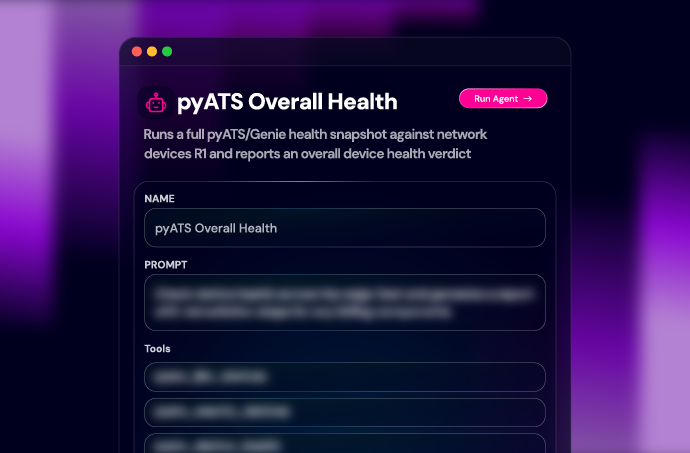
Enterprise AI adoption is entering a new phase, and the change is subtle but significant.
For years, the primary value of AI in infrastructure and operations came from insight. Better visibility. Faster correlation. More accurate recommendations. These capabilities helped teams understand systems that were growing more complex by the day.
But insight was only the beginning.
According to independent analysis from 451 Research, part of S&P Global Market Intelligence, enterprises are now transitioning from AI experimentation to AI implementation. As AI systems evolve from generating insight to initiating action, a new challenge emerges: how to allow AI to act in production environments without undermining the controls that keep those environments stable, secure, and compliant.
This is where many AI strategies start to strain.
Agentic AI Changes the Operational Equation
Agentic AI fundamentally alters how decisions are made in infrastructure operations.
Traditional automation assumes that decisions are static and predefined. A workflow is triggered, tasks execute in sequence, and outcomes are predictable. This model works well when conditions are known and change is deliberate.
Agentic systems behave differently. They reason over context. They adapt to changing conditions. They evaluate multiple potential actions and select the most appropriate response based on intent, risk, and outcome.
That shift introduces powerful new capabilities, but it also changes the risk profile of operations. When AI systems can decide and act, governance can no longer be layered on after the fact. It must be part of the decision-making process itself.
451 Research underscores this point by highlighting the risk enterprises face when AI-generated actions are not routed through enterprise-grade workflows, validations, and approvals before execution.
In short, as AI becomes more capable, governance becomes more critical.
Why Existing Controls Fall Short
Many organizations assume their existing change management processes will naturally extend to AI-driven operations. In practice, those controls were designed for a world where humans made decisions and systems executed them.
Agentic AI introduces ambiguity into that model.
Decisions are probabilistic rather than deterministic. Context shifts continuously. Actions may be initiated without a clear human trigger. Without a control layer designed for this behavior, organizations are forced into uncomfortable trade-offs.
Either AI adoption slows to preserve oversight, or autonomy emerges through disconnected tools and scripts that bypass governance entirely. Neither outcome supports sustainable operations at scale.
Governance Enables, Rather Than Limits, Autonomy
One of the most common misconceptions I encounter is that governance and autonomy are in tension with one another. In reality, governance is what enables autonomy to scale.
Governance defines the boundaries within which AI can operate. It determines which actions are permitted, under what conditions, and with what level of oversight. When these boundaries are clear and enforced consistently, AI systems can act faster and more confidently.
Independent analyst research reinforces this view. In its assessment of Itential FlowAI, 451 Research notes that enterprise-grade control and governance are what position organizations to move from AI innovation to production readiness without compromising security or compliance requirements.
Governance does not slow AI down. It creates the trust required to let it operate.
Orchestration as the Control Layer for Agentic Operations
To govern agentic AI effectively, governance must be embedded directly into the path from decision to execution. It cannot sit outside the system or rely on manual intervention after the fact.
This is where orchestration becomes the control layer.
Orchestration connects AI reasoning to infrastructure execution through structured workflows, validations, and approvals. AI-generated intent is translated into actionable requests that follow the same operational discipline as human-driven change.
451 Research describes this approach as essential to closing the gap between AI-generated insight and actionable infrastructure change, ensuring that AI-driven actions remain visible, auditable, and compliant. This model allows AI to participate in operations without bypassing them.
Why the Timing Matters Now
The urgency behind this shift is driven by convergence.
AI agents and large language models are becoming operationally capable. Infrastructure vendors are exposing telemetry and command interfaces through standards like Model Context Protocol. AIOps platforms are moving beyond detection toward remediation.
At the same time, regulatory scrutiny, compliance requirements, and operational complexity continue to intensify.
451 Research highlights that these forces are converging as enterprises move from experimentation to implementation, creating immediate demand for orchestration layers capable of managing AI-driven automation workflows at scale.
Autonomy is entering operations whether organizations plan for it or not. The differentiator will be whether that autonomy is governed intentionally or allowed to emerge organically.
From Guardrails to Strategic Advantage
Organizations that view governance as a constraint will struggle to keep pace with the speed AI enables. Those that view governance as an architectural capability will unlock durable advantage.
When governance is embedded into agentic operations, AI-driven actions become predictable rather than opaque. Risk is managed proactively rather than reactively. Compliance is enforced by design rather than documentation.
Most importantly, autonomy becomes scalable.
This is the difference between experimenting with AI and operationalizing it.
A Practical Path Forward
Agentic AI is not a future concept. It is already influencing how infrastructure decisions are made and executed. The question enterprises face is not whether AI will act, but whether they are prepared to govern that action.
Independent analysis from 451 Research makes it clear that governance is the missing layer enabling this next phase of AI adoption. Orchestration provides the structure that allows agentic AI to operate safely, responsibly, and at enterprise scale.
For organizations serious about moving AI into production operations, governance is not the finish line. It is the starting point.
Karan Munalingal is the SVP of AI Strategy & Innovation at Itential. Previously, Karan ran systems engineering at Ciena, focusing on carrier ethernet and core switching platforms. At Itential, Karan drives AI strategy enabling global customers to adopt AI-driven automation journeys that modernize and scale network and infrastructure operations.
To provide the best experiences, we use technologies like cookies to store and/or access device information. Consenting to these technologies will allow us to process data such as browsing behavior or unique IDs on this site. Not consenting or withdrawing consent, may adversely affect certain features and functions.
Functional
Always active
The technical storage or access is strictly necessary for the legitimate purpose of enabling the use of a specific service explicitly requested by the subscriber or user, or for the sole purpose of carrying out the transmission of a communication over an electronic communications network.
Preferences
The technical storage or access is necessary for the legitimate purpose of storing preferences that are not requested by the subscriber or user.
Statistics
The technical storage or access that is used exclusively for statistical purposes.The technical storage or access that is used exclusively for anonymous statistical purposes. Without a subpoena, voluntary compliance on the part of your Internet Service Provider, or additional records from a third party, information stored or retrieved for this purpose alone cannot usually be used to identify you.
Marketing
The technical storage or access is required to create user profiles to send advertising, or to track the user on a website or across several websites for similar marketing purposes.
To provide the best experiences, we use technologies like cookies to record, process, and analyze browsing behavior and other data. Not consenting or withdrawing consent, may adversely affect certain features and functions.
Functional
Always active
The technical storage or access is strictly necessary for the legitimate purpose of enabling the use of a specific service explicitly requested by the subscriber or user, or for the sole purpose of carrying out the transmission of a communication over an electronic communications network.
Preferences
The technical storage or access is necessary for the legitimate purpose of storing preferences that are not requested by the subscriber or user.
Statistics
The technical storage or access that is used exclusively for statistical purposes.The technical storage or access that is used exclusively for anonymous statistical purposes. Without a subpoena, voluntary compliance on the part of your Internet Service Provider, or additional records from a third party, information stored or retrieved for this purpose alone cannot usually be used to identify you.
Marketing
The technical storage or access is required to create user profiles to send advertising, or to track the user on a website or across several websites for similar marketing purposes.


 Build Build agents & workflows visually, with AI, or bring your own.
 Integrate Connect every system, tool, agent, & AI in your stack.
 Execute Execution for agentic & deterministic operations.
 Secure & Govern Govern every action with built-in RBAC, audit & approval gates.
 Operate Self-service operations & real-time visibility.








 Agentic Operations Connect AI to infrastructure for trusted, automated actions.
 Infrastructure Modernization Transform legacy networks into modern, AI-ready infrastructure.
 Infrastructure as a Product Deliver network and infrastructure services on demand - self service, governed, & consumed like cloud.
 Hybrid & Multi-Cloud Orchestration Unify hybrid & multi-cloud infrastructure through agentic orchestration.
 Unified Change Management Unify network & infrastructure changes across every team, tool, & domain.