Itential logo
2026 Infrastructure & Network Automation Tools Landscape

Itential Network Automation & Orchestration Platform

Itential addresses the orchestration gap between individual automation tools and comprehensive business workflow automation – complementing rather than replacing existing investments in Ansible, Terraform, and vendor platforms.

Why This Research Matters

Individual automation tools excel at specific tasks but struggle with the complex, multi-step workflows that characterize real-world network operations. Ansible automates configuration management. Terraform handles infrastructure provisioning. Vendor platforms manage their ecosystems. But connecting these tools, adding business logic, and maintaining workflows across multi-vendor environments creates an “orchestration gap” that causes 82% of network automation initiatives to fail or achieve only partial success.

This analysis examines Itential’s purpose-built network automation and orchestration platform – not as a replacement for existing tools, but as the orchestration layer that addresses the research-identified challenges causing automation failure. We synthesize technical architecture, documented customer outcomes, and comparative analysis to explain how orchestration platforms complement rather than compete with configuration management tools, IaC platforms, and vendor management systems.

What You’ll Find

  • Platform Architecture – Core components (Itential Platform, Automation Gateway, Configuration Manager, Lifecycle Manager, Operations Manager, Template Builder) and how they work together
  • Integration Ecosystem – 400+ pre-built adapters spanning network vendors, cloud platforms, and enterprise systems
  • Research-Based Solutions – How Itential addresses the specific challenges (integration difficulties, network complexity, legacy infrastructure, tool complexity) that research identifies as primary automation obstacles
  • Technical Differentiation – Why network-specific intelligence matters and what generic workflow platforms cannot replicate
  • Strategic Positioning – How orchestration complements existing tool investments rather than replacing them

Who Should Read This

  • Network automation teams evaluating orchestration platform requirements
  • IT architects designing multi-vendor automation strategies
  • Engineering leaders assessing total cost of ownership for automation infrastructure
  • Operations managers seeking to improve automation success rates beyond the industry 18% average

The research is clear: automation success requires coordinating multiple tools within business workflows that span approvals, compliance, and validation. This analysis explains how purpose-built orchestration addresses this requirement.

The Problem:Why 82% of Automation Initiatives Fail

Research-Identified Challenges & Itential Solutions

Challenge Industry Impact Itential’s Approach Research Source
Integration Difficulties 25% cite as biggest challenge Native connectivity to 400+ systems, API-first architecture McGillicuddy, 2025
Network Complexity/Standards 24.9% point to complexity issues Abstraction layer, multi-vendor normalization McGillicuddy, 2025
Legacy Infrastructure 24.3% struggle with API inconsistencies Pre-built adapters, validated integrations McGillicuddy, 2025
Tool Complexity 23.7% find automation difficult to use Low-code visual workflow builder McGillicuddy, 2025
Day-2 Operations Gap Tools excel at provisioning, fail at operations Business workflow automation, compliance integration Multiple sources

Source: McGillicuddy, S. (2025). Network automation challenges are dampening success rates. Network World.

Platform Architecture:Core Components & Capabilities

Itential Platform Architecture

The Itential platform comprises multiple integrated components addressing different aspects of network automation orchestration:

Core Platform Components

Workflow Studio

  • Low-code visual designer for creating multi-step automation workflows
  • Drag-and-drop interface eliminates complex scripting
  • Pre-built templates accelerate deployment
  • Version control and testing capabilities

Operations Manager

  • Job execution engine with triggers, scheduling, and monitoring
  • Real-time workflow status and performance metrics
  • Automated error handling and recovery
  • Comprehensive logging and audit trails

Lifecycle Manager

  • Resource and state management across workflow executions
  • Tracks network resource lifecycle from provisioning to decommission
  • Historical state tracking for compliance and troubleshooting
  • Dependency mapping across resources

Configuration Manager

  • Configuration compliance, golden configs, and policy enforcement
  • Automated drift detection and remediation
  • Multi-vendor configuration templates
  • Change validation and rollback capabilities

Template Builder

  • Jinja2 template engine for dynamic configuration rendering
  • Variable management and testing frameworks
  • Template versioning and sharing
  • Support for vendor-specific and abstracted templates

Gateway Manager

  • Automation Gateway (IAG) orchestration for distributed service execution
  • Centralized management of distributed automation resources
  • Service group organization and clustering
  • Performance monitoring and optimization

Technical Foundation

API-First Design

  • RESTful APIs and GraphQL for seamless integration
  • Programmatic access to all platform capabilities
  • Webhook support for event-driven automation
  • OpenAPI documentation

Flexible Deployment

  • SaaS and On-Premises deployment models
  • Hybrid deployment support
  • Multi-region capabilities
  • High-availability architecture

Multi-Tenancy

  • Isolated environments for different organizational units
  • Separate customer or project workspaces
  • Granular resource allocation
  • Independent scaling per tenant

Role-Based Access Control

  • Granular permissions for users, projects, and workflows
  • Integration with enterprise identity systems (SAML, OAuth, LDAP)
  • Audit logging for compliance
  • Self-service with controlled access

Source: Itential Documentation Portal (https://docs.itential.com)

Itential Gateway: Distributed Service Architecture

The Itential Gateway extends platform capabilities to distributed environments and provides native execution engines for automation tools.

Gateway Core Functions

Service Execution

  • Native Ansible execution with inventory management
  • Python script execution with pre-installed network automation libraries
  • OpenTofu/Terraform execution with state management
  • Custom service framework for additional tools

Device Inventory Management

  • Automated discovery of network devices
  • Dynamic inventory updates from multiple sources
  • Device grouping and tagging
  • Integration with CMDB and IPAM systems

Gateway Clustering

  • High-availability configurations for resilient service delivery
  • Load balancing across gateway instances
  • Automatic failover capabilities
  • Geographic distribution support

Service Groups

  • Logical organization of automation services by domain or function
  • Service-level isolation and security
  • Performance and capacity management
  • Version control for services

Dependency Management

  • Package repositories for Ansible collections and Python libraries
  • External library integration
  • Version pinning and compatibility management
  • Automated dependency resolution

Supported Service Types

Ansible Services

  • Native Ansible execution environment
  • Inventory management and collection support
  • Vault integration for secrets management
  • Callback plugin support for monitoring

Python Services

  • Custom Python script execution
  • Pre-installed network automation libraries (Netmiko, NAPALM, Nornir)
  • Virtual environment management
  • Package installation and updates

OpenTofu/Terraform Services

  • Infrastructure-as-code automation
  • State management and locking
  • Provider plugin management
  • Plan and apply orchestration

Custom Services

  • Extensible framework for additional automation tools
  • REST API wrapper capabilities
  • Script execution (Bash, PowerShell)
  • Integration with proprietary tools

Source: Itential Documentation Portal (https://docs.itential.com)

Integration Ecosystem: 400+ Pre-Built Adapters

Itential provides native connectivity to network infrastructure, cloud platforms, and enterprise systems through pre-built, commercially supported adapters that eliminate custom integration development.

Network Vendor Platforms

Cisco Ecosystem

  • Catalyst Center (DNA Center): Campus and branch automation
  • Nexus Dashboard: Data center fabric management
  • Meraki Dashboard: Cloud-managed networking
  • ACI: Application-centric infrastructure
  • ISE: Identity services and network access control
  • ASA, Firepower: Security platforms
  • IOS-XE, NX-OS: Direct device automation

Arista Networks

  • CloudVision: Network-wide workload orchestration
  • EOS devices: Direct automation via eAPI and NETCONF
  • Zero Touch Provisioning integration
  • Streaming telemetry support

Juniper Networks

  • Mist: AI-driven cloud networking
  • Junos devices: NETCONF and PyEZ integration
  • Contrail networking
  • Space Network Management Platform

Security Vendors

  • Palo Alto Networks: Panorama, PA-Series firewalls via XML API
  • Fortinet: FortiManager, FortiGate devices via REST API
  • Check Point: Smart-1, Management Server via API
  • Cisco Firepower: FMC integration

Application Delivery

  • F5 Networks: BIG-IQ, BIG-IP devices via iControl REST
  • NGINX: Controller and Plus
  • Citrix: ADC (NetScaler)

Cloud & Virtualization

Public Cloud

  • AWS: EC2, VPC, CloudFormation, Lambda, CloudWatch, Route 53
  • Azure: Virtual Networks, Resource Manager, Azure Functions, Load Balancers
  • Google Cloud: Compute Engine, VPC, Cloud Functions, Cloud Load Balancing
  • Oracle Cloud: Compute, Networking, Infrastructure

Private Cloud & Virtualization

  • VMware: vCenter, NSX-T, Aria Automation (vRealize), Cloud Foundation
  • Red Hat: OpenShift, Ansible Automation Platform (AAP), OpenStack
  • Nutanix: Prism Central, AHV
  • OpenStack: Neutron, Nova, Keystone

Enterprise IT Systems

IT Service Management

  • ServiceNow: Complete ITSM integration including incident, change, request
  • BMC Remedy: Service management and CMDB
  • Jira Service Management: Agile service delivery
  • Atlassian: suite integration

IP Address Management

  • Infoblox: DDI platform integration
  • BlueCat: IPAM and DNS automation
  • phpIPAM: Open-source IPAM
  • NetBox: DCIM and IPAM

Monitoring & Observability

  • SolarWinds: Network performance monitoring
  • PRTG: Infrastructure monitoring
  • Nagios: Enterprise monitoring
  • Prometheus & Grafana: Metrics and visualization
  • Splunk: Log analytics

Configuration Management Database

  • ServiceNow CMDB: Configuration management
  • Device42: Data center infrastructure management
  • FreshService: IT asset management
  • Insight: Asset discovery and tracking

Automation & Development Tools

Configuration Management

  • Ansible: Native execution via IAG)
  • Puppet: Configuration enforcement
  • Chef: Infrastructure automation
  • SaltStack: Event-driven automation

Infrastructure-as-Code

  • Terraform / OpenTofu: native execution via IAG
  • AWS CloudFormation
  • Azure Resource Manager
  • Pulumi: Multi-cloud IaC

Version Control & CI/CD

  • GitHub: Repository management and Actions
  • GitLab: Complete DevOps platform
  • Bitbucket: Atlassian integration
  • Azure DevOps: Microsoft ecosystem
  • Jenkins: Automation server

Scripting & APIs

  • Python: native execution via IAG
  • PowerShell: Windows automation
  • Bash: Unix/Linux scripting
  • Custom REST APIs: Universal connectivity

Source: Itential product documentation and website

The Orchestration Gap:Traditional vs. Platform Approach

The 18% Success Rate Problem

Research reveals that only 18% of network automation initiatives achieve complete success. The root cause isn’t the quality of individual tools, it’s the complexity of connecting them into cohesive business workflows.

Source: McGillicuddy, S. (2025). Network automation challenges are dampening success rates. Network World.

Traditional Multi-Tool Approach: The Challenge

Common Setup

Organizations typically deploy automation tools independently:

  • Ansible for configuration management
  • Terraform for infrastructure provisioning
  • Vendor platforms (Catalyst Center, CloudVision, Panorama) for their ecosystems
  • Monitoring tools for network visibility
  • ServiceNow for change management and ITSM

The Integration Problem

Real-World Pain Points

Example: Simple Firewall Change Request

Without orchestration, a routine firewall rule addition requires:

  1. Manual ticket creation in ServiceNow with change details
  2. Manual approval routing through email or ServiceNow comments
  3. Context switching to Panorama console after approval
  4. Manual firewall configuration or running standalone Ansible playbook
  5. Separate monitoring check in SolarWinds or similar tool
  6. Manual validation that change worked correctly
  7. Return to ServiceNow to update ticket status
  8. No automated rollback if issues detected

Business Impact:

  • Days to weeks to complete routine changes
  • High error rate from manual handoffs between systems
  • Limited adoption – only experts can navigate the complexity
  • No self-service – business units cannot request changes directly
  • Poor visibility – no unified view of automation state
  • Compliance gaps – manual audit trails incomplete

Orchestration Platform Approach: The Solution

Unified Architecture

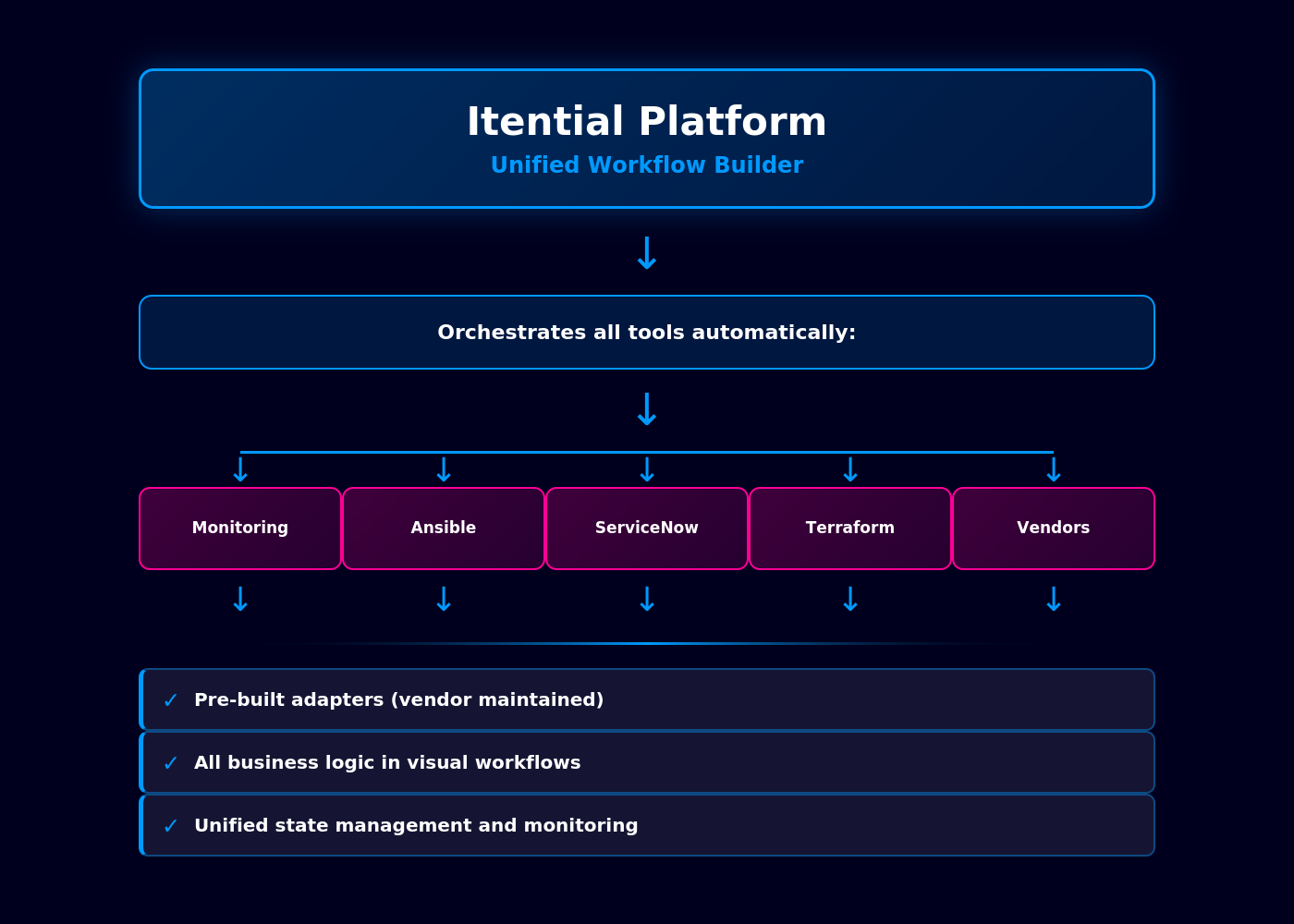
Itential provides a single orchestration layer that coordinates all existing tools through pre-built integrations and visual workflows.

Same Workflow, Automated

Example: Orchestrated Firewall Change

With Itential orchestration, the same firewall change becomes fully automated:

  1. Automated intake: Self-service portal or ServiceNow integration captures request

  2. Intelligent routing: Workflow automatically determines approval path based on:
    • Change type and risk level
    • Affected systems and security zones
    • Organizational policies
    • Historical success patterns

  3. Pre-change validation: Automated checks before execution:
    • Configuration backup
    • Current state capture
    • Compliance verification
    • Impact analysis across affected systems
    • Prerequisites validation (IPAM, routing, ACLs)

  4. Orchestrated execution: Single workflow coordinates:
    • Panorama firewall rule creation via API
    • F5 load balancer updates via iControl
    • Network device updates via Ansible
    • IPAM record updates in Infoblox
    • Monitoring system configuration for new flows

  5. Continuous validation: Real-time checks during deployment:
    • Configuration syntax validation
    • Policy compliance verification
    • Connectivity testing from monitoring systems
    • Traffic flow validation
    • Security posture verification

  6. Automated rollback: If any validation fails:
    • Automatic reversion to backup configuration
    • Coordinated rollback across all affected systems
    • Incident creation for investigation
    • Notification to stakeholders

  7. Complete documentation: Automatic audit trail:
    • ServiceNow ticket updated with full details
    • Configuration changes documented
    • Test results recorded
    • Compliance evidence captured
    • Post-change validation results

Business Impact:

  • Minutes instead of days for routine changes
  • Self-service capabilities for business users with guardrails
  • Complete visibility across all automation activities
  • Predictable outcomes with automated testing and validation
  • Reduced risk through comprehensive rollback capabilities

Visual Comparison: Workflow Complexity

Why Network-Specific Orchestration Matters

The Generic Workflow Platform Gap

Many organizations consider using generic workflow automation platforms (ServiceNow Workflow Orchestrator, BMC Helix, Camunda, enterprise RPA tools) for network automation. While these excel at IT service management workflows, they face fundamental limitations for network automation.

Capability Comparison

Requirement Generic Workflow Platform Purpose-Built Network Orchestration
Network Vendor Integrations Custom development for each vendor 400+ pre-built, vendor-maintained adapters
Network Protocol Support Generic HTTP/REST calls only Native NETCONF, RESTCONF, gRPC, SSH, SNMP support
Multi-Vendor Data Normalization Manual transformation scripts per vendor Automatic abstraction layer across all vendors
Network State Management No network-specific state tracking Purpose-built network resource lifecycle management
Configuration Compliance Requires building entire compliance engine Built-in golden config framework with drift detection
Network-Aware Rollback Generic workflow reversal (often fails) Intelligent rollback with state verification and dependencies
Pre-Change Validation External tools or custom scripts required Integrated network testing and impact analysis
Device Inventory Manual CMDB integration Automated discovery and dynamic inventory

Strategic Value of Network-Specific Intelligence

1. Multi-Vendor Abstraction Layer

The Challenge: Each network vendor implements different:

  • API architectures (REST, NETCONF, gRPC, CLI over SSH)
  • Data models and schemas
  • Configuration syntaxes
  • Authentication methods
  • Error reporting formats

Itential’s Solution: Unified abstraction layer that presents consistent interface across all vendors while preserving vendor-specific capabilities when needed.

Real-World Example: VLAN Provisioning

Business Request: "Add VLAN 100 (Finance) to access switches in Chicago datacenter"

Without Abstraction:
- Write Cisco-specific Ansible playbook for Catalyst switches
  • Uses IOS-XE CLI commands or RESTCONF
  • Specific VLAN configuration syntax
- Write separate playbook for Arista EOS switches
  • Uses eAPI
  • Different configuration structure
- Write separate automation for Juniper switches
  • Uses NETCONF/PyEZ
  • Completely different data model
- Maintain three different workflows
- Update all three when business requirements change

With Itential Abstraction:
- Single workflow handles all three vendors automatically
- Platform translates to vendor-specific APIs behind the scenes
- Adding new vendor = configure adapter (no workflow changes)
- Business logic defined once
- Team focuses on business outcomes, not vendor syntax

2. Network State & Lifecycle Intelligence

The Challenge: Network automation isn’t stateless – changes impact routing, reachability, security policies, and dependent services across multiple domains.

Itential’s Solution: Lifecycle Manager provides comprehensive network resource state management with dependency tracking and historical analysis.

Real-World Example: Application Deployment

Scenario: Deploy new application requiring network changes across multiple domains

Without State Management:
- Manually check IPAM for available IP addresses
- Verify no routing conflicts across network domains
- Ensure firewall rules exist for application traffic
- Configure load balancer pools and health checks
- Update monitoring for new application flows
- Track all assignments in separate spreadsheet or tickets
- High risk of IP conflicts, routing blackholes, or orphaned configs

With Lifecycle Manager:
- Automated IPAM query and IP reservation
- Automatic routing impact analysis across all domains
- Dependency mapping (application → load balancer → firewall → routing)
- Orchestrated deployment across all affected systems
- Complete state tracking: provisioned → active → modified → decommissioned
- Historical record for troubleshooting
- Automated cleanup when application decommissioned
- Automated rollback if any step fails

State Management Capabilities:

  • Resource dependency mapping
  • Change impact analysis
  • Automated prerequisite checking
  • State transition validation
  • Historical state audit trail
  • Orphaned resource detection
  • Automated cleanup workflows

3. Configuration Compliance & Governance

The Challenge: Maintaining security and operational standards across thousands of devices from multiple vendors without automated compliance checking.

Itential’s Solution: Configuration Manager with golden config templates, automated drift detection, and policy-based remediation.

Real-World Example: Security Compliance

Requirement: Ensure all internet-facing routers comply with security baseline:
- Specific SNMP community strings
- NTP servers from approved list
- Syslog to central servers
- Specific access control lists
- Disabled unnecessary services
- Password policies
- Banner text for legal compliance

Without Compliance Framework:
- Manually compare configurations against 50-page standards document
- Write custom parsing scripts for each vendor's output format
- Schedule manual audits quarterly (or less frequently)
- Generate compliance reports manually
- Remediation requires separate change management process
- Compliance gaps remain undetected for weeks or months

With Configuration Manager:
- Golden configs defined once for each device role
- Automatic drift detection across all vendors (hourly or real-time)
- Compliance violations flagged immediately with specifics
- Automated remediation workflows ready to execute
- Approval workflows for high-risk remediations
- Complete audit trail automatically generated
- Continuous compliance vs. point-in-time audits
- Dashboard showing compliance posture in real-time

Compliance Features:

  • Golden configuration templates by device role
  • Automated drift detection and alerting
  • Policy-based remediation workflows
  • Compliance dashboard and reporting
  • Historical compliance tracking
  • Pre-change compliance validation
  • Audit trail for regulatory requirements

Customer Implementation Examples

The following examples are from Itential case studies and customer implementations. Specific customer names and detailed attribution are available from Itential.

Example 1: Global Manufacturing Company

Challenge: Manual firewall change processes taking multiple weeks per request.

Implementation:

  • Orchestration of Palo Alto Panorama with ServiceNow
  • Automated compliance validation
  • Integrated approval workflows

Reported Results:

  • 834 manual hours saved annually
  • Change processing time reduced from weeks to minutes
  • 6-month payback period reported

Source: Itential customer case study (specific reference available from Itential)

Example 2: Financial Services Organization

Challenge: Multi-vendor network changes requiring numerous manual steps across multiple tools.

Implementation:

  • Unified workflows across Cisco, Arista, and F5 platforms
  • ServiceNow integration for change management
  • Automated validation and rollback

Reported Results:

  • 1,670+ automated requests per year
  • Service delivery time reduced from days to minutes
  • 80% reduction in process variation reported

Source: Itential customer case study (specific reference available from Itential)

Example 3: Healthcare Provider

Challenge: Compliance requirements consuming significant network team resources.

Implementation:

  • Configuration Manager with golden configs
  • Automated drift detection
  • Compliance dashboard

Reported Results:

  • 75% reduction in audit preparation time reported
  • 60% reduction in compliance violations reported
  • Automated audit trail generation

Source: Itential customer case study (specific reference available from Itential)

Reported Customer Success Metrics

Based on Itential customer implementations, the following improvements have been reported. These metrics are from Itential case studies and should be understood as vendor-provided data.

Integration Efficiency:

  • 90% reduction in custom integration development time (Itential customer data)
  • Native connectivity to 400+ systems via pre-built adapters

Process Standardization:

  • 80% reduction in process variation across teams (Itential customer data)
  • Consistent workflows across multi-vendor environments

Workflow Automation:

  • 75% improvement in change request processing time (Itential customer data)
  • 60% reduction in manual approval and validation steps (Itential customer data)

Operational Impact:

  • Service delivery time reduced from days/weeks to minutes/hours (Itential customer data)
  • 6-month average payback period (Itential customer data)

Note: These metrics are from Itential-provided customer case studies. Independent verification and specific customer references are available from Itential. Individual results will vary based on environment and implementation.

Implementation Strategy

Phase-Based Deployment Approach

Organizations implementing orchestration platforms typically follow phased approaches:

Phase 1: Foundation (0-90 days)

  • Deploy core platform components
  • Connect initial set of systems (3-5 integrations)
  • Implement 2-3 quick-win workflows
  • Train initial team members
  • Demonstrate ROI through automated routine operations

Phase 2: Business Integration (3-6 months)

  • Expand integrations (10-15 systems)
  • Implement change management workflows with ServiceNow
  • Add compliance automation using Configuration Manager
  • Deploy Lifecycle Manager for resource state tracking
  • Enable self-service capabilities with guardrails

Phase 3: Advanced Orchestration (6+ months)

  • Complex multi-domain workflows (campus + data center + security + ADC)
  • Advanced analytics and reporting
  • Center of excellence establishment
  • Continuous optimization
  • Expand use cases leveraging Template Builder

Source: Itential implementation methodology

Strategic Positioning:Orchestration as Integration Layer

How Itential Complements Existing Investments

Itential positions its platform as complementary to existing tools rather than as a replacement:

Tools Platform Complements:

Tool Category Your Investment What Itential Adds
Ansible Configuration management Business workflow automation around playbooks
Terraform Infrastructure provisioning Network service context and orchestration
NSO Service orchestration Simplified access to sophisticated capabilities
Monitoring Tools Operational visibility Integration into automated decision-making
ITSM Systems Business processes Bridge to network automation execution
Vendor Platforms Device management Cross-platform orchestration and normalization

Gaps Platform Addresses:

  • Multi-Tool Orchestration: Coordinates multiple automation tools within unified business workflows
  • Multi-Vendor Coordination: Unified workflows across Cisco, Arista, Juniper, Palo Alto, F5, Fortinet platforms
  • Business Context: Organizational processes and approvals built into technical automation
  • Self-Service Capabilities: Controlled automation access for non-experts with guardrails
  • Operational Intelligence: Visibility into automation effectiveness across all tools

Conclusion

Industry Context

Research by McGillicuddy (2025) identifies that 82% of network automation initiatives fail or achieve only partial success, with integration difficulties (25%), network complexity (24.9%), legacy infrastructure (24.3%), and tool complexity (23.7%) cited as primary challenges.

Platform Purpose

Network automation orchestration platforms like Itential are designed to address these research-identified challenges by:

  • Reducing Integration Complexity: Pre-built connectivity to 400+ systems eliminates custom development
  • Managing Multi-Vendor Environments: Abstraction layer provides unified interface across vendors
  • Enabling Business Workflows: Integrated approval, compliance, and validation capabilities
  • Lowering Technical Barriers: Low-code interfaces and pre-built templates
  • Coordinating Multiple Tools: Single platform orchestrates Ansible, Terraform, vendor platforms, monitoring, and ITSM systems

The Orchestration Advantage

The platform’s comprehensive architecture – spanning Itential core components, distributed IAG service execution, Configuration Manager, Lifecycle Manager, Operations Manager, and Template Builder – provides purpose-built network automation capabilities that cannot be replicated by:

  • Generic workflow platforms without extensive custom development
  • Individual automation tools working in isolation
  • Custom integration frameworks without ongoing vendor investment

Implementation Considerations

Organizations evaluating orchestration platforms should consider:

  • Current automation tool landscape and integration challenges
  • Multi-vendor network complexity and standardization needs
  • Business process integration requirements (approvals, compliance, audit trails)
  • Team skills and training needs
  • Implementation approach and timeline
  • Total cost of ownership based on specific environment

About This Analysis

This analysis presents:

  • Third-party research from McGillicuddy (2025) and Beevers (2024) regarding network automation challenges
  • Product capabilities as documented in Itential’s public documentation
  • Customer results as reported in Itential case studies (vendor-provided data)
  • Platform positioning based on Itential’s published materials

What This Analysis Does NOT Include:

  • Independent third-party validation of customer metrics
  • Comparative analysis with competing platforms
  • Detailed total cost of ownership models or financial projections
  • Independent performance benchmarks
  • Guaranteed success rates or ROI percentages

For Additional Information:

For detailed customer references, case studies, analyst reports, total cost of ownership analysis, and additional information about Itential’s network automation orchestration platform:

  • Website: https://www.itential.com
  • Documentation: https://docs.itential.com
  • Contact: Reach out to Itential directly for customer references and detailed case studies

References

Beevers, K. (2024). The state of network automation in 2024. NetBox Labs Blog. Retrieved from https://netboxlabs.com/blog/the-state-of-network-automation-in-2024/
McGillicuddy, S. (2025). Network automation challenges are dampening success rates. Network World. Retrieved from https://www.networkworld.com/article/2075207/network-automation-challenges-are-dampening-success-rates.html

Itential Resources

Itential. (2024). Itential Documentation Portal. Retrieved from https://docs.itential.com
Itential. (2024). Itential API Documentation. Retrieved from https://apidocs.itential.com
Itential. (2024). Network orchestration for multi-domain infrastructure. Retrieved from https://www.itential.com/solutions/network-orchestration/

Customer Case Studies

Itential customer implementation case studies. Specific customer references and detailed case study documentation available from Itential.

Dive Deeper into the Itential Platform

Get Started

Agentic infrastructure operations starts here.

See how Itential connects AI reasoning to governed execution across your entire infrastructure.

Talk to our Experts