...
Itential Platform Pricing Explore flexible plans and options for your team

Itential logo
Blogs

The Limits of Deterministic Network Automation & Where AI Reasoning Takes Over

Headshot of Chris Wade, Co-Founder and CTO of Itential, leading development of the company's infrastructure orchestration platform and pioneering agentic operations for enterprise network automation.
Chris Wade
Co-Founder & CTO
Last updated September 10, 2026
Why Deterministic Automation Was Never Going To Be Enough

Key Takeaways

    • Deterministic automation’s core limitation is the same as its core feature: it executes identically every time, with no capacity to absorb variance that wasn’t encoded at build time.
    • In practice, roughly 80% of any operational workflow should stay deterministic; agentic automation handles the remaining 20% where unpredictable situations live.
    • AI agents need the same four inputs as a new engineer: foundational knowledge, tool training, system access, and precise work instructions.
    • Vague runbooks become immediately visible liabilities the moment an agent tries to follow them.
    • The network engineer’s role shifts from writing machine instructions to managing fleets of agents, defining constraints, and applying judgment at escalation points.

The Same Failure Mode, Fifteen Years Running

A team invests seriously in automation. They build the tooling, ship the workflows, and it works. Then somewhere in year two, it starts failing on cases the original engineer never saw coming.

The instinct at that point is to blame the tools. Buy the better platform, hire the better engineers, refactor the pipeline. I have watched teams do this for fifteen years and it does not fix the thing that is actually broken.

The best thing about deterministic automation is that it is deterministic. The worst thing about deterministic automation is also that it is deterministic. Everything that follows comes out of that sentence.

The Ceiling Is Not Where You Think It Is

Earlier this year, I sat in on a working session with the architecture team of a large European telecom operator. They have a mature automation practice, real engineering investment and a strong baseline across three controller domains. And they still hit a ceiling.

Their senior architect put it plainly: Every new service request now starts with a debate about whether to extend the existing workflow or fork it, because the workflow has become too dense to safely modify. “Our automation works,” he told me. “Until it doesn’t. And the cases where it doesn’t are growing faster than the cases where it does.”

That is not a mature-team problem. It is a design problem. Deterministic systems do exactly the same thing every time. That is the feature. It is also what prevents them from absorbing variance that was not encoded at build time. The variance is infinite, and no amount of if-statement engineering has ever closed the gap.

  • 💡 The tools were not the problem.

    Deterministic was the only kind of automation we had. The problem was the assumption that we could code every variance into the pipeline. We cannot.

Where AI Actually Earns Its Keep

When most people hear “AI for infrastructure,” they picture configuration script generators or anomaly detection dashboards. Those are real, and they are the least interesting uses of the technology. The use that matters is reasoning at the points where determinism breaks down.

In every environment I have seen, roughly 80% of any operational workflow follows a known, repeatable path. That work should stay deterministic. The other 20% is where the variance lives. The unexpected device state. The judgment call about whether to proceed or escalate. That variance is what reasoning is for.

One of the more interesting engagements this year was with a regulated network operator that demanded the inverse of what most vendors pitched. They were not asking for autonomy. They wanted 75% of their execution to stay strictly deterministic, with reasoning used only at narrow decision points inside pre-certified workflows. That ratio worked. For the first time, the workflow could pause, weigh an unexpected situation and either choose the right deterministic branch or hand the decision back to a human.

  • 💡 This is not a bolt-on. It’s the intelligence layer that has been missing since the beginning.

    We as an industry spent 15 years trying to encode reasoning into deterministic logic. The effort was heroic. The approach was wrong.

Onboard the Agent the Way You Onboard the Engineer

The clearest analogy is onboarding a new engineer. What does a new hire need to be useful? Foundational knowledge. Training on the tools your organization uses. Credentials and access to the systems they will operate. And instructions for the work itself. Design documents, methods of procedure, runbooks.

An AI agent needs the same four things. The foundational knowledge comes from the large language model. The tool training comes from skills files. The system access comes from connectors. And the instructions come from the documentation you already produce, assuming it is good enough to be followed without human improvisation.

I watched a customer engineering team find out how much “assuming” was hiding when they handed an agent one of their own internal runbooks. The agent made it three steps in before stopping on a line that began with “validate the device state before proceeding.”

  • 💡A senior engineer would have known what to do.

    The agent did not, because the runbook never actually said. That team has since told me the work to harden their documentation was the most valuable side effect of the engagement, regardless of the AI outcomes.

A senior engineer can fill in gaps. An agent cannot. AI changes the cost of deferring that work.

When the Job Stops Being About Syntax

The part nobody wants to say out loud is that this changes the job. For 15 years, the network engineer’s craft has been translating human intent into machine instructions. That craft does not disappear, but it stops being the center of the job. The engineer of the next decade will manage a fleet of agents the way a manager runs a team. They set the intent, define the constraints, review the decisions the agents make and escalate the ones that need a human. Their leverage will come from systems thinking, operational design and judgment. Teams that adapt early will have a real advantage. The ones that wait could spend the next few years catching up.

The Question Has Changed

AI does not replace deterministic automation. It completes it. The 80% that already works stays exactly as it is, governed and repeatable. The 20% that always broke us finally becomes solvable.

Which makes the question for this year a different one. Not whether to put AI into operations, but which parts of the work belong to deterministic execution, which parts belong to reasoning, and how your team evolves so they are running the agents rather than competing with them.

That is a design decision, and it is worth making deliberately.

The Same Argument, From the AutoCon Stage

I closed AutoCon 5 in Munich with a version of this argument, aimed at the question of what NetOps teams do next. Where the deterministic and reasoning layers meet, what it takes to run agents on production infrastructure safely, and why the teams treating this as an organizational shift rather than a tooling purchase are the ones getting somewhere. Watch it below.


Where This Lands in Practice

The 80/20 split isn’t a philosophy for us. It’s the architecture.

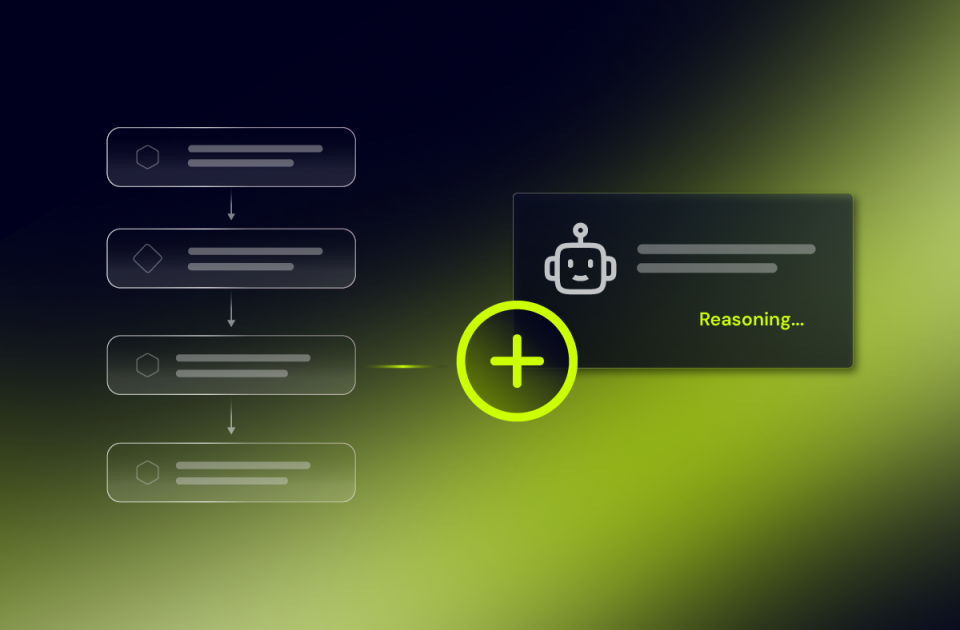
FlowAI is the agent harness of the Itential Platform. A FlowAgent runs a reasoning loop: observe infrastructure state, reason through the goal, select a tool, act, observe the result, reason again. What it never does is touch infrastructure. Every action routes through the same deterministic execution engine that already runs every workflow on the platform, with the same RBAC, the same approval gates, the same audit trail. The agent reasons. The workflow executes. That is the 20% and the 80%, wired together.

Four things make that work.

  • Tools
    Every workflow, automation, API, and gateway service is registered as a callable tool with structured inputs and defined outputs. An agent’s tool set at build time, and nothing outside that set is discoverable or callable at runtime. An agent built to read cannot be prompted into deleting.
  • Skills
    Repeatable task expertise encoded as structured instructions: how your engineers actually handle a vulnerability response, an OS upgrade, a config drift. This is the answer to the runbook problem. Rather than hoping an agent infers what “validate the device state” means, you encode it once and the agent follows your expertise instead of improvising.
  • Context
    Agents reason over live infrastructure state and scoped data, not documentation. Real device inventory, real config state, real ticket history. The reasoning is grounded in what is actually true right now.
  • Governance
    Three layers, all configured at build time and enforced at runtime: who can build agents, what tools each agent can call, and who can execute them. Agents cannot self-escalate. They never hold credentials either. Those stay on the integration instance or gateway service and get injected only at execution time.

Which model sits behind the agent is your choice, and it matters less than people think. What makes an agent useful on production infrastructure is the tools it can call, the expertise encoded in its skills, and the live context it reasons over. The reasoning layer is the easy part now. The governed execution layer underneath is the missing piece.

See how the Itential FlowAI Agent Harness works →


This article originally appeared in Chris Wade’s column for the Forbes Technology Council: Why Deterministic Automation Was Never Going To Be Enough.

Headshot of Chris Wade, Co-Founder and CTO of Itential, leading development of the company's infrastructure orchestration platform and pioneering agentic operations for enterprise network automation.
Chris Wade is Co-Founder and CTO of Itential, responsible for guiding the innovation and development of the company’s flagship infrastructure orchestration platform. He co-founded Itential in 2014 to accelerate network automation adoption and transform how enterprises operate complex infrastructure. Chris is a long-time advocate of automation and is now focused on the next evolution: agentic operations, where AI agents can reason, plan, and act while changes remain trusted, governed, and auditable. Under his technical leadership, Itential is advancing agentic orchestration that blends reasoning intelligence with deterministic automation to safely scale outcomes across cloud, network, and hybrid environments.
Keep Learning

The Latest in Agentic Operations

Frequently Asked Questions

+

No. It completes it. Roughly 80% of an operational workflow follows a known, repeatable path and should stay deterministic. Reasoning belongs at the decision points where determinism breaks down.

+

Because the ceiling is determinism, not tooling. A deterministic system does the same thing every time, which means it cannot absorb variance that was not encoded when the workflow was built. Production variance is infinite.

+

One regulated operator held it at 75% strictly deterministic, with reasoning confined to narrow decision points inside workflows that were already certified. The right number depends on how much of your work follows a known path.

+

The same four things a new engineer needs: foundational knowledge from the model, training on your tools through skills files, scoped system access through connectors, and instructions from your own documentation.

+

Because runbooks are written for readers with judgment. A line like “validate the device state before proceeding” means something to a senior engineer and nothing to an agent. A person fills that gap silently, which is what kept it hidden.

Get Started

Agentic infrastructure operations starts here.

See how Itential connects AI reasoning to governed execution across your entire infrastructure.