











Spec
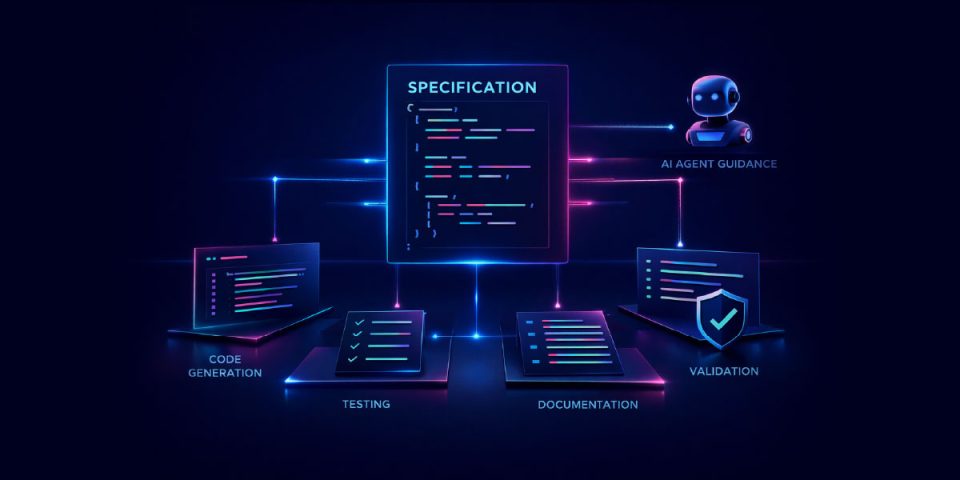
The formal, approved requirements document that locks intent at Gate 1. The spec is the authority everything downstream answers to – not the ticket, not the conversation, not the Slack thread.













Most infrastructure teams have solved the tooling problem. The operating model problem is a different story. Few teams have a governing model that ensures every automation request produces a trusted, documented, reusable outcome – every time, not just when the right engineer is in the room.
Spec-Driven Development (SDD) is that operating model. A five-phase framework with two formal approval gates that governs how requirements become approved designs, designs become working automation, and every engagement produces a reconciled record the next team can start from. It is the discipline that makes automation trustworthy, Day 2 operations faster, and AI acceleration governable.
This guide series covers the full arc – from the foundational framework through real-world application to AI-driven agentic operations at scale.
Guide 01: Foundation
What Is Spec-Driven Development?
The five-phase framework, approval gates, core principles, and how the operating model applies to network and infrastructure automation.
Guide 02: In Practice
SDD for Network & Infrastructure Automation
SDD applied to real provisioning, compliance, cloud resource lifecycle, and server compliance – with worked examples and Day 2 scenarios.
Guide 03: Agentic Ops
SDD for Agentic Operations with Itential
How AI agents execute the SDD operating model, how the platform enforces the gates, and the trust progression from assisted to autonomous.
Spec-Driven Development (SDD) is a structured operating model for network and infrastructure automation. It governs every step from initial request to delivered, reconciled outcome, covering:
The approach originates in software engineering, where specification-first practices like test-driven development and design-by-contract have long been standard. SDD applies that same discipline to network and infrastructure automation, where the cost of ambiguity is higher, configuration errors carry a larger blast radius, and reliance on tribal knowledge has historically been greater than in application development.
Most automation problems aren’t tooling problems. They’re operating model problems – gaps in how requirements get agreed, how designs get reviewed, and how knowledge gets preserved. These three failures repeat across almost every infrastructure team.
SDD structures every automation engagement through five sequential phases with two formal approval gates – converting informal practices into a governed, repeatable operating model that scales.
The terms and concepts that define the operating model. Understanding these is the foundation for everything else in the guide series.






SDD is not a process improvement on top of existing practices. It is a structural shift in how automation gets built, trusted, and scaled. These are the three changes that matter most.
Before SDD
Intent drifts silently
Requirements captured informally – tickets, Slack, email, verbal agreement. Scope evolves under time pressure with no formal record of what was agreed or when scope changed.
The SDD Shift
Spec approval (Gate 1) locks intent before environment access begins
With SDD
Intent is locked in writing
Requirements are formally approved before feasibility, discovery, or design work begins. Scope changes require a new spec cycle, not a Slack thread.
Before SDD
Design happens inside build
Architecture decisions, integration choices, and rollback logic are made under time pressure inside the build phase – invisible to stakeholders until delivery reveals them.
The SDD Shift
Design approval (Gate 2) locks the execution contract before build begins
With SDD
Design is reviewed and approved
The solution design is formally reviewed and approved before a single component is built. Build answers to the approved design – not to the engineer’s interpretation.
Before SDD
Knowledge lives in the workflow
Why automation works the way it does lives in the workflow code – or in the memory of whoever built it. Day 2 work starts with archaeology. Handoffs are painful. Audits are unreliable.
The SDD Shift
As-built reconciliation produces the authoritative record at every engagement close
With SDD
Truth is preserved as a required output
Every engagement closes with a reconciled as-built record. The next engineer, the auditor, the AI agent – all start from the same authoritative baseline.
SDD is an operating model, not a development methodology. It applies to every role involved in designing, building, and managing network and infrastructure automation.
Role
Network Automation Engineer
Uses SDD to
→ Build automation against a locked execution contract instead of an evolving verbal brief
→ Eliminate late-stage rework caused by unreviewed design decisions
→ Close engagements with authoritative as-built records rather than tribal knowledge
→ Extend existing automation from a reconciled baseline rather than reverse-engineering the workflow
Start With
Role
Infrastructure Architect / Platform Lead
Uses SDD to
→ Enforce design review before build begins, not after delivery surfaces problems
→ Establish platform-enforced gates that don’t depend on team discipline alone
→ Build a governed path for AI and agentic operations without losing auditability
→ Accumulate a reuse library from consistent, reconciled as-built records
Start With
Role
Operations Director / IT Leader
Uses SDD to
→ Convert automation from an engineer-dependent practice into a governed, auditable operating model
→ Reduce Day 2 operational debt accumulation across the automation portfolio
→ Establish the governance layer required to trust AI-accelerated and agentic operations
→ Build the case for platform investment with TTV and compounding reuse evidence
Start With
SDD defines what should happen at each phase – what gets approved, what gets enforced, what gets preserved. But a framework without enforcement is just documentation. A governed, deterministic execution platform is what converts SDD from a practice into a system – one that enforces the gates, connects approved artifacts to execution, and ensures as-built records are authoritative rather than decorative.
Itential’s platform enforces every phase boundary, gates execution against approved artifacts, connects AI agents to infrastructure through governed interfaces, and produces the as-built record the operating model requires. That is the difference between SDD as a practice and SDD as a system that scales.

Spec-Driven Development (SDD) is an operating model for network and infrastructure automation that governs how every engagement moves from an approved requirement through to a delivered, documented outcome. The SDD framework defines five sequential phases with two formal approval gates, ensuring that intent is locked before feasibility work begins and the execution contract is agreed before anything is built.
An SDD framework is a structured, five-phase approach to automation delivery that replaces informal, ad-hoc practices with a governed sequence of phases and approval gates. Where ad-hoc automation typically collapses requirements, design, and build into a single unreviewed motion, the SDD framework separates each stage, requires formal sign-off at two defined gates, and produces a reconciled record at the end of every engagement. The result is automation that is repeatable, auditable, and reusable rather than dependent on whoever built it.
An SDD platform is the enforcement layer that puts the operating model into practice. It handles spec validation, gate approvals, workflow execution, and as-built reconciliation within a single governed environment, so the framework is applied consistently rather than selectively. Itential is the SDD platform for network and infrastructure automation, providing the workflow engine, approval gates, and reconciliation capabilities that make the SDD operating model operational at scale.
Most automation frameworks focus on how automation is built; spec-driven development frameworks govern how automation is commissioned, reviewed, and preserved as organisational knowledge. Scripting and ticket-driven models move from request to build without formal approval gates, which means design decisions are made under time pressure, requirements are never formally agreed, and knowledge disappears when the engagement closes. SDD introduces two mandatory approval gates that lock intent before feasibility work begins and lock the execution contract before build starts, making every outcome traceable back to an approved specification rather than a Slack thread or a verbal brief.