10. Harnesses
The harness is everything around the model that turns it into an agent. The shorthand that stuck in 2026 is agent = model + harness.
A switch ASIC forwards packets, but nobody racks a bare ASIC. The NOS makes it a switch. The harness is the NOS.
It holds the tool definitions, the system prompt, the permissions, the context management, the memory, and the hooks that run checks. Claude Code, Codex CLI, and Gemini CLI are all harnesses.
When an agent fails, look at the harness before you blame the model. A missing tool, a loose permission, or a skipped verification step is a harness bug. Your guardrails live here too: which commands run freely, which need approval, and which never run.
Start here: OpenAI’s February 2026 post, Harness engineering. Then read the permissions and tool list of the harness you already use.
11. Loop Engineering
Loop engineering is designing the system that prompts the agent, so you’re no longer the one pressing enter.
Addy Osmani named it in a June 2026 essay. A loop is a goal the agent iterates on until it’s done. His parts list is automations that trigger runs, worktrees for parallel work, skills, connectors, sub-agents, and one place to keep state.
You’ve built this before. Closed-loop remediation is detect, decide, act, and verify. The difference is that the decide step now reasons.
Three things are hard: when to stop, who checks the work, and what it costs. Split the maker from the checker, because a model grades its own work too kindly. Put an iteration cap and a token budget on every loop.
Osmani says himself that it’s early and that the token costs need watching. Believe him.
Start here: His essay, then one scheduled, read-only loop. A morning pass over yesterday’s syslog that files a summary is enough.
12. Graph Engineering
Graph engineering is designing how many agents, scripts, checks, and people work as one system. It’s topology design for work.
The name arrived in mid-2026. An August survey, Graph Engineering in the Era of LLM Agents, frames it as three problems: organizing tasks, coordinating agents, and managing state at runtime.
Nodes are agents, deterministic code, validators, and human checkpoints. Edges are the handoffs you allow. An agent still reasons freely inside its node, but the graph decides where the work can go next.
You already know where a firewall belongs. A validation gate belongs in the same kind of place, on the edge where trust changes. Keep deterministic steps deterministic too. If a script does it reliably, make it a node of code, not a prompt.
Loops and graphs aren’t rivals. A loop is what one node does. The graph is how the nodes connect.
Start here: Draw your change process as a graph. Mark who or what does each step and which handoffs need approval.
Part 5: Trust
These two chapters answer the question from the top of this guide. You’ll know the agent is wrong because you test it. And it can’t do much damage because you fenced it in.
13. Evals
An eval is a test for an AI system: give it a task, grade the result, and repeat. It’s the pre-check and post-check for a system that can answer differently each time.
That last part changes the method. One passing run proves little. You run several trials per task and watch the pass rate.
Anthropic’s guide, Demystifying evals for AI agents, names three kinds of grader: code, model, and human. Use code wherever you can. Did the session come up? Does the parsed state match intent? Did the diff stay inside the change scope?
Save model graders for fuzzy output like an incident summary, and check them against a human now and then. Read the transcripts too. A pass can hide a lucky guess, and a fail can be a bad grader.
You need two suites. A capability suite asks whether the agent can do the task at all. A regression suite asks whether it still can, and that one is your change control for prompts, models, and tools.
Start here: The Anthropic guide, then a handful of tasks pulled from real tickets where you already know the right answer.
14. Agent Security
Agent security starts from one uncomfortable fact. A model has no separation between control plane and data plane, so anything it reads can try to steer it.
That’s prompt injection. The indirect kind is the one to fear, where the instruction arrives inside data the agent was only supposed to read. Now think about what a network agent reads: interface descriptions, LLDP neighbor names, syslog messages, and ticket text. Every one is a string someone else can write.
Filters help, but they don’t close the hole. So design for the day the agent gets hijacked:
- Give each agent its own identity. Not a shared service account, and not your login.
- Scope it to least privilege, read-only by default. TACACS+ command authorization already does this job for humans.
- Put an approval gate in front of every change to production.
- Log every tool call under the agent’s identity, so the audit trail can tell the agent from the engineer.
- Grant only the autonomy the task needs. OWASP calls this least agency.
OWASP published its Top 10 for Agentic Applications in December 2025. Goal hijack, tool misuse, and identity abuse are the first three entries.
Start here: The list at OWASP’s GenAI Security Project. Then ask one question of every agent you run: what’s the worst it could do with the access it has right now?
Part 6: Delivery
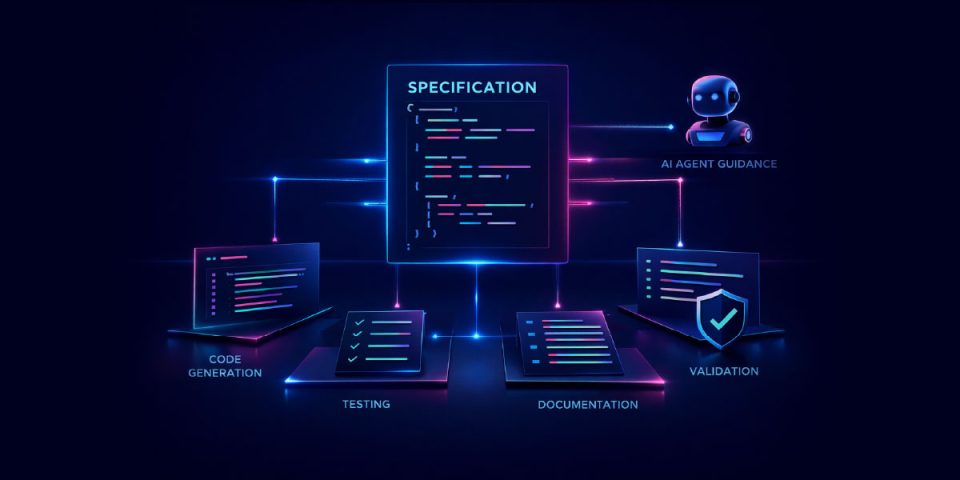
Specs are back. The documentation Agile pushed aside returns here with a different job: it’s the input, and working software is still the output.
15. Spec-Driven Development
Spec-Driven Development (SDD) means you write what you want before anything gets built, and the agent builds from that. The spec is the source of truth, and the code is generated from it.
Network engineers have always been spec people. The design document, the MOP, and the intent were all specs. The difference is that this one is executable.
A good spec is short. It says what, why, what must not change, and how you’ll prove it worked. For a VLAN rollout, that’s the sites, the VLAN, the SVI standard, the things nobody may touch, and the checks that confirm it.
That last line matters most. A spec that states what done looks like has already written half your evals.
Review changes too. You stop reading diffs line by line and start approving intent at each stage. When the result drifts, you fix the spec and regenerate, not the output.
Start here: Write a one-page spec for your next change before you open a terminal.
16. GitHub Spec Kit
Spec Kit is the fastest way to feel SDD instead of reading about it. It’s GitHub’s open-source toolkit, and its specify CLI adds a set of commands to the coding agent you already use.
Each command writes a Markdown file you review before the next one runs:
- Constitution: the rules that never bend, set once per project.
- Specify: what and why, in plain language.
- Plan: the technical approach.
- Tasks: small, ordered units of work.
- Implement: the agent works through the tasks.
- Converge: a check of the result against the spec.
The constitution is the part network engineers will like most. It’s where you write “never touch the management VRF” and “every change has a rollback.” Every plan gets checked against it.
It was built for software projects, and your automation repo is one. It also moves fast. Guides from early 2026 are already stale, so trust the README over last year’s blog post.
Start here: The Spec Kit repository. Run it once on a small feature in an automation repo you own.
Part 7: Economics & Ownership
The last three chapters cover what this costs and who holds the model. They decide whether your agent survives contact with the budget and the security team.
17. Tokenomics
Tokens are the new bandwidth. You’ll capacity-plan them, meter them, and get the bill.
A token is the unit of three budgets at once. Money, because input and output tokens are priced separately. Context, because the window is measured in tokens. Time, because speed is tokens per second.
Agents multiply all three. Every turn of a loop sends the context again, and a loop can run for hours. Configs and IP addresses also cost more tokens than prose of the same length.
The controls are familiar ones. Cache what repeats. Trim what the model doesn’t need. Send easy steps to a smaller model. Put a cap on every loop.
The number to track is cost per successful task, not cost per call. A cheap model that fails half the time isn’t cheap.
Start here: Turn on usage reporting in the agent you use and read one session’s token count. Then set a budget.
18. Hugging Face & Open-Weight Models
Open-weight models are the ones you can download and run yourself, and Hugging Face is where they live. Think of it as the GitHub of models.
The families worth knowing include Llama, Qwen, Gemma, Mistral, Phi, and DeepSeek. A model’s card should tell you what it’s for, how it was evaluated, and how it’s licensed.
Read the license. Open-weight isn’t the same as open source. You get the weights, and the license decides what you may do with them.
This earned a place because your running configs are a map of your network. Some of you can’t send that map to anyone’s cloud. With open weights, the model comes to the data.
Start here: Pick one model family, read its card end-to-end, and note the license and the hardware it needs.
19. Ollama, LM Studio, & Microsoft Foundry
These are the tools that run a model on hardware you own. This is the home lab.
| Tool | What it is | Pick it when |
| Ollama | A command-line tool and background service that serves models on a local API | You want a local endpoint for scripts and agents |
| LM Studio | A desktop app for finding, downloading, and chatting with models, with a local server built in | You want to browse and compare models first |
| Foundry Local | Microsoft’s on-device runtime, with Microsoft Foundry as the cloud side | You’re a Microsoft shop and want one path from laptop to cloud |
All three speak the OpenAI API format. Most agent tooling can point at localhost and keep working.
GNS3, EVE-NG, and CML taught a generation of us by letting us break things for free. A local model does the same for agents. Nothing leaves the laptop, and nothing shows up on a bill.
Be honest about the trade. A model that fits on your laptop is smaller than a frontier model and does worse on hard reasoning. Your evals will tell you where that line sits for your tasks.
Start here: Install one, pull a small model, and point your read-only MCP server from chapter 6 at it.
Where to Start
Don’t read all 19 chapters first. Build one small, read-only agent in a lab and let it pull you through them.
- Run a model on your own machine. (Chapter 19)
- Write a one-page spec for an assistant that answers questions about one device. (Chapter 15)
- Wrap one show command in an MCP server. (Chapter 6)
- Write one skill that holds your pre-check list. (Chapter 8)
- Write a handful of evals from real tickets, and run each one several times. (Chapter 13)
- Give the agent its own read-only identity. (Chapter 14)
- Put it on a schedule only after it passes. (Chapter 11)
If you read three chapters before you start, read 2, 6, and 13. They cover what the model is, how it touches your network, and how you know it’s right.
None of this asks you to forget what you know. It asks you to stop making it the job.
Tell me what I missed. The second edition will be vibe published too.
Sources
Primary papers and specifications are linked in the chapters. The status claims were checked against these pages in November 2026.
- MCP revision 2026-07-28 and its move to the Agentic AI Foundation: AWS Machine Learning Blog and Wikipedia
- A2A v1.0 and its foundation history: Turing Post
- Agent Skills timeline and adoption: Rubin Lake technology radar
- Where the harness vocabulary came from: Harness Engineering: Anatomy, Architecture, and Evolution of Coding Agents
- OWASP Top 10 for Agentic Applications: Promptfoo’s summary of the list
- Spec Kit stages as they stand today: Developer Toolkit
- Local runners: Ollama vs LM Studio and Microsoft’s Windows AI comparison

 Build Build agents & workflows visually, with AI, or bring your own.
 Integrate Connect every system, tool, agent, & AI in your stack.
 Execute Execution for agentic & deterministic operations.
 Secure & Govern Govern every action with built-in RBAC, audit & approval gates.
 Operate Self-service operations & real-time visibility.










 Agentic Operations Connect AI to infrastructure for trusted, automated actions.
 AI Vulnerability Response Discover & remediate critical vulnerabilities at machine speed.
 Infrastructure Modernization Transform legacy networks into modern, AI-ready infrastructure.
 Infrastructure as a Product Deliver network and infrastructure services on demand - self service, governed, & consumed like cloud.
 Hybrid & Multi-Cloud Orchestration Unify hybrid & multi-cloud infrastructure through agentic orchestration.
 Unified Change Management Unify network & infrastructure changes across every team, tool, & domain.