Market Shifts
Why Product Thinking & AI Are Reshaping Infrastructure Delivery
Infrastructure teams are expected to deliver consistent, on-demand services, not ad hoc scripts or one-off tickets. That’s why platform engineering keeps rising: treat infrastructure like a product, built once and consumed many times. Now AI is accelerating the shift, with agentic interfaces that speed delivery and remove cognitive load from the teams behind them.
But most automation strategies fall short. Teams are stuck with fragmented tools, disconnected workflows, and domain-specific automations that don’t scale. The result is more complexity, slower delivery, and limited ROI. Adding AI on top of that fragmentation only multiplies the risk without a control layer underneath it.
Automation alone won’t get you there. Orchestration, with control built in, is what makes agentic operations enterprise-ready.
Gartner’s Take
Gartner’s Take: You Can’t Productize or Operationalize AI Without Orchestration
Gartner’s recommendation is clear: orchestration is essential to evolving from isolated automations to platform-driven service delivery, and it’s now the layer that makes AI-driven operations safe.
To support productized infrastructure and agentic operations, organizations need platforms that unify provisioning, configuration, and operations into full-lifecycle workflows, with policy, governance, and human oversight built in. This is how teams deliver infrastructure as standardized, reusable services at the speed and scale modern environments demand, while keeping control of what AI and automation actually execute.
AI Can Reason. It Can’t Be Trusted to Act, Yet.
Large language models are probabilistic. Infrastructure is unforgiving. A model that’s right 95% of the time is a liability when the other 5% touches production networks, firewalls, or cloud environments.
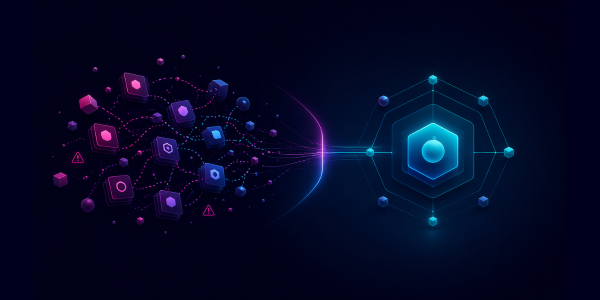
Point AI directly at your infrastructure and you introduce a new kind of risk. Agent sprawl is the next script sprawl: more actors making more changes, faster, and harder to see. The answer isn’t smarter AI. It’s a governed execution layer that sits between reasoning and action, so every AI-initiated change is validated, approved, and auditable before it reaches your infrastructure.
What the 2026 Guide Says Enterprises Need
The Capabilities Gartner Says Enterprises Now Need
The 2026 Gartner Market Guide is specific about the capabilities infrastructure teams now need. Here is each requirement, and how Itential supports.
| Gartner Requirements | How Itential Supports |
| Orchestration across the full lifecycle, not isolated task automation. | Itential runs multi-step workflows that chain provisioning, configuration, change, compliance checks, and remediation across different systems, instead of standalone scripts. |
| Low-code interfaces, AI capabilities, and AI agents to speed adoption and skills. | Build workflows in a low-code designer, and build agents from natural language with FlowAI. FlowAgents can call workflows as tools, and workflows can call FlowAgents as steps. |
| Coverage across hybrid infrastructure, now including AI infrastructure. | Itential executes against on-prem, cloud, and edge targets through its integrations and Itential Gateway, including the infrastructure that AI workloads run on. |
| Infrastructure managed as code, with self-service and API access. | Workflows are exposed through a self-service catalog, a REST API, and the Itential MCP Server. Configuration and drift checks run as steps inside those workflows. |
| An extensible ecosystem that integrates security, testing, and cost tooling. | 1,000+ open source integrations, plus REST and API connectors, let workflows call the security, ITSM, CMDB, and cloud tools you already run. |
| Policy, governance, and human oversight embedded in delivery, not bolted on. | Every workflow and FlowAgent run enforces RBAC, can require approval gates, and is recorded in an audit trail. The same controls apply whether a human or an agent starts it. Itential does not keep copies of your infrastructure data. |

 Build Build agents & workflows visually, with AI, or bring your own.
 Integrate Connect every system, tool, agent, & AI in your stack.
 Execute Execution for agentic & deterministic operations.
 Secure & Govern Govern every action with built-in RBAC, audit & approval gates.
 Operate Self-service operations & real-time visibility.








 Agentic Operations Connect AI to infrastructure for trusted, automated actions.
 Infrastructure Modernization Transform legacy networks into modern, AI-ready infrastructure.
 Infrastructure as a Product Deliver network and infrastructure services on demand - self service, governed, & consumed like cloud.
 Hybrid & Multi-Cloud Orchestration Unify hybrid & multi-cloud infrastructure through agentic orchestration.
 Unified Change Management Unify network & infrastructure changes across every team, tool, & domain.