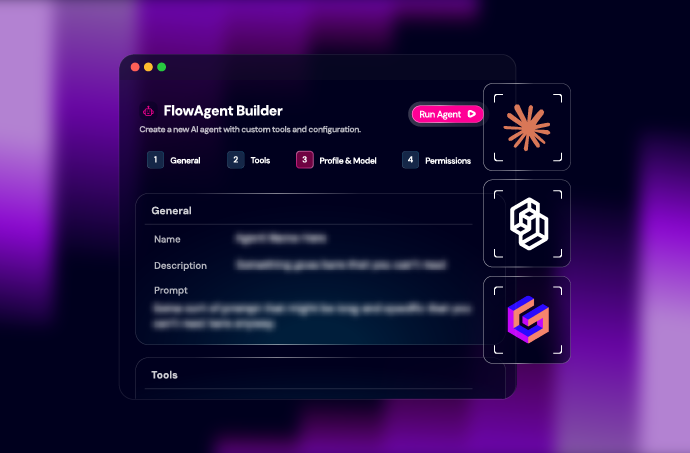
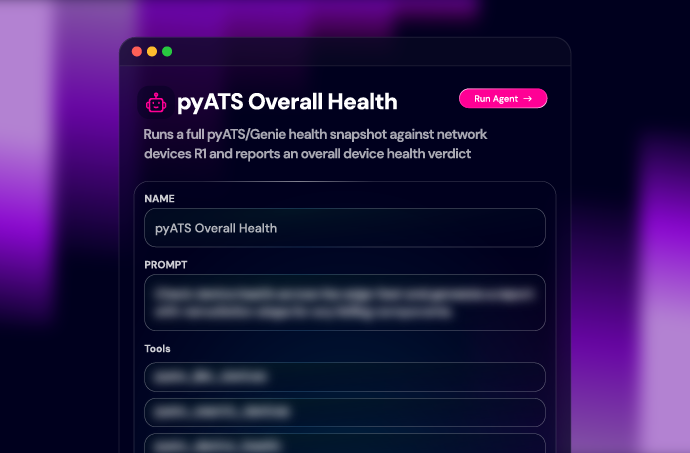
Today, I can describe an agent in network engineering terms. Test the interfaces on these devices. Produce a report. Notify me if you find a serious problem.
The network knowledge still shapes the request. You have to understand which devices matter, what constitutes a problem, and what information belongs in the report.
But you have another way to turn that knowledge into something useful.
Let People Start With What They Know
There is a lot of operational expertise sitting inside infrastructure teams.
People know which checks they run before a change. They know what they look for when an interface is behaving badly. They know which information another team needs before it can make a decision.
Giving them a way to express that knowledge in their own technical language is significant.
At Itential, I work with tools that let me describe what I need and build toward it. During the interview, I gave the example of an agent that tests interfaces, sends a report, and escalates serious findings.
That is a recognizable job to a network engineer. It has an outcome they understand.
The interesting questions then become very practical. What should it test? What counts as serious? What should happen when the data is incomplete? Who needs the result?
Those are good questions. They bring the engineer’s experience into the work.
Making something easier to build creates an opportunity to spend more time understanding what it should do.
The First Build Needs Somewhere to Go
The ability to create an agent is exciting. I build them, so I understand that excitement very well.
But accessibility has to extend beyond the first successful demonstration.
In an enterprise, somebody needs to understand what the agent can access, who can run it, what it did, and how its work fits into the operation.
If all of that becomes a separate engineering project after the agent is built, we have introduced another barrier between an idea and useful work.
This is one of the reasons I joined Itential.
The building experience sits alongside an operational platform. Agents use scoped tools, access controls govern their use, and their actions run through governed execution. Those controls are described in Itential’s security and governance overview and Trust Center.
That foundation matters to the person building. It also matters to the people who have to operate, review, and support what gets built.
A useful path into this technology should help people participate in the whole process: describing the work, inspecting it, testing it, and understanding how it runs.
Access Includes Knowing How to Judge the Result
When we make building easier, we also need to make the learning around it visible.
- An agent returns a report. How do you know the report answers the question you asked?
- It identifies a problem. What evidence supports the finding?
- It proposes a change. What else could that change affect?
These are the kinds of questions infrastructure engineers already work through. They belong in the learning experience alongside the tools and the prompts.
That gives experienced engineers an important role. The knowledge they have accumulated can help somebody else understand what good looks like.
It gives newer practitioners something useful to study, too. They can inspect the request, the tools, the findings, and the reasoning behind the next step.


 Build Build agents & workflows visually, with AI, or bring your own.
 Integrate Connect every system, tool, agent, & AI in your stack.
 Execute Execution for agentic & deterministic operations.
 Secure & Govern Govern every action with built-in RBAC, audit & approval gates.
 Operate Self-service operations & real-time visibility.










 Agentic Operations Connect AI to infrastructure for trusted, automated actions.
 AI Vulnerability Response Discover & remediate critical vulnerabilities at machine speed.
 Infrastructure Modernization Transform legacy networks into modern, AI-ready infrastructure.
 Infrastructure as a Product Deliver network and infrastructure services on demand - self service, governed, & consumed like cloud.
 Hybrid & Multi-Cloud Orchestration Unify hybrid & multi-cloud infrastructure through agentic orchestration.
 Unified Change Management Unify network & infrastructure changes across every team, tool, & domain.