The airline is taking its network back from an outsourced provider and rebuilding operations on an AI-ready, agentic platform. One governed engine runs deterministic workflows and AI agents alike across a Cisco-centric estate, so a lean team can absorb 100x the devices, execute change in minutes instead of overnight windows, and keep every action, human or AI, fully governed and auditable.
With limited devices under direct management and change work running on manual, overnight windows, the airline could not insource thousands of devices from its provider without scaling headcount, or build a network operation ready for AI agents to act on safely.
The Itential Platform gives the airline one agentic operations foundation: a governed engine that runs low-code workflows and FlowAI agents across the Cisco-centric estate, ServiceNow, firewall and load-balancer management, and IP address management, with validation, approval, and audit on every action.
Chosen as an agentic-native platform: deterministic-plus-agentic execution on one governed engine, a governed execution layer for AI action, Spec-Driven Development with Builder Skills, deep Cisco and native ServiceNow integration, and a land-and-expand fit for a multi-year timeline.
A major North American airline operates a complex, predominantly Cisco-based network supporting operations across the Americas: data centers, access-layer switches, SD-WAN, firewalls managed through a central policy console, and load balancers. The team runs ITSM in ServiceNow and has begun adopting modern practices like infrastructure as code with Terraform.
At the start of the engagement, the airline had limited devices under direct internal management. Thousands of additional devices were run by a third-party managed services provider under an outsourced contract. That arrangement kept the lights on, but it capped the airline’s agility and control, and it stood between the team and the operating model they wanted to build.
The strategic goal was to bring the network in-house. The problem was that doing it the way the team worked today, with manual change at maintenance-window speed, would mean hiring at a rate no budget would approve. And the bigger goal behind it, running network operations with AI agents, was impossible on a manual foundation: agents cannot safely act on infrastructure without a governed execution layer beneath them. A Cisco 9500 series core switch refresh became the catalyst, the moment to prove new devices could be automated, agent-ready, and managed by the airline’s own team.
Each gap blocked the path to insourced, automated operations, and made it impossible to put AI on top safely.
Every change followed the same manual path: a ServiceNow request, a change request, a CAB review, then hands-on execution pushed to devices during overnight windows from 1 to 5 AM. Slow, error-prone, and a hard ceiling on how fast the network could move, with no execution surface an AI agent could ever call.
Taking the estate back from the provider meant managing exponentially more devices without a proportional increase in team size. With manual operations, that math did not work. Scaling in-house required a new operating model, and eventually a workforce of AI agents, not just more people.
With the network managed externally, the team lacked direct control over configuration standards, IOS currency, and hardening, and had no governed, auditable place for either automated workflows or AI agents to run. Standards, golden configurations, and drift detection would all have to be built in as devices came in-house.
After weighing native Cisco tooling, a build-your-own approach on existing scripts, and a ServiceNow-centric path, the airline selected Itential. Point tools and native automation could act on a device. None could orchestrate the whole process across ServiceNow and IP address management, scale it across a team with mixed automation experience, or give AI agents a governed surface to act on.
Six capabilities sat at the center of the decision – together giving the team a governed foundation for both deterministic execution and agentic operations.
Underneath the use cases, the Itential Gateway executes scripts and reaches network devices, with integrations to ServiceNow, Cisco network management, the firewall and load-balancer consoles, IP address management, network documentation, and secrets management. The team is organized into builders who author workflows and agents, and consumers who run them from a simple form, so both automation and AI can scale across engineers of every skill level.
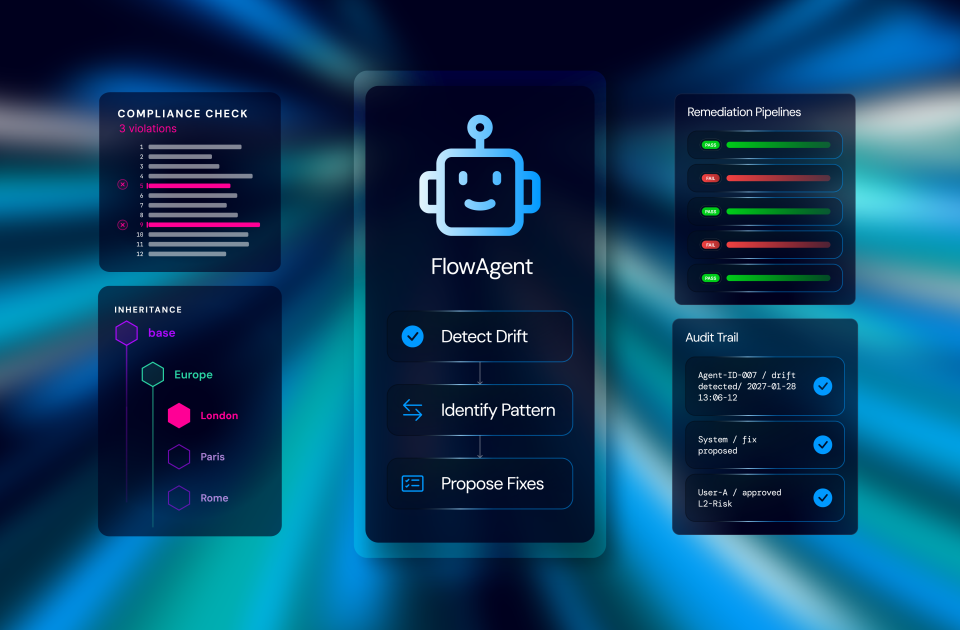
Deterministic workflows and FlowAI agents run on the same engine, with three execution modes: deterministic, agentic, and hybrid. Teams can lead with an agent to reason through new work, then convert the proven pattern into a deterministic workflow with one click, and flex back to the agent when the environment changes. Whichever way the airline enters, there is no rip-and-replace to move between workflow automation and agentic operations.
AI agents need a deterministic, auditable surface beneath them or they cannot be trusted in production. Itential applies RBAC, approval gates, secrets management, and immutable audit identically whether an action comes from an engineer or a FlowAgent, so the airline can adopt AI without giving up control.
Engineers author workflows and agents from plain-language intent using Itential Builder Skills, rather than coding automation from scratch. Domain experts ship working automation directly, and the same skills let the team stand up FlowAgents as they are ready.
For a Cisco-centric shop, Itential brings broad connectivity to Cisco platforms and the cross-domain orchestration layer the native tools do not provide, so the airline is not locked into a single vendor’s management silo, and every integration is also exposed as a tool for FlowAI agents to call.
The airline’s ITSM investment stays intact. Itential integrates with ServiceNow for bidirectional change management, renders forms directly in ServiceNow, and works with Flow Designer, adding automation and AI without forcing the team to change how they work.
Existing Terraform modules, Ansible playbooks, and Python scripts are imported and orchestrated rather than rebuilt, and capacity grows as devices come under management, matching the platform to a phased, multi-year insourcing plan measured in years, not weeks.
The rollout is underway and tied directly to the switch refresh and insourcing program, so value lands in phases. The airline chose a production-focused rollout over a lab proof of concept, because the network is live and there is no separate lab, which ties every workflow to real business value from day one. Measured against the team’s own current-state baselines, the target outcomes are dramatic.
The mechanics behind the numbers are simple. Manual work that once ran through ServiceNow tickets, CAB approvals, and hands-on device configuration during overnight windows now executes as a governed workflow in minutes. Golden configurations and continuous drift detection hold standards steady as devices come in-house, so compliance stops being a periodic scramble and becomes an always-on state. Every action, whether an engineer clicks submit or a FlowAgent invokes the same workflow, runs through one RBAC, approval, and audit model, which is what lets the airline put AI to work on production infrastructure at all.
Most important, the model changes the economics of insourcing. Instead of hiring in lockstep with the incoming estate, the airline scales through automation and, increasingly, AI agents, taking thousands of devices back from the provider with a lean team, faster change, continuous compliance, and a full audit trail. That is the difference between an insourcing plan that pencils out and one that never leaves the slide deck.
Because the airline built on an agentic-native platform, AI is not a future bolt-on. The same governed engine that runs today’s workflows runs FlowAI agents, so the team can move from AI-assisted authoring, describing changes in plain language through Builder Skills, to agentic execution, where FlowAgents validate, plan, and drive change with intelligent remediation when drift appears, to natural-language operations through the Itential MCP Server. Every step inherits the same guardrails. AI adds the reasoning. Itential adds the governance.
Today the airline’s deterministic workflows are moving into production: firewall policy, load balancer VIP provisioning, and switch refresh automation, alongside the first devices coming in-house and the governance and training to support them. That deterministic foundation is where this team’s journey began, and it stays the reliable, auditable layer everything runs on.
What comes next is the motion the platform is built for. Instead of hard-coding every new or variable change up front, the team leads with a FlowAgent: the agent reasons over live device state, iterates on the approach, and proves the change out fast, all on the same governed engine, with the same RBAC, approval, and audit as any workflow. Once the pattern is proven, one click converts it into a deterministic workflow. Reasoning becomes determinism, and what ran as an agent in seconds runs as a workflow in a fraction of that, at near-zero cost. When the environment shifts, the team flexes back to the agent, then converts again. Agents to reason and iterate, workflows to run at scale.
That loop is what scales across the estate: access-layer switches, comprehensive compliance and configuration management, software upgrades across every device type, new domains including data center operations, and eventually cloud alongside existing Terraform and OpenTofu. The destination is a fully insourced, largely agent-run network where new work starts with an agent, stabilizes into a governed workflow, and every change, human or AI, happens safely and on the record.
See how Itential connects AI reasoning to governed execution across your entire infrastructure.