Itential Builder Skills Have Arrived
Infrastructure automation teams can now build production-ready workflows directly from Claude Code – governed, documented, and deployed in minutes.
Infrastructure automation teams have the platforms. They have the engineers. What they’ve never had is a fast, repeatable way to go from “here’s what we need to automate” to a production-ready workflow – without losing weeks to manual task construction, adapter configuration, and design decisions that live only in someone’s head.
Today that changes.
Itential Builder Skills are now available in the Anthropic Marketplace – installable directly into Claude Code with a single command. Install them, point them at your Itential Platform environment, write a spec describing what you need to automate, and let the agents build it. Governed, tested, documented – not a prototype that needs cleanup.
What Are Itential Builder Skills?
Itential Builder Skills are a set of AI agent skills for Claude Code and other major coding harnesses that implement Spec-Driven Development (SDD) for infrastructure automation. They give your coding agent the domain knowledge it needs to build real things inside the Itential Platform – not generic code, not scaffolding, but production-ready workflows, form entries, command templates, Lifecycle Manager assets, Itential Gateway services, and more.
The package includes 1 plugin, a full set of delivery and platform skills, and 4 delivery agents – purpose-built for infrastructure automation delivery on Itential Platform 6 and Itential Gateway 5. The four delivery agents map directly to the six stages of the SDD lifecycle:
- Spec Agent – owns Requirements
- Solution Architecture Agent – owns Feasibility and Design
- Builder Agent – owns Build
- QA Agent – owns Test and As-Built
Four agents because the goal isn’t agent proliferation. The goal is lifecycle clarity. Each agent has a defined responsibility, and each stage produces a named artifact that gates the next.
Note: Itential Builder Skills run in coding harnesses such as Claude Code, Anthropic’s agentic coding tool, not in the claude.ai chat interface. Since launch, support has expanded to GitHub Copilot CLI, GitHub Copilot in VS Code, Cursor, and Codex. See the Itential Builder Skills page for setup in each harness. If you’re new to Claude Code, start here.
What They Build
Once installed, the skills can generate and deploy the following directly into your Itential Platform environment:
- Workflows – multi-task automation logic with full dependency sequencing and error handling
- Operations Manager entries – form-triggered automations ready for self-service use
- Command templates – MOP-style templates with validation rules
- Configuration Manager assets – golden config, compliance grading, and drift remediation
- Lifecycle Manager resources – resource models, instances, and lifecycle actions
- Itential Gateway services – Python scripts, Ansible playbooks, and OpenTofu integrated through Itential Gateway
- FlowAgents – AI agents with LLM providers, tools, and defined missions
Everything built is deployed, tested, and documented – not handed back to your team as something that still needs finishing.
How It Works: Spec-Driven Development
The skills implement a six-stage delivery lifecycle – the same model covered in depth here:
Requirements → Feasibility → Design → Build → Test → As-Built
Each stage produces a named artifact. Each artifact requires human approval before the next stage begins. AI agents execute the work – engineers control the gates.
In practice: you write a spec file. It’s a plain-language markdown document that describes what the automation needs to do – the entry point, the workflow logic, the form fields, the systems involved. The skills read it, bootstrap your environment, discover your available adapters, and build.
You define the intent. The agents handle the construction. And every decision along the way is documented – so the next person to touch it isn’t starting from scratch.
The Skills, Explained
Delivery Skills – the SDD lifecycle:
| Skill | What It Does |
spec-agent | Locks requirements – refines the use case into an approved spec |
solution-arch-agent | Feasibility + Design – assesses your platform, produces the solution design |
builder-agent | Build – implements the approved design and hands the result to the test stage |
qa-agent | Test + As-Built – prepares the test plan, runs approved checks, records results, and documents what was delivered |
flowagent-to-spec | Turns exploratory FlowAgent work into a requirements spec for governed delivery |
project-to-spec | Reads an existing project and produces spec + design documentation |
explore | Authenticates to your platform and lets you browse what’s available |
Platform Skills – direct platform operations:
| Skill | What It Does |
flowagent | Create and run AI agents with LLM providers, tools, and missions |
iag | Python, Ansible, and OpenTofu via iagctl |
itential-mop | Command templates with validation rules |
itential-devices | Device management, backups, diffs, groups |
itential-golden-config | Golden config, compliance grading, and remediation |
itential-inventory | Device inventories, nodes, actions, and tags |
itential-lcm | Resource models, instances, and lifecycle actions |
22 Spec Files, Ready to Use
The repository ships with 22 technology-agnostic spec files covering the most common infrastructure automation use cases – ready to use as starting points with spec-agent.
- Networking: Port Turn-Up, VLAN Provisioning, Circuit Provisioning, BGP Peer Provisioning, VPN Tunnel Provisioning, WAN Bandwidth Modification
- Operations: Software Upgrade, Config Backup & Compliance, Network Health Check, Device Onboarding, Device Decommissioning, Change Management, Incident Auto-Remediation
- Security: Firewall Rule Lifecycle, Cloud Security Groups, SSL Certificate Lifecycle
- Infrastructure: DNS Record Management, IPAM Lifecycle, Load Balancer VIP, Config Drift Remediation, Network Compliance Audit, AWS Webserver Deploy
Each spec is a starting point – customizable to your environment, your adapters, your constraints.
The point isn’t to hand you a finished product. It’s to remove the blank-page problem and give teams something real to react to.
Three Ways to Get Started
1. Start fresh with new work
Run the full SDD lifecycle from scratch. Write a spec (or start from one of the 22 examples in the repo), run spec-agent, and deliver through all six stages.
2. Productionize exploratory agent work
If you’ve been using FlowAgent to explore automation ideas, use flowagent-to-spec to move that output into a real, governed delivery path with proper documentation.
3. Bring existing automation under governance
Use project-to-spec to read an existing Itential project – documented or not – and produce a retroactive spec and solution design. The automation your team built three years ago that nobody can fully explain anymore? That’s a real problem, and this is where you start fixing it.
How to Install
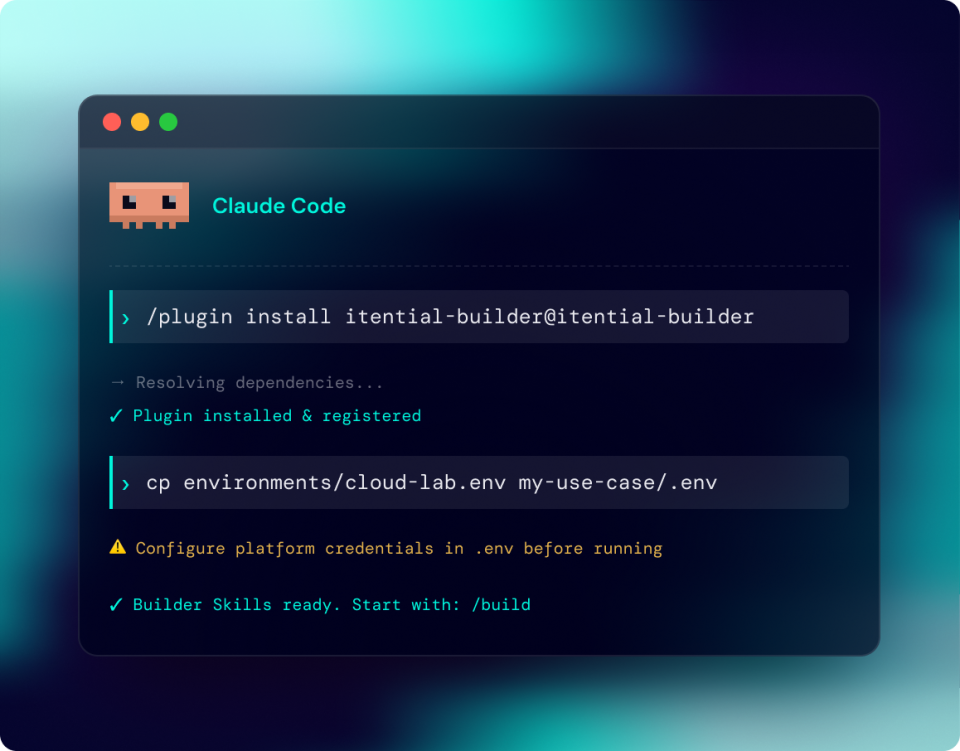
Install from the official Anthropic Marketplace in Claude Code:
/plugin install itential-builder@claude-plugins-official
Then copy an environment template and configure your platform credentials:
cp environments/cloud-lab.env my-use-case/.env
Full setup and first delivery walkthrough: docs/quickstart.md
Using GitHub Copilot CLI, Copilot in VS Code, Cursor, or Codex? Setup steps for each harness are on the Itential Builder Skills page.
The repo is public: github.com/itential/builder-skills
What’s Next
This is v1. The spec library will grow. The skills will deepen. And I expect the community will build use cases we haven’t thought of yet – that’s the part I’m most interested to see.
If you hit something that doesn’t work, open an issue. If you have a use case you want to see in the spec library, start a discussion. The repo is public and contributions are welcome.
Most infrastructure teams I’ve talked to over the years aren’t short on ambition – they’re short on time and bandwidth to build automation the right way. A delivery model that removes the construction burden without removing the engineer from the decisions is a meaningful shift. This is that.
Try it: github.com/itential/builder-skills
See It in Action
Want to see the full lifecycle from spec to deployed workflow? Watch Joksan Flores, Principal Solutions Engineer, build a DNS A record provisioning workflow end-to-end – form-triggered, Infoblox-integrated, and live in Operations Manager in under two minutes.
Watch the demo →


 Build Build agents & workflows visually, with AI, or bring your own.
 Integrate Connect every system, tool, agent, & AI in your stack.
 Execute Execution for agentic & deterministic operations.
 Secure & Govern Govern every action with built-in RBAC, audit & approval gates.
 Operate Self-service operations & real-time visibility.








 Agentic Operations Connect AI to infrastructure for trusted, automated actions.
 Infrastructure Modernization Transform legacy networks into modern, AI-ready infrastructure.
 Infrastructure as a Product Deliver network and infrastructure services on demand - self service, governed, & consumed like cloud.
 Hybrid & Multi-Cloud Orchestration Unify hybrid & multi-cloud infrastructure through agentic orchestration.
 Unified Change Management Unify network & infrastructure changes across every team, tool, & domain.