John Capobianco • 00:00
Hi, John Capobianco here and I was on LinkedIn earlier today and I saw a post from a very good friend of mine, Oren Brigg, and it really flashes me back to 10 years ago when I was starting my network automation journey, I saw one of his Cisco example Git repositories for Cisco Ansible playbook. And I was at the Parliament of Canada at the time, and I emailed Orin and asked him, you know, a little bit about it and how to get started with it. And it was, I followed along, and I just wanted to thank him for pointing me into the direction of network automation. That was very, the furtherly, the truly the 1st thing I did for network automation. And we’ve known each other ever since. We’ve seen each other live at events, at Cisco Live and other Cisco events, even at AutoCon and things like that when he’s there. We really do connect and sit down and have coffee and catch up.
John Capobianco • 00:58
And he really is a good friend of mine. And I wanted to share, let me share his post. And let me try to avoid the effect here. So this was the post I saw. The next great network experience might be an agent that your team builds itself. And he points to Meraki and Catalyst Center MCP servers are now available. So I went to the Catalyst Center one.
John Capobianco • 01:25
I cloned the repository locally, right? And you can see here it is locally. I made a minor adjustment to it. And then I basically used the ability for this machine. So a couple things I want to highlight. I have an Itential DevStack with the gateway locally. And you can see the Catalyst MCP server container running.
John Capobianco • 01:46
And I can do things like IAG CTL. Install MCP servers, which is what I’ve done with the Catalyst Center. So now they present themselves as tools inside of the platform. So if I go to the platform and go to agent projects, I have this Catalyst Center project with two different agents in them: a health triage agent and a remediation agent. Now, I’m not going to click on these, I’m actually going to show you their outputs, and then we’ll build a new one. So if we look at the 1st one I built, health triage agent, here’s the conclusion, but here’s all of the logs. Now, what I love about our Flow AI and our platform here is I can see who triggered it.
John Capobianco • 02:30
It was manual. It called three tools. It took less than 30 seconds and it had 709 outputs. We can see the reasoning and the tool calling and expand and see all of the payloads and all of the logs that you know and how many tokens were used, right? So, we have all the logging, all the tokenomics, and we have this wonderful health triage report. Right? Really, really cool.
John Capobianco • 02:57
Now, the next thing is the remediation agent, a similar agent that took a little longer and took more tool calling, but only a minute and a little bit more output tokens. And we can again toggle the reasoning and the tools. And this one actually showed that a lot of things were compliant, except there were some gaps. There’s some end of software warnings. There is some, you know, golden image warnings and some other observations. It’s really, really cool. So I thought we could build another agent inside of this project.
John Capobianco • 03:34
And we’re going to go ahead and create an agent. And I have some suggestions from my Claude Code session. A power and efficiency agent. Power capacity risk agent for capacity. Now, this requires POE devices, and I don’t know if there are any POE devices in the stack, but there’s also an EOX and security advisory risk agent, which might be different than a compliance agent and actually picks some different tools. So, let’s go ahead and build this agent, right? And what we’re going to say is: can I get the prompt and tools for this agent?
John Capobianco • 04:15
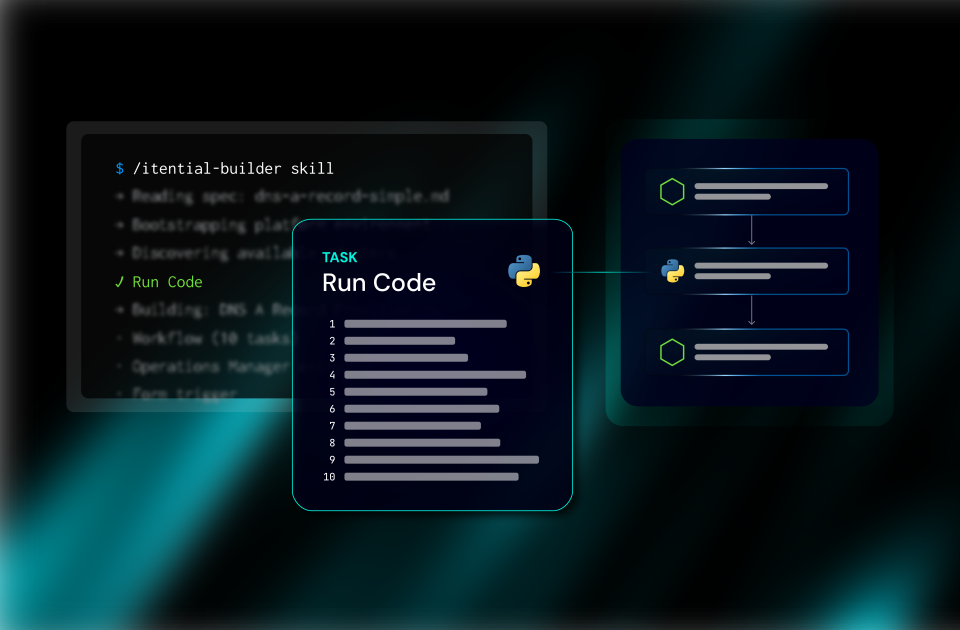
Now, I want to mention that Itential has a published anthropic skill. And right here from Cloud Code, I could/builder skill flow agent and invoke it and build it that way. Or I could just, you know, do it through the GUI. And I wanted to do it this way on purpose. So because I’ve used Cloud Code to help install the MCP and integrate it with my IAG CTL commands, it knows of all the capabilities. That’s how it’s able to give me these advisories. So we’re going to build an agent that picks one, two, three, maybe four tools, it looks like.
John Capobianco • 04:50
Okay, there’s a few tools here that we’re going to pick. And here’s the system prompt. So we’re going to wait for the system prompt to generate and we’re going to work backwards. Okay. And this is a lot of fun. I’ve only had my hands on this and I can’t stop building agents with it because, and I’ll get to this at the end, but let me just build this agent for now. And it does say you are read-only.
John Capobianco • 05:13
If asked to patch, remediate, or replace, or take any action on a flag device, say this agent only reports exposure and points the user to the normal change procedure. Okay, so we’re going to highlight, if I can get my mouse to cooperate, our agent prompt here. And paste it in, and this one’s going to be called the Cisco. And let’s just use one of these names, Cisco, and we’ll call this EOX and Security Advisories. Right? And agent used, let me just fix this. Agent using the Catalyst Center MCP tools to discover EOX and security advisories.
John Capobianco • 06:13
Okay, now I’m going to actually give it some instructions here at the very end of this prompt and say, please go ahead and assess the current fleet. Next is my tool selection. And this is where it’s pretty neat where, and I’m going to split screen this. So we can actually pick the tools that it recommends here. And they’re down here, too. Right? But what I’m going to do is I’m going to say catalyst center_API_get EOX.
John Capobianco • 06:54
And there are some tools here, right? It recommends three of them. We’re going to pick the three of them. All right. And then we’re going to look for security advisories. Get security advisories. And there’s a few of them here.
John Capobianco • 07:14
So let’s actually filter on the one it recommends. Security advisory network. Whoops. Network devices. All right, and we’ll just go ahead and pick both of those tools. And there’s a couple of more in here that it wants us to pick. So let’s just filter those down.
John Capobianco • 07:45
And this doesn’t take too long. This is an advantage of using the skill builder, actually, is that you don’t have to do this part. So get count of security advisories. And finally, get network bugs. Count of network bug devices and retrieve network devices. All right. So let’s maximize this.
John Capobianco • 08:39
And we’ve picked 12 tools. All right, because this is doing the AEOX and security-related stuff. So we’ve got our 12 tools selected, all from my local gateway, remember. And we’re going to give this to the solution engineering group with our back. So no one else can access this agent other than my solution engineering group. All right, save and run agent. Now let’s take a look at this.
John Capobianco • 09:02
I’m doing this live. I’ve never, you watch me build it live. And we’re going to get some reasoning 1st and then a bunch of tool calling in parallel. All right, so if we focus on the reasoning, I’m going to pull headline numbers and per device list in parallel. Let me kick off the full data collection. Good. I’ve got four right.
John Capobianco • 09:20
And if we go to the tools, we have all the tool calling and all the JSON payloads. It’s all JSON RPC2 because we’re using MCP. Remember that? Right. So this is not just regular JSON, the remote procedure tool calls. And it’s still running. Everything has succeeded, by the way.
John Capobianco • 09:40
And we can actually kind of see if we go to the reasoning here at the end, we’ll get all the numbers. But we have our output count. We’re less than a thousand output tokens so far. And I think what’s happening now is the reasoning over all of the data that has been collected. I imagine that’s why this reasoning step is taking a little longer, and I was correct because it was coming to its conclusion. So, all data is in. I have a full device identity, lifecycle dates, and advisory context for every flag device.
John Capobianco • 10:13
Here’s the complete fleet risk exposure report. So, we’ve got four end-of-life devices. We’re getting some permission errors for some API calls. That’s okay. Here’s the identity summary. Here’s the risk, and that they’re all high-tier. And here are some of the bulletins that affect these devices.
John Capobianco • 10:39
Right, and here’s some compounded risk, and we’ve passed the last ship date. So, here’s some recommended next step: restore the API permissions, software upgrade planning, fleet diversity review, and a compliance note. Okay, so where do we go here? I just built a compliance report, an end-of-life compliance report agent. I’m sorry, I lost track of the screen. So I’ve built three agents today in the 2 h that I’ve been made aware of this session. And actually, this is my 2nd recording.
John Capobianco • 11:33
I kind of made a mistake in my previous recording where something was on the screen, the Riverside recording. So in fact, I had all this done with my 2nd agent live. Mistakes aside, three Catalyst Center agents, a health report, an end-of-life report, and security summary, and a compliance report, all built through Flow AI’s Builder with simple prompts, simple tool selection, run the agents. They all take a minute, 2 min , less to run. And we’re getting real value out of our Catalyst Center now, that investment we’ve made. Now, there’s only four devices because I’m using a sandbox, but this would scale just fine. You can see it’s all parallel calls.
John Capobianco • 12:08
It’s all JSON RPC2. We can handle the context window with large payloads. So this would scale out. I want to thank Orenbrig and congratulate the team over at Cisco who’s behind this effort. I’m so excited to see MCTs coming from vendors like this that I can plug into my tools and I can plug into platforms like Itential. So if you have a Catalyst, if you have a Cisco fleet, a friend of mine has also done Meraki in a similar way. Jocks and Flores has done the Meraki through a Flow AI agent.
John Capobianco • 12:36
I might be able to find the logs and show you. But the whole point is. As they are released, we can bring your own MCP. I recommend if this interests you how to bring your own MCP to our gateway, watch my BYOMCP podcast where I brought PyETS and Netbox, my MCPs that I wrote, onto my gateway and I started building agents. Well, today I brought in the Catalyst Center, okay? And it was smooth, it integrated just fine. I’m calling the tools and filtering tools in the platform.
John Capobianco • 13:06
Thanks again for your time. This was an ad hoc video. It wasn’t planned. I just wanted to show and share the excitement around Model Context Protocol and Flow AI agents. Thanks again.
















 Build Build agents & workflows visually, with AI, or bring your own.
 Integrate Connect every system, tool, agent, & AI in your stack.
 Execute Execution for agentic & deterministic operations.
 Secure & Govern Govern every action with built-in RBAC, audit & approval gates.
 Operate Self-service operations & real-time visibility.
 Agentic Operations Connect AI to infrastructure for trusted, automated actions.
 Infrastructure Modernization Transform legacy networks into modern, AI-ready infrastructure.
 Infrastructure as a Product Deliver network and infrastructure services on demand - self service, governed, & consumed like cloud.
 Hybrid & Multi-Cloud Orchestration Unify hybrid & multi-cloud infrastructure through agentic orchestration.
 Governed Change Management Execute every infrastructure change with pre/post validation, audit evidence, & rollback, human or AI-initiated.