The category just hit an inflection point.
In a First Take published on May 15, 2026, Gartner stated something the market has been circling for two years:
I&O automation vendors must add governed agentic automation to existing deterministic automation capabilities to remain relevant.
Not should. Must. And not someday. Now.
That’s a meaningful shift in how analysts frame infrastructure automation. The era of deterministic-only tooling is closing. The era of agentic infrastructure operations is opening. And the question every I&O leader should be asking is not whether to make the move, but what a real agentic platform actually looks like, versus what’s going to show up in the marketing materials.
Because here’s the part that gets lost in the announcement cycle: getting AI into your automation stack is not the same as building an agentic infrastructure operations platform. One is a checkbox. The other is an architecture. The difference between them is going to define winners and losers in the next twenty-four months.
Step One Was Deterministic. Step Two Combines Agentic Reasoning & Deterministic Execution.
For the last decade, infrastructure automation meant one thing: encode a known procedure, run it the same way every time, scale it. That model gave us configuration management, network automation platforms, and orchestration tools. It worked, until it didn’t.
Deterministic automation hits a wall the moment the workflow isn’t fully knowable in advance. Multi-vendor environments. Incident response. Compliance investigations. Anything that requires judgment, context, or reasoning across systems that weren’t designed to talk to each other. That’s where scripts run out of room and humans get paged at 2am.
Agentic AI changes that story. An agent can reason across unstructured inputs, decide what to do next, and adapt when reality doesn’t match the playbook. That’s the unlock, and the risk. An agent making decisions about your production network without guardrails is not automation. It’s exposure.
The answer is not deterministic or probabilistic. It’s both, in the same platform, governed end-to-end. That is what agentic infrastructure operations actually means. And that is the bar Gartner just made explicit.
Four Requirements Every Agentic Infrastructure Operations Platform Must Meet
If a vendor is telling you they’ve made the leap to agentic operations, this is the checklist to run them through. Anything less is just talk.
1. Governance Has to Be the Architecture, Not a Release Note
Most of what’s getting added to legacy automation tools right now falls under the heading of guardrails: human-in-the-loop modes, RBAC, pre- and post-checks, error handling, audit trails. These are good capabilities. They are also table stakes that should have been there before agents got anywhere near production infrastructure.
The harder question is structural. Does the governance model actually scale with the agent? Can it enforce policy across heterogeneous systems, not just within one vendor’s stack? Does every action, agent-initiated or human-initiated, flow through the same control plane?
If governance is something the platform was retrofitted to include in a recent release cycle, the seams will show under load. If it’s how the platform was designed from day one, it disappears into the workflow. There is a difference between a platform that has guardrails and a platform that is the guardrail.
2. You Have to Build Agents, Not Just Plug Them In.
Integrating an off-the-shelf coding assistant into your automation tool is a useful capability, but it’s not an agent strategy.
The valuable agents in infrastructure operations are not generic coding assistants. They are agents grounded in your network, your data, your operational reality. Those don’t come from a model provider. They come from a platform that gives infrastructure teams the building blocks to construct them: a way to define agent behavior, a way to connect agents to the systems they need to read from and act on, and a governance layer that wraps the agent regardless of which model is reasoning behind it.
Itential built FlowAgent Builder and FlowMCP Server precisely for this. If your platform only lets you connect to someone else’s agents, you are renting capability, not building it. And rented capability is not a moat.
3. The Platform Has to Orchestrate the Whole Stack, Not Just One Vendor’s.
Every enterprise network is multi-vendor. Cisco, Juniper, Arista, F5, Palo Alto, cloud providers, ITSM, observability, the homegrown scripts nobody wants to admit are still in production. A platform that orchestrates beautifully within its own ecosystem and awkwardly outside it is solving a marketing problem, not an operational one.
Agentic operations only delivers value when agents can reason and act across the entire stack the enterprise actually runs, including the automation tools already deployed. Itential sits above execution engines and governs them. We don’t replace your investment in Ansible, Python or NSO. We orchestrate them, alongside ServiceNow, Sources of Truth, cloud providers, and everything else, under one unified model.
That is the difference between a platform that orchestrates the things its parent company sells and a platform that orchestrates the things its customers actually run.
4. It Has to Be Running in Production, Not in a Press Release.
Roadmap is not deployment. Tech preview is not production. The market is full of announcements right now. Some of them are impressive. Far fewer have been pressure-tested by an enterprise with a real change-control process and a real outage cost.
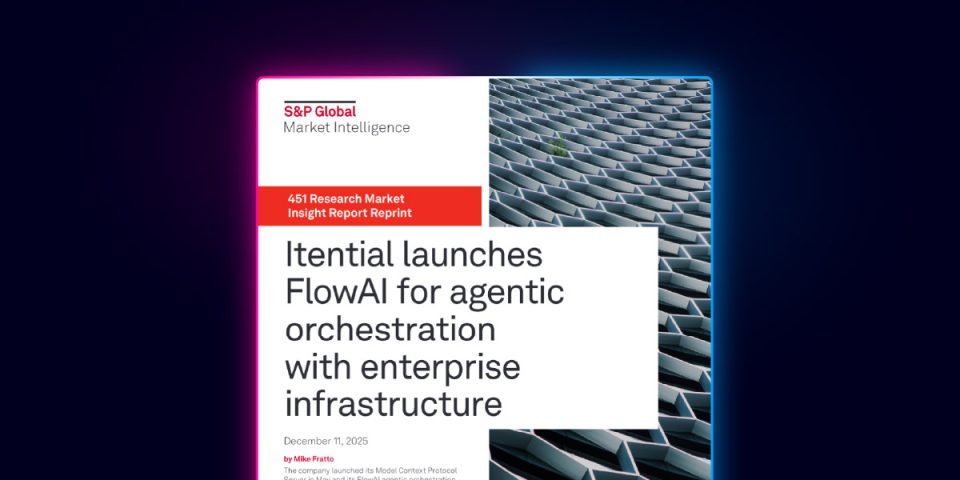
Gartner’s First Take named Itential as one of the vendors who have already delivered combined deterministic and probabilistic automation with guardrails. That sequencing is intentional. There is a difference between shipping a release and operating it at scale, and the analyst community can tell the difference.
Ask the hard question of any vendor claiming agentic operations: who’s running this in production today, against what, and at what scale? The answers will narrow the field fast.

















 Build Build agents & workflows visually, with AI, or bring your own.
 Integrate Connect every system, tool, agent, & AI in your stack.
 Execute Execution for agentic & deterministic operations.
 Secure & Govern Govern every action with built-in RBAC, audit & approval gates.
 Operate Self-service operations & real-time visibility.
 Agentic Operations Connect AI to infrastructure for trusted, automated actions.
 Infrastructure Modernization Transform legacy networks into modern, AI-ready infrastructure.
 Infrastructure as a Product Deliver network and infrastructure services on demand - self service, governed, & consumed like cloud.
 Hybrid & Multi-Cloud Orchestration Unify hybrid & multi-cloud infrastructure through agentic orchestration.
 Unified Change Management Unify network & infrastructure changes across every team, tool, & domain.