The Hidden Cost of DIY Agentic Orchestration
This is the part I want to sit on, because it’s the part I underestimated most.
When you build a system like this in-house, the cost you see is the build cost. Engineering hours. A few months of focused work. Maybe a small team. That number is real, but it’s also the smallest number in the whole equation.
The cost you don’t see is everything after the build. Patching libraries when a CVE drops. Hardening the auth layer when your security team finally gets around to reviewing it. Keeping up with model API changes when your LLM provider deprecates an endpoint. Rebuilding the audit pipeline when your auditors ask questions you didn’t anticipate. Pulling engineers off real business automation work to keep the platform running, because the platform is now a thing your business depends on.
Building your own car engine to learn how engines work is genuinely valuable – I’d recommend it. Trying to drive that engine cross-country, in traffic, with your family in the back, is a completely different proposition.
That’s the hidden cost of DIY: you don’t just build the system once. You become responsible for it forever. And the longer it runs, the more business logic it accumulates, the harder it gets to walk away.
What a Platform Like Itential Actually Solves
I didn’t start this project thinking I’d end up writing about platforms. I started it thinking I’d build something useful – a real demo environment, connected through the Itential MCP, that I could put in front of customers. What the exercise showed me, in concrete detail, is exactly what a mature platform absorbs on your behalf. The infrastructure nobody talks about. The unglamorous stuff that has to work before any of the interesting stuff can matter.
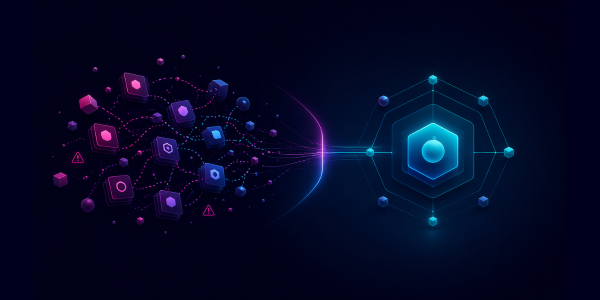
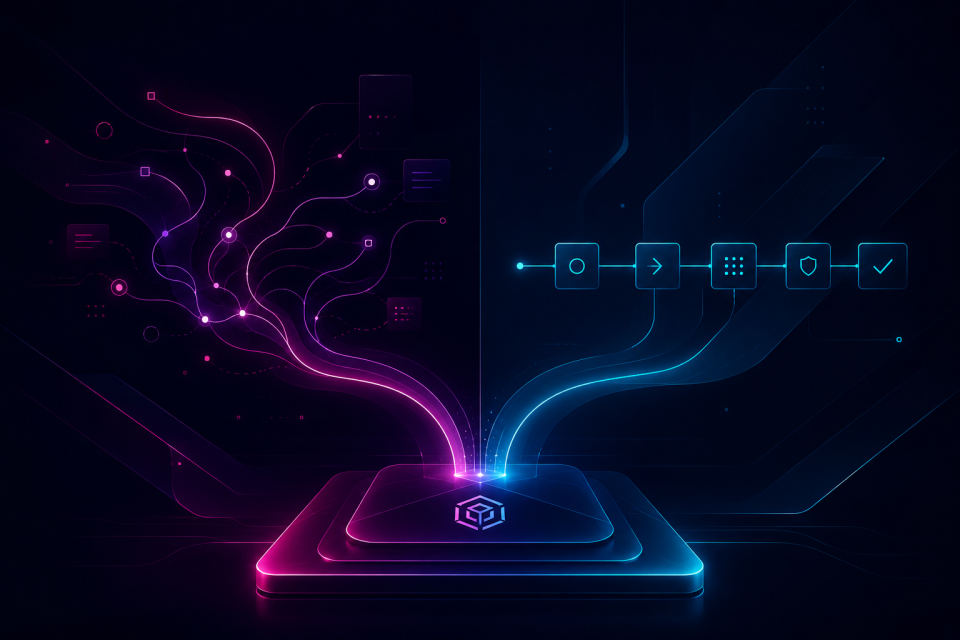
Itential’s FlowAI, layered on top of the broader Itential Platform, is built on the assumption that the orchestration control plane has to come first – and that the agentic layer rides on top of it. That sequencing turns out to matter enormously.
SSO, OAuth 2.1, RBAC, secrets management – embedded, not bolted on. Every AI-initiated action passes through the same governance plane as every human-initiated one, which means audit trails and policy enforcement aren’t an afterthought; they’re a property of the system. Agents connect through an MCP gateway that inherits governance automatically, so a new agent can’t quietly escape the rules just because it’s clever. High availability and multi-tenant SaaS delivery aren’t a roadmap item – they’re how the thing ships.
What that looks like in practice:
- Identity & access — SSO and OAuth 2.1 embedded from the start, not configured later
- Governance — every AI-initiated action passes through the same policy plane as human-initiated ones
- Audit trails — policy enforcement is a property of the system, not a layer added after the fact
- Agent governance — the MCP gateway inherits governance automatically for every connected agent
- Resilience — high availability and multi-tenant SaaS delivery ship by default
And critically, the platform is agent-agnostic at the connection layer. Claude, ChatGPT, a custom agent your team builds – any MCP-compatible agent can plug in, while the governance, audit, and execution layers stay constant underneath. That’s what “governed agentic orchestration” actually means in practice: the AI-to-action loop is closed, instrumented, and accountable from the first call to the last.
When I look at my DIY system next to that, the comparison isn’t even close. Not because my build was bad. Because the surface area of what a real platform absorbs is genuinely enormous, and I was carrying every bit of it personally.
Why It Matters
I’m glad I built it! Building something real – not a toy, but an actual platform with real infrastructure underneath it – is the fastest way I know to understand what production-grade agentic orchestration actually requires. You don’t truly appreciate secrets rotation, RBAC, audit trails, or HA failover until you’ve stared at the gap where they should be in your own architecture and realized the gap is your problem to solve.
The system I built works. It runs on top of Itential, connected through the Itential MCP, and it does exactly what I set out to build. But building it is also what made me understand, at a visceral level, why the Itential Platform is architected the way it is – and how much complexity it’s absorbing on behalf of everyone who doesn’t want to rebuild it themselves.
If you’re considering building this in-house for enterprise use, the line I wish someone had said to me earlier still applies: the build isn’t the hard part. The everything-else is.
If that resonates, it’s worth seeing what we’ve built at Itential. You may find, like I did, that someone has already solved the parts you were about to spend the next two years rediscovering.


 Build Build agents & workflows visually, with AI, or bring your own.
 Integrate Connect every system, tool, agent, & AI in your stack.
 Execute Execution for agentic & deterministic operations.
 Secure & Govern Govern every action with built-in RBAC, audit & approval gates.
 Operate Self-service operations & real-time visibility.








 Agentic Operations Connect AI to infrastructure for trusted, automated actions.
 Infrastructure Modernization Transform legacy networks into modern, AI-ready infrastructure.
 Infrastructure as a Product Deliver network and infrastructure services on demand - self service, governed, & consumed like cloud.
 Hybrid & Multi-Cloud Orchestration Unify hybrid & multi-cloud infrastructure through agentic orchestration.
 Unified Change Management Unify network & infrastructure changes across every team, tool, & domain.